.jpeg)
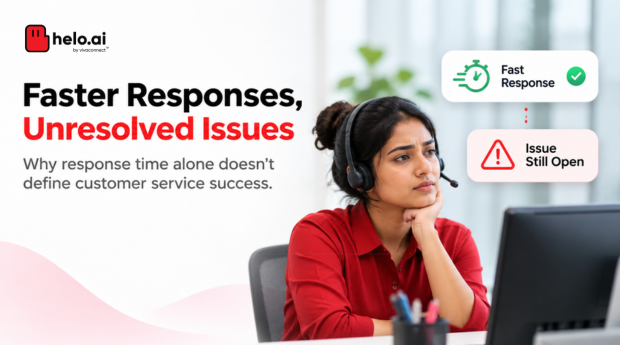


A customer contacts their bank about a failed transaction. The support team responds within a minute, acknowledges the complaint and promises an update.
The response-time target is met.
But the money has not been credited. The customer contacts support again, explains the issue again and waits for another update.
From the company's dashboard, the first interaction looks successful. From the customer's perspective, nothing has been resolved.
This is the problem with measuring customer service primarily through response time. A quick reply creates a good first impression, but it does not necessarily solve the customer's problem.
As businesses automate more customer interactions, they need to look beyond how quickly they respond. They need to understand how effectively they resolve issues, how much effort customers put in and how often the same problem returns.
1. Fast response vs meaningful resolution: What is the difference?
Response time and resolution time measure different parts of the customer experience.
A fast response tells customers that their request has been received. A meaningful resolution gives them an outcome.
| Fast response | Meaningful resolution |
|---|---|
| Measures how quickly a customer receives an initial reply | Measures how long it takes to solve the customer's issue |
| Focuses on acknowledgement and communication | Focuses on the actual outcome |
| Can improve through automation and faster routing | Requires information, ownership and appropriate action |
| Reduces initial waiting time | Reduces repeat contacts and customer effort |
| Shows how responsive the support operation is | Shows whether the service delivered what the customer needed |
Consider a few everyday examples:
- Banking: A customer receives an immediate acknowledgement about a failed transaction, but the payment is still under investigation.
- E-commerce: A customer gets an instant delivery update, but the parcel remains delayed.
- Insurance: A claim is registered quickly, but the customer is still waiting for document verification and a decision.
- Utilities: A complaint about an incorrect bill receives a ticket number, but the bill has not been corrected.
In each case, the first response is useful. But the customer's problem remains open.
Businesses should therefore distinguish between four stages:
- Response: The customer receives an acknowledgement or answer.
- First-contact resolution: The issue is solved during the customer's first attempt to contact the business.
- Case closure: The organisation marks the support ticket as closed.
- Confirmed resolution: The customer receives the intended outcome, with appropriate follow-through or confirmation.
These stages should not be treated as interchangeable. A closed ticket is not automatically a resolved problem.
2. What does the research tell us?
The difference between how businesses perceive service and how customers experience it is reflected in industry research.
The gap between internal performance and customer experience
ServiceNow's India 2025 Customer Experience Recap highlights a significant difference in how agents and customers perceive resolution time.
of Indian customer service agents believe their organisation takes around 30 minutes to resolve an average customer service issue.
Customers report an average resolution time of 3.8 days.
of customers identify speed as the most important factor in customer service.
These figures represent two different perspectives reported in the same research. They are not a controlled comparison of identical cases. However, they highlight how internal perceptions of service efficiency can differ from the time customers believe it takes to get an issue resolved.
ServiceNow surveyed 5,000 Indian consumers and 204 customer service agents in November 2024. Its press release describes the agent estimate as the time for a simple issue.
The report also identifies operational fragmentation. Agents use an average of 3.4 systems to answer a customer query, while only 62% of organisations have integrated systems.
This points to a practical challenge. Even when a support team responds quickly, resolving the underlying issue may depend on information, approvals or actions spread across different systems and departments.
Source: ServiceNow, India 2025 Customer Experience Recap.
The limitations of self-service
Automation can help customers find information and complete routine tasks without speaking to an agent. But making self-service available does not mean every customer can resolve their issue through it.
In an August 2024 survey of 5,728 customers, Gartner found that only 14% of customer service issues were fully resolved through self-service. Even among issues customers described as very simple, only 36% were fully resolved.
Gartner announced the findings in August 2024. A secondary write-up says the survey itself ran in December 2023.
The research also found that 45% of customers who began in self-service said the company did not understand what they were trying to do.
This is an important distinction for businesses investing in chatbots, knowledge bases and automated support. A customer may successfully enter a request or receive information without actually completing the task they came to perform.
Source: Gartner, Survey Finds Only 14% of Customer Service Issues Are Fully Resolved in Self-Service, August 2024.
Why first-contact resolution matters
Gartner's February 2024 research on First Contact Resolution highlights another measurement problem: organisations may measure resolution within an individual support channel, while customers judge the entire journey.
For example, a customer may first try a chatbot, then contact support through WhatsApp and finally call an agent. The phone agent may resolve the issue, but the customer's first attempt did not succeed.
Gartner's abstract says leaders usually track resolution within a single assisted channel, while customers count their first attempt in any channel.
From the customer's perspective, the journey involved multiple attempts.
Gartner's research also links consistent first-contact resolution with higher customer satisfaction and lower customer effort.
Businesses need to measure resolution across the customer journey rather than treating each channel as an isolated service operation.
Source: Gartner, How to Measure and Interpret First Contact Resolution, February 2024.
Research at a glance
| Source | Finding | Sample and date | Type |
|---|---|---|---|
| ServiceNow India 2025 CX recap | 57% of agents believed issues resolve within 30 minutes; customers reported 3.8 days. | 5,000 consumers and 204 agents, November 2024. | Vendor survey |
| Gartner self-service survey | 14% of issues fully resolved in self-service; 36% for very simple issues. | 5,728 customers; announced August 2024. | Analyst survey |
| Gartner FCR research | Customers with first contact resolution report higher satisfaction and lower effort. | Abstract published 27 February 2024. | Analyst research |
3. What happens when response time improves but resolution does not?
Optimising response time without improving resolution can create several problems for both customers and businesses.
More repeat contacts
When the original issue remains unresolved, customers return through another message, call or email.
An insurance customer may contact support several times for the same claim update. A banking customer may follow up repeatedly about a disputed transaction.
Each interaction adds effort without necessarily bringing the customer closer to an outcome.
Higher operational workload
Repeat contacts consume agent time, require additional investigation and create more coordination between departments.
A team may appear productive because it handles a high number of interactions every day. But if many of those interactions relate to the same unresolved cases, the actual workload is higher than the interaction count suggests.
Frustration and declining trust
Customers expect a business to follow through after acknowledging a problem.
When they receive repeated acknowledgements without meaningful progress, confidence can decline. Customers may feel that the organisation is responding to them without actually listening.
Pressure on support teams
Agents often inherit cases that have already passed through multiple channels or departments.
They may need to search for earlier conversations, request the same information again or contact another team for an update. This creates avoidable work and makes consistent service harder to deliver.
Misleading performance reports
A dashboard may show lower first-response times, higher interaction volumes and shorter handling times.
But these figures can hide unresolved cases, repeat contacts and tickets that were closed without a satisfactory outcome.
When reporting focuses mainly on activity, management may believe service is improving even when customers are still struggling to get their problems solved.
Typical gaps between the dashboard and the customer's experience:
| The dashboard shows | The customer may be experiencing |
|---|---|
| A fast first response | Waiting for an outcome after the acknowledgement. |
| High interaction volume | Several contacts about the same issue. |
| Short handling time | A ticket closed before the promised outcome. |
| A low reopen rate | Giving up or switching channel instead of reopening the case. |
4. Response-time metrics vs resolution metrics: What should businesses measure?
Response time should remain an important customer service metric. The problem begins when it becomes the primary measure of success.
Businesses need a combination of speed, resolution and customer-experience metrics.
| Metric | What it measures | What businesses should watch |
|---|---|---|
| First Response Time (FRT) | Time taken to send the first response. | Automated acknowledgements can improve this number without resolving the issue. |
| Average Resolution Time | Time taken to reach an outcome. | Averages can hide complex or long-running cases. |
| First Contact Resolution (FCR) | Whether the issue is solved during the customer's first attempt. | Channel-specific reporting can overstate success. |
| Repeat Contact Rate | How often customers contact the business again about the same issue. | Different interactions may be incorrectly counted as unrelated cases. |
| Reopen Rate | How often closed cases are reopened. | A low rate does not necessarily mean customers received a satisfactory outcome. |
| Customer Satisfaction (CSAT) | How customers evaluate an interaction or service experience. | Customers may be satisfied with an agent while the underlying issue remains open. |
| Customer Effort | How much work customers need to do to get an issue resolved. | High effort can reveal friction across channels and departments. |
No single metric tells the complete story.
For example, a low average resolution time may look positive, but it can be misleading if agents close cases before the customer receives the promised outcome. Similarly, a high first-contact resolution rate may be unreliable if it only counts the final interaction within one channel.
Businesses should also measure resolution by issue category. A password reset, a disputed banking transaction and an insurance claim involve different levels of complexity and should not be evaluated against identical service targets.
The objective is to understand whether the customer's problem was solved, how long it took and how much effort was required.
| Speed metric | Pair it with | Why |
|---|---|---|
| First Response Time | First Contact Resolution | A quick reply only matters if the issue is solved. |
| Average Resolution Time | Reopen Rate | Shows whether closed cases stayed closed. |
| Interaction volume | Repeat Contact Rate | Separates new issues from the same issue returning. |
| CSAT | Customer Effort | A pleasant agent does not show how hard the journey was. |
5. How can businesses improve resolution without slowing down responses?
Improving resolution does not mean making customers wait longer for every answer. It means ensuring that a quick response is supported by the right processes and ownership.
1. Give every issue clear ownership
Every customer issue should have a responsible team or individual, particularly when it requires coordination across departments.
A customer should not have to work out whether the support team, billing department or operations team is responsible for resolving a problem.
2. Connect customer interactions across channels
If a customer starts on WhatsApp and follows up through a phone call or email, the support team should be able to access the earlier conversation.
Shared context reduces the need for customers to repeat themselves and helps agents understand what has already happened.
3. Connect customer support with back-office operations
Many customer issues cannot be resolved by the front-line support team alone.
A failed transaction may require payment reconciliation. An insurance claim may need document verification. A utility complaint may require a technical team to investigate.
Customer service processes should connect with the teams and systems responsible for taking the next action.
4. Separate acknowledgement from resolution
Automated acknowledgements are useful for setting expectations and confirming that a request has been received.
However, they should not be counted as completed resolutions. Track when the actual customer problem is solved.
5. Set targets based on issue complexity
A simple account enquiry and a disputed financial transaction do not require the same resolution process.
Set appropriate service-level targets for different categories, and communicate clearly when an issue requires additional investigation.
6. Investigate repeat contacts
Do not simply count how often customers return. Understand why they return.
Is information missing? Is an approval delayed? Is the customer receiving inconsistent answers? Is the issue being transferred without clear ownership?
Identifying the cause helps businesses address recurring problems rather than repeatedly handling their symptoms.
7. Review closed cases and customer outcomes
A closed ticket does not always mean a resolved problem.
Use customer feedback, reopened cases, repeat-contact patterns and outcome checks to understand whether the customer received what they needed.
The seven actions and the metric that shows progress:
| Action | Metric to watch |
|---|---|
| Clear ownership | Repeat Contact Rate |
| Context shared across channels | First Contact Resolution, measured across channels |
| Support connected to back-office teams | Average Resolution Time by issue type |
| Acknowledgement separated from resolution | First Response Time and confirmed resolution, tracked separately |
| Targets set by complexity | Resolution time by issue category |
| Repeat contacts investigated | Repeat Contact Rate, with reasons |
| Closed cases reviewed | Reopen Rate and customer feedback |
6. The role of connected customer communication
Customers rarely think in terms of departments, channels or internal ticketing systems. They see one company and expect it to understand the history of their interaction.
This makes connected communication important.
Businesses need systems that help teams retain conversation context, route enquiries to the right people and understand what happened across different touchpoints.
Helo.ai's communication ecosystem supports businesses in managing customer interactions across channels. Helo Convo can help automate suitable conversations and workflows, while Helo Clarity supports customer engagement insights.
| Resolution need | Helo.ai product | What it does |
|---|---|---|
| Automate suitable conversations | Helo Convo | No-code AI agent on WhatsApp, web and mobile apps, with human handoff. |
| Bring incoming replies together | Helo Inbound | Manages incoming messages across channels such as WhatsApp and SMS, with AI chatbots, live agents and a live analytics dashboard. |
| Understand engagement | Helo Clarity | Customer engagement insights. |
These capabilities can contribute to a more connected customer journey. However, improving resolution also depends on the business processes, teams and systems responsible for taking action after a customer makes contact.
Technology can make communication faster and more organised. Businesses still need clear ownership and follow-through to ensure that customer issues reach an actual outcome.
Talk to the Helo.ai team about building more connected customer communication experiences.
Final takeaway
A fast response creates a good first impression. A successful resolution builds confidence.
Companies that focus only on response time risk creating service operations that look efficient on dashboards but leave customers making repeated calls, sending follow-up messages and waiting for answers.
The better approach is to measure both speed and outcomes. Track how quickly customers receive a response, how long it takes to solve their problem, how often they need to follow up and whether they receive the outcome they expected.
The real measure of customer service is not how quickly a company replies. It is how effectively it puts the customer's problem behind them.
Frequently asked questions
What is the difference between response time and resolution time?
Response time measures how quickly a customer receives the first reply. Resolution time measures how long it takes to solve the issue and deliver the outcome.
Why is first contact resolution important in customer service?
First contact resolution shows whether the issue was solved on the customer's first attempt. Gartner's research abstract says customers who achieve it report higher satisfaction and lower effort.
How do businesses measure customer service resolution?
Businesses combine resolution time, first contact resolution, reopen rate and repeat contact rate. They also check whether customers received the outcome, and measure by issue category because complexity differs.
What causes repeat customer service contacts?
Common causes include missing information, delayed approvals, inconsistent answers and transfers without clear ownership. Businesses should investigate why customers return, not only count the returns.
Which customer service metrics matter beyond response time?
Average resolution time, first contact resolution, repeat contact rate, reopen rate, CSAT and customer effort all matter. No single metric tells the complete story.
How can businesses reduce customer effort and improve resolution?
Give each issue clear ownership, connect conversations across channels, link support with back-office teams and set targets by complexity. Then review closed cases to confirm customers received the outcome.