.jpeg)
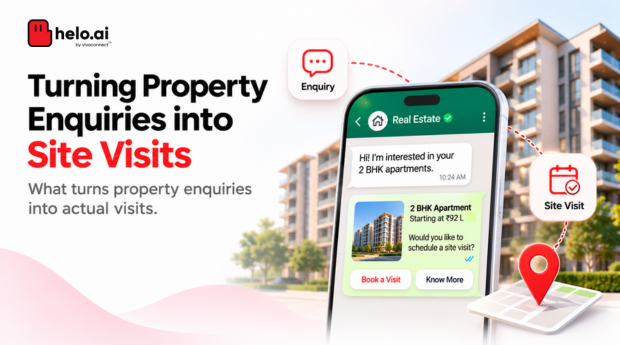


Quick answer: Developers convert more enquiries into site visits by qualifying buyers, responding fast, sharing useful property information and making booking simple. In a 2011 Harvard Business Review study, firms contacting leads within an hour were nearly seven times as likely to qualify them.
Site-visit conversion is the share of enquiries that end in a completed property visit.
- Enquiry
- Qualify
- Inform
- Book
- Confirm
- Completed visit
Two real estate developers can invest similar amounts in advertising and generate comparable numbers of enquiries, yet achieve very different site-visit numbers.
The difference may not be in how much they spend, but in what happens after an enquiry comes in.
How quickly does the sales team respond? Does the prospect receive relevant property information? Is follow-up consistent? And how easy is it to book a visit?
These interactions influence whether an interested buyer takes the next step.
1. Are developers measuring lead volume or buyer intent?
Developers should measure buyer intent, not just lead volume.
A campaign generating hundreds of enquiries may look successful. But not every enquiry represents a potential buyer.
Someone looking for a 2BHK apartment within a specific budget has different requirements from someone casually exploring properties.
Developers should assess enquiries based on:
- Preferred configuration and budget.
- Purchase timeline.
- Preferred location.
- Financing requirements.
- Interest in the specific project.
This helps sales teams focus on prospects whose requirements match the property.
Instead of evaluating campaigns only through cost per lead, developers should also track cost per qualified lead and cost per site visit.
2. How quickly does the sales team respond?
Property buyers often enquire about multiple projects while comparing their options. A delayed response gives another developer the opportunity to start the conversation first.
Harvard Business Review's 2011 research, The Short Life of Online Sales Leads, examined 1.25 million leads across 42 US companies. It found that companies attempting to contact prospects within an hour were nearly seven times as likely to qualify them as companies waiting another hour.
The sample was 1.25 million leads received by 29 B2C and 13 B2B companies in the US.
The study measured lead qualification, defined as establishing a meaningful conversation with a decision-maker. It did not measure property visits or completed sales, and its findings are not specific to Indian real estate.
Nevertheless, it demonstrates why response delays deserve attention.
Developers should establish a process to acknowledge new enquiries, assign them to sales representatives and follow up when prospects are unavailable.
A first-hour routine:
Acknowledge
The buyer receives a reply and the project details they asked for
Owner: Automated message or sales teamAssign
The enquiry goes to a named sales representative
Owner: Sales managerContact
The representative calls or messages and notes the outcome
Owner: Sales representativeRetry
If the buyer is unavailable, a follow-up time is set
Owner: Sales representative
Set the response target with your own sales team. The study did not test a property-specific benchmark.
Source: Harvard Business Review, The Short Life of Online Sales Leads
3. Does the follow-up help buyers evaluate the property?
Repeatedly asking prospects whether they are interested does little to help them make a decision.
Buyers need information that helps them assess whether a property suits their requirements.
Useful follow-up can include:
- Floor plans and configuration details.
- Location advantages and nearby facilities.
- Pricing and payment schedules.
- Construction progress and project specifications.
- Amenities and available inventory.
- Site-visit availability and directions.
| Buyer question | Information to share |
|---|---|
| Buyer questionDoes it fit my budget? | Information to sharePricing and payment schedules |
| Buyer questionDoes it fit my needs? | Information to shareFloor plans and configuration details |
| Buyer questionIs the location convenient? | Information to shareLocation advantages and nearby facilities |
| Buyer questionIs the project on track? | Information to shareConstruction progress and specifications |
| Buyer questionWhat will I get? | Information to shareAmenities and available inventory |
| Buyer questionHow do I visit? | Information to shareSite-visit availability and directions |
KPMG's India CX Report 2025: Residential Real Estate found that 44% of customers considered property assessment the most impactful stage in shaping their overall perception of a builder's brand.
The report also identifies location accessibility and accurate property specifications as important experience factors.
This makes property information an important part of the sales conversation. Follow-ups should answer buyer questions and help them assess the project, not simply remind them to visit.
Source: KPMG, India CX Report 2025: Residential Real Estate
Research context: KPMG's overall India CX Report covered 6,600+ customer evaluations across 280+ brands and 11 sectors. The 44% figure is a residential real estate finding, not a site-visit conversion rate.
Make the next step easier for your buyers.
Connect enquiry acknowledgements, useful project information and appointment reminders with your sales workflow.
4. Are developers building trust before asking for a visit?
Buying property involves a significant financial commitment. Prospects want confidence in the developer, the project and the information they receive.
Unclear pricing, incomplete specifications and unanswered questions can create hesitation.
Developers can build confidence by providing:
- Transparent pricing and payment terms.
- Accurate project specifications.
- Relevant approvals and documentation.
- Genuine project photographs.
- Clear construction and possession updates.
KPMG's residential real estate research also highlights builder reputation, transparent communication and integrity as important parts of the customer experience.
A site visit becomes a more meaningful next step when prospects already have enough information to evaluate the project.
5. Is booking a site visit simple?
Even an interested prospect may drop off if scheduling involves multiple calls, unclear availability or delayed confirmation.
Developers should make the process straightforward:
Understand the buyer's preferred date and time.
Offer available visit slots.
Confirm the appointment.
Share the location and contact details.
Send a reminder before the scheduled visit.
The objective is to remove unnecessary effort between expressing interest and visiting the property.
Where booking breaks, and the fix:
| Friction | Fix |
|---|---|
| FrictionSeveral calls to agree a time | FixOffer visit slots in the first message |
| FrictionUnclear availability | FixShow open dates and times |
| FrictionDelayed confirmation | FixConfirm the appointment straight away |
| FrictionMissing location details | FixSend the address and a contact number |
| FrictionNo reminder | FixSend a reminder before the visit |
6. Are sales teams following up consistently?
Not every buyer is ready to visit immediately. Some may be comparing locations, discussing budgets with family or arranging financing.
Without a structured follow-up process, these enquiries can get lost.
Sales teams should maintain records of:
- Previous interactions.
- Budget and property preferences.
- Purchase timeline.
- Questions and concerns.
- Next follow-up date.
- Site-visit booking and attendance status.
This gives representatives context for their next conversation and helps managers identify where prospects are dropping off.
7. What should developers measure beyond advertising spend?
To understand why similar advertising investments produce different outcomes, developers need visibility across the enquiry-to-visit journey.
| Metric | What it reveals |
|---|---|
| MetricCost per lead | What it revealsCost of generating an enquiry |
| MetricQualified lead rate | What it revealsRelevance of enquiries to the project |
| MetricFirst-response time | What it revealsSpeed of sales engagement |
| MetricContact rate | What it revealsShare of enquiries that become conversations |
| MetricFollow-up completion | What it revealsConsistency of sales communication |
| MetricLead-to-booked-visit rate | What it revealsHow many enquiries result in appointments |
| MetricVisit show-up rate | What it revealsHow many booked appointments are attended |
| MetricCost per completed visit | What it revealsAdvertising investment per actual site visit |
The distinction between booked and completed visits is important. A high number of appointments does not necessarily mean a high number of property visits.
Tracking these metrics helps developers identify whether the problem lies in campaign targeting, lead quality, response delays, follow-up or appointment management.
If a metric is weak, check this first:
| Weak metric | Check first |
|---|---|
| Weak metricQualified lead rate | Check firstCampaign targeting and lead form questions |
| Weak metricFirst-response time or contact rate | Check firstAssignment and response process |
| Weak metricFollow-up completion | Check firstFollow-up routine and CRM records |
| Weak metricLead-to-booked-visit rate | Check firstProperty information and booking steps |
| Weak metricVisit show-up rate | Check firstConfirmations and reminders |
Where communication platforms fit into the journey
Managing enquiries across advertising channels, sales representatives and follow-up systems can become difficult as lead volumes grow.
Helo.ai's communication capabilities can support real estate developers through SMS, WhatsApp, RCS and voice.
When integrated with CRM and lead management systems, communication workflows can help businesses:
- Acknowledge incoming enquiries.
- Share relevant project information.
- Follow up with interested prospects.
- Send site-visit confirmations and reminders.
- Route customer responses to sales representatives.
Helo WhatsApp
Automates conversations, alerts and campaigns on WhatsApp Business API
The purpose is to make communication more consistent and reduce delays between an enquiry and the next sales action. Actual conversion still depends on lead quality, project suitability and the sales experience.
Want to test faster enquiry follow-up on your own leads? Talk to the Helo.ai team.
Final takeaway
Similar advertising spend does not guarantee similar site-visit numbers.
The difference often lies in how developers manage the journey after an enquiry arrives. Understanding buyer requirements, responding quickly, sharing useful information, building trust and simplifying appointments can all help move prospects towards a site visit.
Before increasing the advertising budget, developers should examine what happens to the enquiries they are already paying for.
Sometimes, the next opportunity for growth is not generating more enquiries. It is converting more of the existing ones.
Frequently asked questions
How can real estate developers increase site visits?
Developers can qualify enquiries by buyer intent, respond quickly, share useful property information, build trust, simplify booking and follow up consistently.
Why are property leads not converting?
Common causes include low-intent enquiries, slow responses, follow-ups that do not help buyers decide, unclear pricing and a complicated booking process.
How can developers improve lead-to-site-visit conversion?
Track the journey from enquiry to completed visit, including qualified lead rate, contact rate, booked visits and show-up rate. Then fix the stage where prospects drop off.
How quickly should real estate sales teams respond to enquiries?
Teams should set a fast response target. In a Harvard Business Review study of US companies, firms contacting leads within an hour were nearly seven times as likely to qualify them. The study did not measure property visits.
How can developers improve real estate lead follow-up?
Keep a record of each buyer's budget, preferences, timeline, questions and next follow-up date. Share information that helps them evaluate the project.
Which metrics should real estate marketers track beyond cost per lead?
Track qualified lead rate, first-response time, contact rate, follow-up completion, lead-to-booked-visit rate, visit show-up rate and cost per completed visit.
Put your enquiry-to-visit journey to work.
Want to test faster enquiry follow-up on your own leads? Talk to the Helo.ai team.