.jpeg)
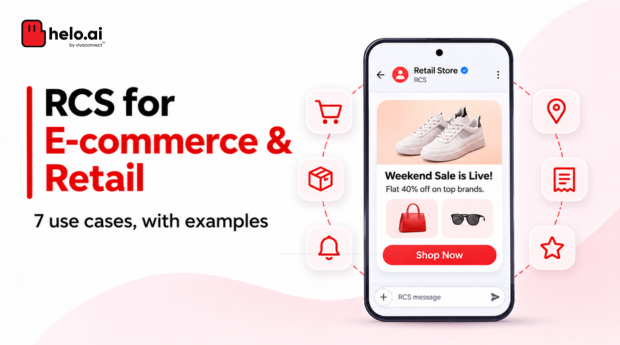


Retail customers receive messages at every stage of their shopping journey: product announcements, offers, order confirmations, delivery updates and feedback requests. But when every message looks like plain text, brands have limited room to showcase products or make the next step easier.
RCS Business Messaging gives retailers a richer way to communicate. It combines the familiarity of a messaging app with branded profiles, images, rich cards, carousels and interactive actions.
For e-commerce and retail businesses, this creates opportunities to make product discovery more engaging, bring shoppers back to their carts and keep customers informed after a purchase.
Here are seven practical ways retailers can use RCS Business Messaging.
RCS Business Messaging lets retailers send branded messages with images, rich cards, carousels and tap-to-act buttons instead of plain text and links. It suits launches, abandoned-cart reminders, sale alerts, order updates and feedback requests. Each agent must follow its declared use case, and RCS support varies by device, operator and country.
What is RCS Business Messaging for retail?
RCS, or Rich Communication Services, upgrades traditional text messaging with richer content and interactive features.
Instead of sending a message with only text and a link, a retail brand can use RCS to share product images, descriptions, rich cards, carousels and suggested actions within a supported messaging experience.
For example, a fashion retailer announcing a new collection could display selected products with images, short descriptions and buttons that take shoppers to the relevant product pages.
RCS messages can also display a verified business identity, helping customers recognise the brand they are communicating with.
The experience depends on device compatibility, the messaging client, operator support and the features enabled for the business. Not every customer will see the same RCS features.
For a broader introduction, read Helo.ai's guide to what RCS messaging is, or see the glossary entry on an RCS agent, the verified sender identity that a brand uses to send RCS messages. The RCS standard itself is maintained through the GSMA RCS Universal Profile publications.
Why are retail brands exploring RCS?
Retail communication often has two jobs: capture attention and make the next action convenient.
RCS can help with both.
- Show products visually: Use product images and rich cards instead of relying only on text and links.
- Create branded conversations: Present messages through a recognisable business identity.
- Make actions easier: Add suggested actions such as visiting a website, calling a store or exploring a product.
- Support product discovery: Use carousels to showcase a selection of products or offers.
- Connect with SMS: Where the implementation supports it, configure SMS fallback for recipients who cannot receive an RCS message.
RCS is not a replacement for every SMS campaign. It is another messaging option for situations where richer presentation and interaction can improve the customer experience.
Helo.ai's glossary explains RCS to SMS fallback, and its retail page covers messaging for retail brands and e-commerce.
7 RCS Business Messaging use cases for e-commerce and retail
Before the detail, here is how the seven use cases line up with the agent types Google describes. Abandoned-cart reminders are named as promotional, and purchase confirmations and shipping information as transactional, in Google's RCS for Business use-case documentation. The remaining rows are Helo.ai's reading and depend on the message content.
| Use case | Usual agent type | Basis |
|---|---|---|
| 1. New products and collections | Promotional | Marketing content (Helo.ai reading) |
| 2. Personalised recommendations | Promotional | Marketing content (Helo.ai reading) |
| 3. Abandoned-cart reminders | Promotional | Named by Google |
| 4. Seasonal offers and flash sales | Promotional | Marketing content (Helo.ai reading) |
| 5. Order confirmations and delivery updates | Transactional | Named by Google |
| 6. Back-in-stock notifications | Depends on content | Check the current rules before sending |
| 7. Feedback and loyalty | Depends on content | Keep feedback separate from promotions |
1. Announce new products and collections
A new collection launch is an opportunity to give customers a preview before they visit the website or store.
Retailers can use RCS cards or carousels to showcase selected products, highlight key details and direct customers to the relevant product pages.
Example: A fashion brand launches its festive collection. The RCS message features a few selected outfits, a short collection introduction and a button to explore the range.
2. Share personalised product recommendations
A customer who has browsed a particular category may be interested in related products.
Retailers can use relevant customer preferences and available behavioural data to create more useful product recommendations. RCS can then present a selection visually, rather than sending a generic product link.
Example: A customer who regularly browses skincare products receives a message featuring a curated selection from that category, with links to explore each product.
Recommendations should be based on appropriate data use and customer permissions. Personalisation should make messages more relevant, not more intrusive.
3. Bring shoppers back to abandoned carts
A customer may add products to a cart but leave before completing the purchase. A timely reminder can bring the products back to their attention.
RCS can display selected cart items, where supported by the integration, alongside a link to return to the cart.
Example: A customer leaves a pair of shoes in their cart. The retailer sends a reminder featuring the product image and a button to return to checkout.
An important distinction: abandoned-cart reminders are considered promotional messaging under Google's RCS Business Messaging use-case rules. They should be sent through an appropriately classified promotional agent, with the required customer consent.
Check before you send: Abandoned-cart reminders sit under Promotional in Google's use-case rules. Confirm the consent requirements that apply in each market you send to, and use a promotional agent for these reminders.
For more on bringing shoppers back through messaging, see Helo.ai's guide to recovering abandoned carts with messaging.
4. Promote seasonal offers and flash sales
Festive sales, end-of-season offers and limited-period promotions depend on getting the message across quickly.
RCS can help retailers present selected offers visually, highlight the promotion period and provide a direct action to browse the sale.
Example: An electronics retailer announces a weekend sale with a carousel of selected products, offer details and links to the product pages.
Promotional content should follow the applicable RCS agent classification, consent and traffic policies.
5. Send order confirmations and delivery updates
The customer journey does not end when an order is placed. Customers also want to know whether their purchase has been confirmed and when it will arrive.
RCS can make these updates easier to understand through clear message layouts and relevant actions.
Example: After a customer places an order, the retailer sends a confirmation with the order reference and a link to view order details. A later message shares a delivery update with a tracking link.
Purchase confirmations and delivery updates are examples of transactional communication. They should be handled through an appropriately classified transactional agent, rather than mixed into a promotional campaign.
6. Notify customers about product availability
A customer may be interested in a product that is currently unavailable. A relevant availability notification can bring them back when the item becomes available.
Example: A customer signs up to receive an update when a particular pair of shoes is back in stock. The retailer sends a message with the product image and a link to check availability.
The message classification depends on its purpose and content. A straightforward service notification and a message that also promotes an offer may be treated differently. Retailers should check Google's current use-case requirements before sending these campaigns.
7. Collect customer feedback and encourage loyalty
The experience after a purchase can influence whether a customer returns.
Retailers can use messaging to invite customers to share feedback, explore loyalty benefits or discover relevant updates.
Example: After a customer receives an order, the retailer sends a short feedback request with a link to a survey. A separate, appropriately consented promotional message can introduce a loyalty offer or relevant collection.
Keep feedback requests focused on the customer's experience. Do not turn a transactional interaction into an unsolicited promotional campaign.
See RCS carousels and cards in action
Explore how Helo.ai supports RCS Business Messaging for retail campaigns, then talk to the team about your catalogue and audience.
RCS vs SMS: What is the difference?
Both channels have a role in retail communication. The choice depends on what the message needs to achieve.
| Capability | SMS | RCS |
|---|---|---|
| Message format | Primarily text and links | Text, images, rich cards and carousels |
| Branding | Sender ID, depending on market and setup | Branded business profile and identity |
| Interaction | Primarily link-based | Suggested replies and supported actions |
| Product presentation | Limited | Visual product cards and carousels |
| Compatibility | Broad mobile reach | Depends on device, messaging client and operator support |
| Fallback | Not applicable in the same way | SMS fallback can be configured where supported |
The two channels can complement each other. RCS can support richer experiences for compatible recipients, while SMS can remain part of the wider communication strategy.
For a closer look at how each channel works for retail updates, see Helo.ai's guides to RCS messaging on Apple devices and WhatsApp vs SMS notifications, and the SMS product page.
What should retailers consider before implementing RCS?
A successful RCS campaign needs more than attractive product images. Retailers should plan the experience and the messaging rules together.
1. Check device and network compatibility
RCS availability and feature support vary by device, operating system, messaging client, operator and market. Check the capabilities of the audiences you want to reach and test the experience across relevant devices.
2. Choose the correct agent use case
Google's RCS Business Messaging policies distinguish between use cases such as Promotional, Transactional and OTP. The agent's declared use case must match the messages it sends.
For example, sale announcements and abandoned-cart reminders are promotional. Order confirmations and delivery updates are transactional. These categories should not be treated as interchangeable.
Google's documentation says each use case has rules about what you can send and that these vary by country, so check the current use-case page for your market before launch.
3. Understand India's RCS requirements
Businesses operating in India should pay particular attention to Google's country-specific rules.
Google's documentation lists the Multi-use use case as not available in India. Indian retailers therefore need to plan separate transactional and promotional agents rather than one agent that mixes both.
For promotional traffic in India, Google sets limits over a rolling 28 days that depend on the agent's reputation. New agents start with low reputation, replies to messages that users start are exempt, and businesses can only start conversations between 7 AM and 10 PM.
Initial promotional messages per user in 28 days, India, by agent reputation
| Reputation | Initial messages per user | Unique users reachable |
|---|---|---|
| High | 8 | 300 million |
| Medium | 4 | 25 million |
| Low | 2 | 1 million |
Rules can change: Google notes that these rules vary by country and can change. Treat the figures above as correct at the time of writing and confirm them on the official page before planning a campaign.
Pre-launch checklist for retailers
- Have you tested the experience on the devices, messaging clients and operators your customers use?
- Is each message type sent from an agent whose declared use case matches it?
- Are abandoned-cart and sale messages sent through a promotional agent?
- Are order confirmations and delivery updates sent through a transactional agent?
- Is SMS fallback configured where your setup supports it?
- Do you have customer consent records that meet the rules of each market?
- Are promotional sends planned within the reputation-based limits and sending hours?
- Do feedback requests stay free of unsolicited promotion?
How Helo.ai supports RCS Business Messaging for retail
Helo.ai offers RCS as one of several channels for retail and e-commerce brands. Its RCS product page describes branded messages with images, buttons, carousels and real-time delivery reports, plus automated order updates. Its retail page lists RCS alongside WhatsApp, SMS, email and voice.
Retailers who want a step-by-step plan can read Helo.ai's RCS playbook. Feature availability depends on your setup, market and agent approval, so confirm details with the Helo.ai team.
You can also compare channels on the WhatsApp product page, or contact Helo.ai to discuss your requirements.
Frequently asked questions about RCS for e-commerce and retail
What is RCS Business Messaging for e-commerce?
It is a way for retailers to send branded messages with images, rich cards, carousels and suggested actions through a supported messaging app, instead of plain text and links. Features depend on the device, messaging client, operator and the features enabled for the business.
How is RCS different from SMS for retailers?
SMS is primarily text and links with broad mobile reach. RCS adds images, rich cards, carousels and suggested actions, but its availability depends on device, messaging client and operator support. SMS fallback can be configured where supported.
Are abandoned-cart reminders promotional on RCS?
Yes. Google's RCS for Business use-case documentation names abandoned-cart reminders as promotional, so they should be sent through an appropriately classified promotional agent.
Are order confirmations and delivery updates transactional?
Yes. Google lists purchase confirmations and shipping information as transactional communication. They should be sent through a transactional agent, not mixed into a promotional campaign.
Can retailers in India use the Multi-use agent type?
Google's documentation lists Multi-use as not available in India. Retailers there should plan separate transactional and promotional agents. Rules vary by country and can change, so check the current page.
Is there a limit on promotional RCS messages in India?
Google sets rolling 28-day limits by agent reputation. Initial messages per user are 8 for high, 4 for medium and 2 for low reputation, and new agents start with low reputation. Replies to user-started messages are exempt.
What happens if a customer cannot receive RCS?
Where the implementation supports it, you can configure SMS fallback so recipients who cannot receive an RCS message still get a text. Helo.ai's glossary covers RCS to SMS fallback.
Conclusion: use RCS where richer messages help the customer
RCS gives retailers a way to show products, simplify the next step and keep customers informed after purchase. It works best when each message type follows its agent classification, the audience is checked for compatibility, and SMS remains part of the wider strategy.
Plan your RCS retail campaigns with Helo.ai
Share your catalogue, audience and markets, and the Helo.ai team can walk through RCS options for your business.
Disclaimer. This article is general information, not legal, regulatory or compliance advice. RCS features, Google's use-case rules and India-specific limits vary by country and can change, so check current requirements and consult qualified advisers before sending. Examples are illustrative. Helo.ai is the publisher and offers RCS and other messaging products. Sources were last checked in November 2026.