.jpeg)


Quick answer: Prioritise outage updates by safety, severity, duration and vulnerability. Communicate early even when information is incomplete, send localised and timestamped updates, and keep a predictable schedule across suitable channels. In Victoria's February 2024 storms, over 530,000 customers were without power at the peak.
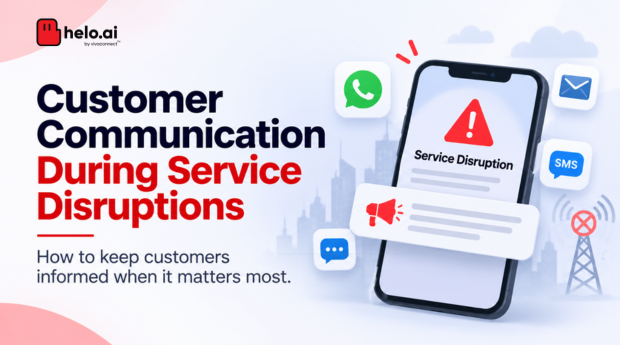
Customer communication during service disruptions means telling affected customers what happened, where, what is being done and when the next update will arrive.
When electricity, water, gas or telecommunications services are disrupted across multiple locations, customers need more than an outage announcement. They want to know whether their area is affected, how long the disruption might last and what they should do next.
For utility providers, communicating this information at scale is challenging. Restoration estimates change, operational teams are still investigating, and customer support channels face a sudden increase in enquiries.
The priority should not be to send more messages. It should be to deliver accurate, relevant updates to the right customers at the right time.
Why communication becomes difficult during major disruptions
Large-scale disruptions create several communication challenges:
- Incomplete information: The cause and extent of the disruption may not be immediately clear.
- Changing restoration estimates: Field assessments can change expected recovery times.
- High enquiry volumes: Customers turn to call centres, websites and messaging channels for updates.
- Unequal customer impact: Hospitals, businesses and vulnerable households may have more urgent requirements.
- Channel failures: Power or network outages can affect the communication systems providers rely on.
The Victorian Government’s review followed the February 2024 storms, which left more than 530,000 electricity customers without power. The government’s account of the interim report notes that AusNet’s Outage Tracker failed and highlights the need to reach customers with limited phone and internet access. Read the government’s interim-report summary.
A later Essential Services Commission review also reports that record website traffic overwhelmed online systems during the storm, while outdated or inaccurate customer contact information meant critical updates were missed. Read the commission’s review.
The incident highlights why providers need reliable information and multiple ways to reach customers.
1. Prioritise customers by impact and urgency
Not every affected customer has the same communication needs. A hospital experiencing a power interruption requires a different response from a household facing a short service disruption.
Providers should consider:
- Safety: Hospitals, emergency services and customers dependent on essential equipment.
- Severity: Complete service loss versus intermittent disruption.
- Duration: Short interruptions versus prolonged outages.
- Vulnerability: Senior citizens, people with disabilities and customers needing additional assistance.
- Community impact: Essential businesses and public services.
Ofwat's 2024 research, Improving customer service and support during incidents, highlights the importance of identifying customers who may need additional support during water-sector incidents.
Ofwat and CCW's joint research covered five water incidents, with fieldwork from July 2023 to March 2024. It found low awareness of Priority Services Register support among eligible customers (see the CCW overview).
A practical prioritisation model could look like this:
1. Safety
Immediate safety risks and essential facilities
Urgent alerts and specific instructions2. Severe impact
Complete loss of essential services
Early disruption notification3. Prolonged outage
Extended service interruption
Regular progress and restoration updates4. Partial disruption
Intermittent or reduced service
Localised status information5. Wider community
General public information
Website, social media and public updatesThis is a recommended operational model, not a universal regulatory classification.
Source: Ofwat, Improving customer service and support during incidents
2. Communicate early, even when information is incomplete
Waiting for a complete technical explanation can leave customers uninformed during the most critical stage of an incident.
An initial notification should explain:
- What has happened, based on confirmed information.
- Which locations or services are affected.
- What the provider is doing.
- When customers can expect another update.
If the cause or restoration time is unknown, communicate that honestly. Avoid making promises based on unverified estimates.
In India, the Electricity (Rights of Consumers) Rules, 2020 provide for immediate intimation of unplanned electricity outages or faults through SMS or another electronic mode, along with an estimated restoration time.
This reinforces the importance of having processes that allow providers to communicate promptly.
3. Make updates accurate, localised and consistent
A general message saying that restoration work is underway may not answer a customer's most important question: what is happening in my area?
Providers should use accurate customer records and service-location data to send relevant updates.
For example:
- Area A receives a provisional restoration estimate.
- Area B receives confirmation that field assessment is underway.
- Area C receives a service restoration notification.
- Customers in areas with safety risks receive specific instructions.
Every restoration estimate should include a timestamp and indicate whether it is confirmed or provisional. If it changes, customers should receive an updated message explaining the change.
Anatomy of a useful outage update
- Location
- The area or service affected
- Status
- Confirmed or provisional
- Timestamp
- When the information was last checked
- Action for the customer
- What to do or avoid
- Next update time
- When customers will hear again
- Support route
- Where to get help
Providers should also maintain a single source of verified incident information, such as an outage status page or central incident management system. SMS, WhatsApp, websites, apps and contact centre teams should use the same verified information.
This reduces conflicting updates and helps customers find reliable information without contacting support repeatedly.
4. Use multiple channels and maintain a predictable schedule
No single communication channel reaches every customer. Providers should select channels based on urgency, accessibility and the level of detail required.
Immediate outage alerts
SMS, app notifications, WhatsApp where appropriate
Localised service information
Website, app, outage tracker
Detailed explanations
Email and website
Customer assistance
Call centre, WhatsApp, live chat
Wider public awareness
Social media, local media and public announcements
Providers should also establish an update schedule:
Initial notification:
Confirm the disruption.
Investigation update:
Share known details and affected areas.
Progress update:
Communicate restoration developments.
Resolution update:
Confirm service restoration and provide further assistance instructions.
For prolonged incidents, updates should continue even when there is no significant change.
For example, Australia's ACMA Telecommunications (Customer Communications for Outages) Industry Standard 2024 requires covered telecommunications providers to send updates every six hours during the first 24 hours of a major outage, followed by updates every 24 hours.
This applies to specified telecommunications outages in Australia, not all utility providers globally.
ACMA’s current guidance also covers significant local outages and sets different communication requirements for outages caused by natural disasters. Check the category and rules that apply before adopting this schedule.
| Region | Rule | What it requires |
|---|---|---|
| RegionIndia | RuleElectricity (Rights of Consumers) Rules, 2020 | What it requiresImmediate intimation of unplanned outages by SMS or another electronic mode, with an estimated restoration time |
| RegionAustralia | RuleTelecommunications (Customer Communications for Outages) Industry Standard 2024 | What it requiresFor covered major outages, updates at least every six hours for the first 24 hours, then once in each following 24-hour period. A major outage includes 100,000 or more services, or all network services in a state or territory, and lasts or is expected to last longer than 60 minutes. Natural-disaster outages have different requirements. |
This is general information, not legal advice. Check the rules that apply to your licence and region, as standards can be amended.
Connect incident updates with customer communication.
Discuss how verified incident information, customer records and messaging channels can work together in your notification workflow.
5. Prepare for communication infrastructure failures
A disruption can affect the very systems providers use to communicate. Power outages may interrupt mobile networks, internet access and digital support services.
Providers should prepare alternative communication arrangements, including:
- Backup communication infrastructure.
- Pre-approved incident messages and escalation workflows.
- Alternative channels when primary systems are unavailable.
- Assisted communication for customers who cannot access digital services.
- Coordination with local authorities and emergency services.
September 2026 joint guidance published by New Zealand’s National Cyber Security Centre emphasises backup communication methods, clear incident responsibilities and regular preparedness exercises.
The guidance covers IT and operational technology outages and was co-authored by CISA, the FBI, and cybersecurity agencies in Australia, Canada and the UK.
6. Connect operational systems with customer communication
The delay often happens between receiving an operational update and communicating it to customers.
Field teams know which locations are affected. Operations teams manage restoration. Customer service teams handle enquiries. These teams need access to consistent, verified information.
Connecting incident management systems with communication workflows can help providers:
- Identify affected customers using location and service records.
- Trigger notifications when an incident is confirmed.
- Distribute revised restoration updates.
- Route customer enquiries to appropriate teams.
- Maintain communication history for support teams.
An omnichannel communication platform can support this process. Helo.ai's CPaaS capabilities support communication through SMS, WhatsApp, RCS, email and voice. These can form part of a utility provider's notification infrastructure when integrated with its operational systems and customer data.
Features and availability vary by plan and market. Confirm them with Helo.ai, and test channel failover for your own network.
The platform supports message distribution and customer engagement. Outage detection, restoration estimates and operational decisions remain the responsibility of the provider's systems and teams.
Want to plan outage notifications for your customers? Talk to the Helo.ai team.
7. Continue communication after restoration
Service restoration should not be the last customer update.
Providers should confirm when service is available again, explain how customers can report continuing issues and share relevant information about the incident.
Where appropriate, they should also communicate what caused the disruption and what steps are being taken to prevent similar incidents.
This helps close unresolved customer concerns and gives providers an opportunity to rebuild confidence after a difficult experience.
A practical framework for prioritising disruption updates
- Safety
Identify urgent risks and customers requiring immediate assistance
- Awareness
Notify affected customers when a disruption is confirmed
- Clarity
Share verified impact and restoration information
- Continuity
Maintain scheduled updates across suitable channels
- Consistency
Use one source of verified incident information
- Recovery
Confirm restoration and address continuing issues
- Learning
Review communication reach, accuracy and customer feedback
The framework should be adapted to the type of utility, incident severity, customer needs and applicable regulations.
Final takeaway
During a large-scale service disruption, communication is part of the response itself.
Providers need to prioritise safety, notify customers early, share accurate localised information and maintain consistent updates across accessible channels. They also need reliable customer data and backup communication arrangements.
The goal is not to send the highest number of messages. It is to ensure every update answers a customer's most important questions: What happened? How does it affect me? What should I do next?
Frequently asked questions
How should utility companies communicate during power outages?
They should communicate early, share confirmed information, localise updates and use multiple channels. A single source of verified incident information keeps messages consistent.
How often should customers receive updates during a service disruption?
It depends on the incident and the applicable rules. ACMA’s guidance specifies six-hourly updates in the first 24 hours of major telecommunications outages, followed by daily updates. Natural-disaster outages have different requirements. For prolonged incidents, updates should continue even without significant change.
What information should an outage notification include?
It should state what has happened, which locations are affected, what the provider is doing and when the next update will arrive. Restoration estimates need a timestamp and a confirmed or provisional label.
How can utilities reach vulnerable customers during emergencies?
Providers should identify vulnerable customers in advance, prioritise by safety and vulnerability, and offer assisted communication for those who cannot use digital services. They should also coordinate with local authorities.
Which communication channels work best during large-scale outages?
No single channel reaches every customer. SMS, app notifications and WhatsApp suit alerts, websites suit local detail, email suits explanations and call centres suit assistance.
How can utility providers automate outage notifications?
Connect incident management systems with communication workflows. This can identify affected customers from location and service records, trigger notifications when an incident is confirmed and distribute revised estimates. Outage decisions stay with the provider.
Plan the message before the next outage.
Want to plan outage notifications for your customers? Talk to the Helo.ai team.