.jpeg)
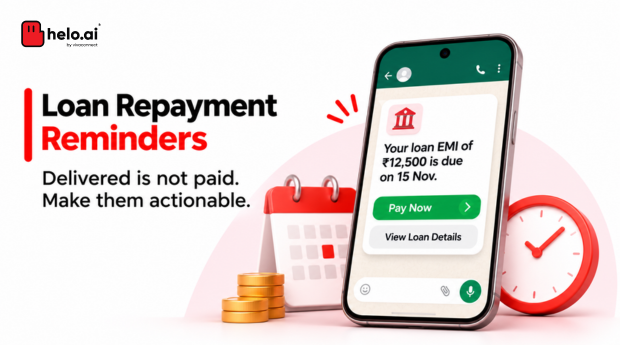


A lender sends a payment reminder before an EMI is due. The message includes the amount and a payment link. But the borrower is unsure whether the amount includes overdue charges, cannot understand the payment instructions or encounters an error while completing the transaction.
The reminder has been delivered, but the payment has not been made.
This is an often-overlooked problem in digital lending. Sending a reminder is only one part of the repayment process. The borrower must also understand what is being requested, know how to act on it and be able to complete the payment without unnecessary difficulty.
When any of these steps fails, lenders may see delayed repayments, repeated customer queries, failed transactions and additional collection effort.
The challenge is not simply to send more loan repayment reminders. It is to make every repayment communication clear, accessible and actionable.
A delivered reminder is not a completed payment. Borrowers also need to understand the amount, know the next step and finish the payment without errors. Clear wording, accessible payment options, checked transaction status and a visible help route make repayment communication more actionable.
- State the amount, instalment, deadline, payment route and what to do if already paid.
- A 2022 Indian study of digital payments found network issues, missing guidance and technical language to be barriers.
- Check transaction status before treating an account as overdue.
- Measure completed payments, failed payments and repeat contacts, not messages delivered.
A delivered reminder does not guarantee a completed payment
Payment reminders are designed to help borrowers remember their repayment obligations. But a message being delivered does not necessarily mean it has been understood or acted upon.
Consider a borrower who receives this message:
Example message: Your loan account is overdue. Please clear the outstanding amount immediately to avoid further action.
The message communicates urgency, but it leaves several questions unanswered.
- What is the exact outstanding amount?
- Which instalment is overdue?
- Does the amount include additional charges?
- What is the payment deadline?
- Where should the borrower make the payment?
- What should they do if they have already paid?
Without these details, the borrower may need to contact customer support before taking action.
A useful reminder should do more than notify someone that a payment is due. It should explain the obligation and make the next step clear.
For lenders, this distinction matters because an unclear reminder can create additional work for both the borrower and the collections team.
Clear language makes a reminder easier to act on
Financial communication often uses terms that are familiar to lenders but not necessarily to borrowers.
Words such as overdue balance, penal charges, outstanding principal, mandate failure and repayment reference may be understood internally but can be confusing without an explanation.
The problem becomes more significant when messages are long, contain multiple instructions or use language that is difficult to follow.
A borrower should not have to interpret a financial message to understand what action is required.
For example:
Less helpful
Your account reflects an overdue obligation. Kindly regularise the account immediately.
Clearer
Your EMI of ₹5,000 for this month is pending. Please make the payment by 7 November using the payment link below. If you have already paid, please contact us with your transaction reference.
The second message communicates the amount, purpose, action and an alternative route if the payment has already been made.
This is particularly important when lenders communicate with customers across different languages and levels of financial literacy. A message that is technically correct but difficult to understand may not achieve its purpose.
A payment option is useful only when the borrower can access it
Even when a borrower understands the reminder, the payment process itself can create difficulties.
A payment link may not open. The borrower may not know which application to use. Their internet connection may be unreliable, or they may not be comfortable completing a digital transaction.
These challenges are not limited to individual borrowers.
A 2022 study by the Centre for Social and Behaviour Change at Ashoka University, conducted in partnership with Dvara Research, examined the digital payment experiences of women, migrant workers and gig workers.
The research included a survey of 262 respondents across urban and rural locations in two Indian states, in-depth interviews with 25 respondents and usability testing with the same 25 participants.
survey respondents across urban and rural locations in two Indian states
CSBC, Ashoka University, with Dvara Research, 2022
in-depth interviews
CSBC, Ashoka University, with Dvara Research, 2022
usability tests, with the same participants
CSBC, Ashoka University, with Dvara Research, 2022
The study identified several barriers to using digital payments, including:
- Network and server issues.
- Lack of timely notifications and guidance.
- Difficulty navigating digital payment applications.
- Confusion caused by technical language.
- Limited guidance for first-time users.
The researchers describe these barriers as structural and usability issues, not behavioural ones. They also cite difficulty navigating English-language interfaces.
These findings are relevant to understanding digital-payment accessibility, although the study did not specifically examine loan repayment behaviour.
They highlight an important point: digital payment access does not automatically translate into an easy payment experience.
For lenders, repayment communication should account for different levels of digital familiarity. Providing clear instructions, accessible payment options and a visible support route can make the process easier to complete.
Failed transactions can turn a simple reminder into a customer-service issue
A borrower may follow the payment instructions, initiate a transaction and still not receive confirmation.
In some cases, the account may be debited even though the beneficiary has not received the payment. In others, the transaction may remain pending or the merchant may not receive confirmation.
From the borrower's perspective, the situation can be confusing. The money has left the account, but the lender's records may still show the instalment as unpaid.
This creates a difficult experience if another overdue reminder is sent before the transaction status is reconciled.
The Reserve Bank of India established specific turnaround-time requirements for certain failed transactions through its September 2019 circular on harmonisation of turnaround time and customer compensation.
For UPI transactions, the framework distinguishes between two situations:
| Failed transaction scenario | Prescribed resolution timeline |
|---|---|
| Account debited but beneficiary account not credited in a person-to-person fund transfer | Auto-reversal by T+1 day |
| Account debited but transaction confirmation not received at the merchant location for a merchant payment | Auto-reversal within T+5 days |
Where the prescribed timeline is exceeded, compensation of ₹100 per day is applicable under the framework for the relevant failure category.
These timelines and compensation provisions apply to the specified failed-transaction scenarios. They are not general repayment deadlines and do not mean that every delayed loan repayment qualifies for compensation.
The circular is RBI/2019-20/67, dated 20 September 2019 and effective 15 October 2019. It says any compensation is credited to the customer's account automatically, without a complaint.
For lenders, the operational lesson is that payment reminders and transaction reconciliation need to work together. Before treating an account as overdue, payment status should be checked against the relevant transaction records.
A borrower should not have to repeatedly explain a payment failure that the systems involved should be able to identify and investigate.
Give borrowers a clear next step when something goes wrong
A payment reminder should not assume that every borrower will successfully complete the transaction on the first attempt.
Some borrowers may have already paid. Others may face a technical issue, need clarification about the amount or require help using the payment channel.
A useful communication process should account for these situations.
For example:
| Situation | Suggested response |
|---|---|
| Payment completed | Confirm receipt and provide an acknowledgement. |
| Payment initiated but pending | Explain that the transaction status is being checked and avoid treating it as a confirmed default without reconciliation. |
| Payment failed | Explain what the borrower should do next and provide an appropriate support route. |
| Amount unclear | Direct the borrower to a statement or support channel that explains the outstanding amount and applicable charges. |
| Payment already made | Provide a way to submit the transaction reference and get the account status checked. |
If a borrower contacts support after receiving an unclear reminder, the response should address the actual query rather than generate another generic payment demand.
The objective is to help the borrower complete the repayment or resolve the issue preventing it.
Coordinate communication across channels
Borrowers do not necessarily interact with lenders through one channel.
A payment reminder may arrive through SMS, WhatsApp, email, an application notification or a voice call. A borrower may read the message on one channel and seek help through another.
If these interactions are not coordinated, the experience can become fragmented.
For example, a borrower may respond to a WhatsApp reminder, call customer support to clarify the amount and then receive another automated overdue SMS because the earlier interaction was not reflected in the collections system.
This creates unnecessary repetition and can make the lender appear disconnected from the borrower's situation.
A coordinated communication process should help lenders:
- Maintain a consistent record of borrower interactions.
- Ensure the amount and due date communicated across channels are consistent.
- Track whether a borrower has responded or raised a query.
- Avoid unnecessary duplicate reminders.
- Update communication when payment status changes.
- Direct unresolved queries to the appropriate support team.
Automation can help with routine reminders and payment confirmations. However, situations involving disputed amounts, failed transactions or financial difficulty may require human support.
The goal is not to communicate through every available channel. It is to ensure that the borrower receives the right information through a channel they can use.
Making repayment messages clearer?
Read Helo.ai's guides to WhatsApp EMI collection and voice reminders for EMIs, or talk to the team about repayment communication.
Measure whether reminders actually help borrowers repay
The number of reminders sent or delivered does not tell lenders whether their communication is effective.
A better assessment looks at what happens after the reminder reaches the borrower.
Lenders can monitor several indicators:
| Metric | What it helps measure |
|---|---|
| Reminder-to-payment conversion | How many borrowers make a payment after receiving a reminder |
| Payment completion rate | How many initiated payments are successfully completed |
| Failed transaction rate | How frequently payment attempts fail |
| Repeat contact rate | How often borrowers contact support about the same payment |
| Payment reconciliation time | How quickly successful or failed transactions are reflected in account records |
| Reminder-related complaints | Whether borrowers are facing confusion or incorrect communication |
| Payment link success rate | Whether borrowers can access and complete the payment journey |
These measures should be considered together.
For example, a high reminder delivery rate accompanied by low payment conversion may indicate that communication is not sufficiently clear or actionable. A high number of repeat contacts may point to problems with payment instructions, transaction status or customer support.
Similarly, a high failed transaction rate may indicate a payment infrastructure issue rather than a borrower unwillingness to repay.
The distinction helps lenders identify where the problem actually lies and improve the appropriate part of the repayment journey.
Conclusion
A payment reminder is useful only when it helps the borrower take the next step.
Clear language, accurate payment details, accessible payment options and reliable transaction confirmation all contribute to a smoother repayment experience. When something goes wrong, borrowers also need a clear route to get help rather than receiving repeated generic reminders.
For lenders, the opportunity is to look beyond the number of messages delivered and understand what happens after a borrower receives one.
A successful payment reminder is not one that simply reaches the borrower. It is one that helps the borrower understand, act and complete the payment.
Help borrowers understand, act and pay
Tell the Helo.ai team which repayment moments cause the most queries, and they can help you plan clearer communication across channels.
Frequently Asked Questions
Why do borrowers ignore loan repayment reminders?
Often they are not ignoring the reminder. It may be unclear, the amount or charges may be uncertain, the payment link may fail, or the borrower may already have paid and the record has not updated.
How can lenders improve EMI payment reminders?
Use plain language, state the amount and deadline, and give one clear payment route. Avoid duplicate reminders by keeping a shared record across channels, and answer queries instead of repeating a payment demand.
What should a loan repayment reminder include?
Include the exact amount, the instalment it covers, whether it includes additional charges, the payment deadline, where to pay, and what to do if the borrower has already paid.
What happens when a UPI payment fails but the account is debited?
Under RBI's 2019 framework, a debited but uncredited person-to-person transfer is auto-reversed by T+1 day. A merchant payment without confirmation is auto-reversed within T+5 days. Compensation of ₹100 per day applies beyond those timelines. These rules cover only the specified failure scenarios.
How can banks reduce failed loan repayments?
Make payment instructions clear, test payment links, reconcile transaction status before sending overdue reminders, and offer a visible support route. Track failed transaction rate and payment link success rate to find where the journey breaks.
Note. This article is an editorial guide and general information, not legal or financial advice. Regulations change, so confirm current requirements with the RBI and your advisers. Helo.ai is a CPaaS provider and publishes this guide. Research cited comes from Ashoka University, Dvara Research and the RBI, not Helo.ai. Facts were checked on 13 November 2026.