.jpeg)
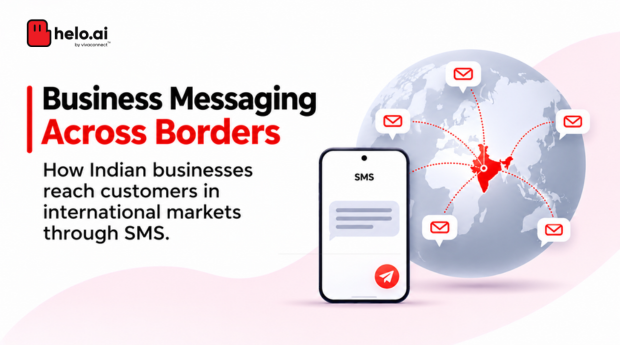


Sending an SMS to a customer in another country is not as simple as adding an international dialling code to a mobile number. Businesses also need to consider destination-country regulations, sender ID availability, message content, pricing, routing and delivery reporting.
For Indian businesses reaching customers overseas, these details can affect whether a message is accepted, how the sender appears on the recipient’s phone and what the campaign ultimately costs.
This guide explains how to send international SMS from India, what to check before launching a campaign, how sender IDs work across countries, how international SMS pricing is calculated and how businesses can monitor delivery.
To send international SMS from India, use a provider or SMS API that covers your destination, then check each country's sender ID, consent and content rules first.
- Sender IDs and registration differ by country, so an Indian sender ID may not work overseas.
- Indian DLT assumptions do not automatically apply to every overseas route. Confirm the route with your provider.
- Cost is billable segments multiplied by the rate per segment. There is no universal rate.
- An API acceptance response is not delivery. Track delivery reports country by country.
What Is International SMS?
International SMS is a text message sent between mobile networks in different countries.
For example, an Indian e-commerce company sending an order update to a customer in the United Kingdom is using international SMS. The same applies to a bank sending an account notification to an overseas customer or a travel company sharing booking updates with international travellers.
Businesses commonly use international SMS for:
- Transactional notifications: Order confirmations, payment alerts, booking updates and account notifications.
- Authentication: One-time passwords and verification codes, where supported by the destination network and applicable regulations.
- Marketing campaigns: Offers, product announcements and promotional messages, subject to local consent and marketing rules.
- Service updates: Appointment reminders, delivery notifications and important customer communications.
The sending country and destination country both matter. A route used to deliver an international message to an Indian number may follow different requirements from a route used to send a message from India to an overseas number.
How to Send International SMS from India
Businesses can send international SMS through a messaging provider or an SMS API. The exact setup depends on the destination country, message type, sender ID and route.
Step 1: Identify your destination countries
Start by listing the countries where your recipients are located.
Do not assume that one sender ID, message format or route will work everywhere. A sender name accepted in one country may be unsupported or require registration in another.
Check:
- Whether the provider supports SMS delivery to the destination.
- Which mobile networks are covered.
- Whether the destination accepts alphanumeric sender IDs.
- Whether sender registration or local documentation is required.
- Whether two-way messaging is supported.
- Whether the message type is permitted.
If you are sending to multiple countries, maintain a separate configuration for each destination wherever requirements differ.
Step 2: Choose an international SMS provider
Choose a provider with established international connectivity and clear destination-level coverage.
Before committing, ask for:
- Supported countries and mobile networks.
- Available routes for each destination.
- Sender ID options and registration requirements.
- Transactional and promotional messaging restrictions.
- Pricing by destination and message segment.
- Delivery report availability and status definitions.
- Support for API integration, webhooks and delivery troubleshooting.
A provider's claim of global coverage does not automatically mean every sender ID, message type or network is supported.
Step 3: Check sender ID requirements
A sender ID tells recipients who sent the message. Depending on the country, it may appear as a brand name, a mobile number or a short code.
Before choosing one, confirm what the destination network permits and whether the sender identity needs to be registered.
Do not assume that a sender ID registered in India will automatically be accepted overseas.
Step 4: Prepare the message and check local rules
Review the message before sending it.
Check whether the destination country has requirements relating to:
- Marketing consent and opt-outs.
- Permitted message categories.
- Sender identity and brand representation.
- URL and shortened-link restrictions.
- Restricted products, services or content.
- Local sending times and frequency limits.
- Privacy and customer-data handling.
For marketing messages, keep evidence of consent and provide an appropriate way for recipients to stop receiving communications where required.
Step 5: Integrate through an SMS API or platform
For one-off or smaller campaigns, a provider's dashboard may be sufficient. For recurring notifications or high-volume messaging, an SMS API can connect the provider to your website, application, CRM or business system.
The integration typically sends the recipient number, message content and approved sender identity to the provider.
Step 6: Test the destination route
Before sending to your entire customer list, test the setup with valid numbers across the intended destinations.
Check:
- Whether the message reaches the handset.
- How the sender ID appears.
- Whether special characters display correctly.
- Whether links open as expected.
- Whether delivery reports are returned.
- Whether the final charge matches the quoted route and message length.
A successful API response alone does not confirm that the recipient received the SMS.
Step 7: Monitor delivery and campaign performance
Once the campaign is live, monitor delivery reports, failed messages, destination-level performance and costs.
Compare performance by country and, where possible, by network. This helps identify route issues, invalid numbers, filtering and other delivery problems before they affect the entire campaign.
For a wider setup guide, see Helo.ai's guide on how to send bulk SMS.
Rules for Sending International SMS from India
International SMS compliance involves more than one country's regulations. Businesses must understand the difference between domestic messaging within India, international messages delivered to Indian numbers and messages sent from India to overseas recipients.
Does DLT apply to international SMS?
India's Distributed Ledger Technology (DLT) framework under TRAI's commercial communications regulations is relevant to applicable commercial messaging delivered to Indian subscribers through the domestic telecom ecosystem.
However, a business sending messages from India to overseas mobile numbers should not automatically apply domestic Indian DLT assumptions to every destination. The international route, provider arrangement and destination-country rules need to be checked.
TRAI has also issued recommendations concerning the definitions and treatment of domestic and international SMS traffic. Businesses should therefore confirm the applicable route and current requirements with their telecom or messaging provider rather than rely on a blanket statement that all international messages either require or are exempt from DLT.
A useful distinction:
| Messaging scenario | What to check |
|---|---|
| Domestic SMS sent to Indian numbers | Applicable Indian DLT registration, sender header, content template and consent requirements |
| International-origin SMS delivered to Indian numbers | The provider's permitted international route and the rules applicable to incoming traffic |
| SMS sent from India to overseas numbers | Destination-country regulations, provider route, sender ID requirements and applicable Indian obligations |
For the third scenario, ask your provider to confirm the route and compliance requirements for each destination before sending.
Useful references: TRAI – Advice to Senders and TRAI – TCCCPR. For Indian sender and template registration, see Helo.ai's DLT management service.
What destination-country rules should businesses check?
There is no single international SMS rulebook. Each destination can have its own sender identity, consent, content and registration requirements.
For example:
| Destination | What businesses should check |
|---|---|
| United States | A2P messaging requirements, number registration where applicable, carrier rules and permitted sender types |
| United Kingdom | Sender ID rules, restrictions on impersonation and the provider's supported sender options |
| Australia | SMS Sender ID Register requirements and whether the international provider has an approved Australian partner |
| Singapore | Sender ID registration requirements for applicable message categories and sender types |
| United Arab Emirates | Local sender ID approval, registration and content restrictions before campaign launch |
These are planning pointers, not a complete statement of each country's law. Requirements can change, and the rules may differ by message category, sender type and network.
Australia is a particularly important example. Its SMS Sender ID Register introduced requirements for branded messages, including messages sent from international providers. ACMA says that from 1 July 2026 unregistered sender IDs are replaced with the word "Unverified" and grouped in a single "Unverified" thread on phones. International providers sending branded SMS to Australia should work through an approved Australian telecommunications provider and confirm the registration process.
Refer to ACMA's guidance for international telecommunications providers before sending branded messages to Australian numbers.
Before launching in any country, confirm the current requirements with your messaging provider and, where necessary, local compliance advisers.
International SMS Sender IDs: What Are Your Options?
A sender ID is the identity displayed to the recipient. The available options depend on the destination country and the provider's network arrangements.
Alphanumeric sender ID
An alphanumeric sender ID displays a business or brand name instead of a phone number.
For example, a recipient may see HELOSTORE or BRANDNAME as the sender.
It is commonly used for:
- Order and delivery notifications.
- Booking confirmations.
- Account alerts.
- One-way branded updates.
What to check: Some countries require sender ID registration or approval. Others may not support alphanumeric sender IDs at all. In certain destinations, the sender name may be replaced or modified by the network.
Long code or virtual number
A long code is a standard phone number used to send messages. Depending on the destination and provider, it may also support replies.
It can be useful for customer communication that needs a recognisable number or two-way interaction.
What to check: Number availability, local registration, throughput limits, two-way support and the country's application-to-person messaging rules.
Short code
A short code is a shorter number used for business messaging. It is often associated with high-volume notifications, authentication and other application-to-person use cases.
What to check: Short codes are country-specific. They may require carrier approval, local registration, setup time and recurring charges. A short code from one country should not be assumed to work in another.
Which sender ID should you choose?
| Requirement | Sender ID to evaluate |
|---|---|
| Branded one-way notifications | Alphanumeric sender ID, if supported |
| Customer replies or two-way messaging | Long code or another locally supported two-way number |
| High-volume messaging in a supported market | Local short code or approved business number |
| Authentication messages | The sender type permitted for the destination and use case |
The final choice should be based on destination-country support, registration, message category and provider recommendations—not just brand preference.
How Much Does International SMS Cost?
International SMS pricing varies by destination country, mobile network, route, message length and provider.
There is no single international SMS rate that applies to every country.
The main factors affecting the cost include:
How to calculate international SMS cost
A simple way to estimate the message cost is:
Total messaging cost = Number of billable SMS segments x Rate per segment
This is only an illustrative calculation, not an actual international SMS market rate or provider quotation. The actual rate must be confirmed for the destination, network, route and message type.
When comparing providers, ask for a country-wise rate card and clarify whether the quoted price is per message or per billable segment. Also check which additional fees apply.
Check your destinations before you launch
Share your countries, volumes and use case with the Helo.ai team to confirm routes, sender IDs and reporting.
How to Send International SMS Using an API
Businesses that send regular notifications across countries often use an SMS API to connect their applications with a messaging provider.
An API-based setup typically works like this:
- Your application identifies the recipient and message.
- It checks the destination and selects the appropriate sender configuration.
- The message is submitted to the provider through an authenticated API request.
- The provider validates the request and passes it into the relevant messaging route.
- The destination network attempts delivery.
- The provider sends status updates through delivery reports or webhooks, where supported.
Example API request
The following is an illustrative request. The endpoint, authentication method, sender format and parameters will vary by provider.
{
  "to": "+14155550123",
  "from": "YOURBRAND",
  "text": "Your order has been confirmed. Thank you for shopping with us."
}The destination number and sender ID are examples only. Use the format and sender identity approved for your provider and destination.
What developers should account for
- API authentication: Store credentials securely and use the provider's recommended authentication method.
- Input validation: Validate country codes, recipient numbers and message fields before submission.
- Destination configuration: Apply the correct sender ID and message settings for each country.
- Webhook security: Verify incoming webhook requests using the provider's recommended signature or authentication mechanism.
- Retry handling: Retry temporary failures carefully, with backoff and a defined retry limit.
- Idempotency: Prevent duplicate sends when a request is retried or a webhook is received more than once. Use provider-supported idempotency keys or maintain your own message reference and processing state.
- Error handling: Separate invalid requests, authentication failures, rejected messages and temporary network issues.
- Logging: Maintain message IDs, destination, timestamps, status changes and error codes for troubleshooting.
One important distinction: an API acceptance response usually means the provider has accepted the request for processing. It does not necessarily mean the mobile network has accepted the message or that it has reached the recipient's handset.
For credential and webhook safety, see SMS API authentication. For reporting, see Helo.ai's guide to SMS API analytics.
What Are SMS Delivery Reports?
A delivery report (DLR) provides information about the progress or outcome of an SMS.
Depending on the provider and destination network, a report may include statuses such as:
| Status | What it generally indicates |
|---|---|
| Submitted or Accepted | The provider has accepted the API request |
| Sent or Enroute | The message has been passed into the delivery process |
| Delivered | A delivery confirmation has been received |
| Failed or Rejected | The message could not be delivered or was rejected |
| Expired | The message could not be delivered within the permitted validity period |
Status names and meanings vary by provider. Some international networks may return limited delivery information or no final handset confirmation.
A delivered status is not proof that the recipient opened or read the message. Similarly, a message that remains in a sent or pending state is not necessarily a confirmed delivery.
For international campaigns, check:
- Whether the provider offers destination-level DLRs.
- Which mobile networks return final delivery confirmation.
- How failed, expired and rejected messages are reported.
- Whether DLRs are available through webhooks or dashboards.
- How long the provider retains delivery records.
- Whether billing is based on submission, network acceptance or another event.
For example, GOV.UK Notify's SMS status documentation explains that some international networks do not provide further delivery information. This is why delivery reporting should be evaluated destination by destination.
How to Improve International SMS Delivery
A campaign can be correctly configured and still experience delivery problems. The destination network, sender identity, content, recipient data and route all influence the outcome.
- Use valid international number formats Store numbers with the correct country code and validate them before sending. Remove duplicates and outdated numbers from your contact list.
- Register sender IDs in advance Where a destination requires registration, complete the process before the campaign launch. Allow time for verification and approval.
- Keep messages relevant to the destination Use clear language and adapt content to local expectations. Check whether the destination has restrictions on links, message categories or promotional content.
- Choose routes based on more than price Ask providers about their network coverage, direct connectivity, route performance, filtering and delivery-report availability. A cheaper route is not automatically the better option.
International SMS vs Domestic SMS
Both international and domestic SMS use text messaging to reach mobile subscribers, but their delivery routes and compliance requirements can differ.
| Factor | Domestic SMS | International SMS |
|---|---|---|
| Destination | Mobile numbers within the same country | Mobile numbers in another country |
| Route | Domestic telecom network | International routing and destination network |
| Sender ID | Governed by domestic rules and network support | Depends on destination-country rules and network support |
| Compliance | Domestic regulations and applicable telecom requirements | Destination-country rules and other applicable obligations |
| Pricing | Usually based on domestic pricing plans | Varies by destination, network, route and provider |
| Delivery reports | Depends on domestic network and provider | Availability and detail can vary by destination |
For Indian businesses, it is important to check whether a message is being delivered through a domestic route or an international route. This can affect sender identity, compliance, cost and delivery reporting.
For the domestic rules, see Helo.ai's promotional SMS guide.
How to Choose an International SMS Provider
Use this checklist when evaluating providers:
Before signing up, ask for a destination-wise coverage and pricing review. This makes it easier to compare providers on actual business requirements rather than headline rates.
If you are new to the sending side, start with Helo.ai's explainer on what an SMS gateway is.
How Helo.ai Helps Businesses Manage SMS Communication
Helo.ai provides enterprise messaging capabilities across SMS and other communication channels. Businesses can explore its messaging solutions for bulk and transactional communication, subject to destination coverage, route availability and the relevant sender ID requirements.
Helo.ai's SMS API page says it connects to 225+ countries through direct carrier connections, and it offers DLT registration and template checks for Indian traffic. Confirm destination coverage and sender ID support per country.
When evaluating Helo.ai for international SMS, businesses should confirm:
- Supported destination countries and mobile networks.
- Available international routes and sender ID options.
- Registration and compliance requirements for each destination.
- Transactional and promotional messaging support.
- API integration and delivery-report availability.
- Destination-wise pricing and any additional charges.
Planning an international messaging campaign?
Speak with the Helo.ai team to discuss your destination markets, messaging volume, integration requirements and delivery-reporting needs.
International SMS Campaign Planning Checklist
Before launching an international SMS campaign, make sure you have covered the following:
- Identified all destination countries and mobile networks.
- Confirmed provider coverage for each destination.
- Checked local sender ID and registration requirements.
- Reviewed consent, opt-out and content restrictions.
- Confirmed the correct route and destination-wise pricing.
- Checked message encoding and segment costs.
- Tested API integration and error handling.
- Confirmed delivery-report availability and status definitions.
- Tested messages across representative destinations.
- Set up campaign monitoring and failure reporting.
Frequently Asked Questions
How can I send an international SMS from India?
You can send international SMS through a messaging provider or an SMS API that supports your destination country. First, confirm country coverage, sender ID requirements, local regulations, route availability and pricing. Then configure the sender identity, integrate the API or use the provider's dashboard, test delivery and monitor reports.
Can I send international SMS in bulk from India?
Yes. Businesses can use bulk SMS platforms or APIs to send messages to overseas recipients, provided the provider supports the destination and the campaign meets applicable requirements. Check country-wise sender ID, consent, content and throughput rules before sending.
Do I need DLT registration to send international SMS from India?
Do not assume that domestic Indian DLT requirements apply identically to every international destination. Applicable requirements depend on the message route, destination and current regulatory framework. Confirm the exact route and obligations with your messaging provider and compliance adviser.
Can I use my Indian sender ID for international SMS?
Not necessarily. Sender ID support varies by country and mobile network. Some destinations accept registered alphanumeric sender IDs, while others require a local number, short code or another approved sender type. Confirm support before launching the campaign.
How much does one international SMS cost from India?
There is no universal rate. Pricing depends on the destination, mobile network, route, message length, encoding and provider. Request a destination-wise rate card and check whether the quoted price is per message or per billable segment.
Can international SMS support two-way communication?
It can, but two-way support depends on the destination, sender type, provider and local network. Alphanumeric sender IDs are generally used for one-way messaging. If customers need to reply, check whether a supported long code, short code or local number is available.
How can I track international SMS delivery?
Use the provider's delivery reports or webhooks to monitor message status. However, not all international networks return the same level of delivery information. A delivered status also does not confirm that the recipient read the message.
Can I send OTPs through international SMS?
International SMS can be used for OTP delivery where the provider, destination network and applicable regulations permit it. Before relying on it for authentication, confirm delivery coverage, sender requirements, latency, retry behaviour and fallback options.
Do I need to register a sender ID to send branded SMS to Australia?
Yes, for branded sender IDs. ACMA says organisations sending branded texts to Australia must register them in the SMS Sender ID Register, and organisations without an ABN register through an Australian certified telecommunications provider or one of its partners. Unregistered IDs are replaced with "Unverified" from 1 July 2026.
Why does an international SMS show as accepted but not delivered?
An API acceptance response usually means only that the provider accepted the request. The destination network may still reject or delay the message, or return no final delivery status, so check the delivery report for that country.
Final Takeaway
International SMS gives Indian businesses a way to reach customers across markets, but successful delivery depends on more than choosing a provider and uploading a contact list.
The destination country, sender ID, route, message content, pricing and delivery-report support all need to be considered before a campaign goes live.
Start by checking the requirements for each destination, test the route and sender identity, and monitor delivery at the country level. A well-planned setup helps businesses manage international messaging with fewer surprises in cost, compliance and delivery.
Disclaimer. This article is general information, not legal or compliance advice. Rules differ by destination and change, so confirm them with your messaging provider and local advisers. The API request and cost figures are illustrative, not quotations. Helo.ai is the publisher and offers messaging products; coverage depends on destination, route and setup. Sources were last checked in November 2026.