.jpeg)


A phone number is often the first detail a business collects when someone signs up, logs in or requests a service. But how can a business know whether that number is valid, active and accessible to the person using it?
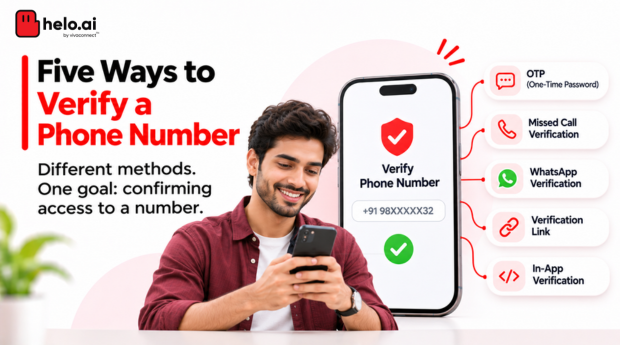
There are several ways to check. Businesses can validate the number's format, send an OTP through SMS or WhatsApp, place an automated voice call, use missed-call verification or explore silent authentication through mobile networks.
Each method checks something different. Some improve contact-data quality. Others help establish whether a user has access to a number or the SIM associated with it.
This guide compares the main phone verification methods, their advantages, limitations and practical use cases.
Phone verification is not one check. Validation checks a number's format, verification shows a user can access the number or its SIM, and authentication decides whether that person may act on an account. Match the method to your users, devices and risk.
- SMS OTP gives the broadest reach but is exposed to delays, SIM swaps and phishing.
- WhatsApp OTP has been open to India since 1 July 2024. Confirm provider support and pricing.
- Missed-call checks on Android are changing: Google Play will stop allowing call-log access for phone-call verification.
- Silent authentication removes code entry but depends on operator and device support.
- NIST SP 800-63B-4 (August 2025) restricts phone-network OTPs, so add risk signals.
What does it mean to verify a phone number?
Phone number verification can involve three different checks:
- Number validation: Does the number follow a valid numbering format and represent a possible number for that country?
- Phone number verification: Can the user demonstrate access to the number or the SIM associated with it?
- User authentication: Is the person trying to access an account authorised to do so?
These checks are not interchangeable.
For example, a number validation service may confirm that a number follows the correct format and belongs to a recognised mobile range. It cannot prove that the person entering it controls that number.
Similarly, entering an OTP demonstrates access to a delivery channel at that moment. It does not establish someone's real-world identity.
5 methods to verify a phone number
1. SMS OTP verification
SMS OTP is one of the most familiar methods of phone verification.
How it works:
- The user enters their mobile number.
- The application generates a one-time password.
- The OTP is sent through SMS.
- The user enters the code.
- The system checks whether the code is correct and still valid.
- Familiar and straightforward for mobile users.
- Does not require a separate messaging application.
- Works across a wide range of basic phones and smartphones.
- Suitable for registrations, login verification and transaction confirmation.
- Delivery depends on mobile network coverage and SMS routing.
- Users may experience delays or fail to receive the message.
- SMS OTP can be exposed to phishing, SIM-swap attacks and number-reassignment risks.
- Repeated OTP requests can increase costs and frustrate users.
SMS OTP is a practical option when broad mobile reach is important, but it should not be treated as a complete fraud-prevention mechanism.
For a deeper explanation of the process, see What Is SMS Verification?.
India-specific consideration: Businesses sending bulk SMS must account for applicable TRAI requirements under TCCCPR, 2018. TRAI's sender guidance covers Principal Entity registration, headers, content templates and the required information passed to telecom service providers. The applicable requirements depend on the message category and sending arrangement. OTP and transactional traffic should not simply be treated as exempt from the framework. For help with headers and templates, see Helo.ai's DLT management service.
2. WhatsApp OTP verification
WhatsApp-based verification uses an authentication message to deliver a one-time code through WhatsApp rather than conventional SMS.
How it works:
- The user enters a phone number.
- The business initiates an authentication message using an eligible, approved template.
- The user receives the verification code.
- The user enters or uses the code to complete verification.
- Uses a messaging application familiar to many customers.
- Provides another potential delivery route alongside SMS.
- Can offer a convenient experience in markets where the required authentication features are supported.
- The user needs access to an eligible WhatsApp account and internet connectivity.
- Authentication messages must follow Meta's template and messaging requirements.
- Availability of authentication features can vary by market and provider.
- It is not a universal replacement for SMS or voice verification.
Important India consideration: Meta's documentation says authentication templates became available in India on 1 July 2024, so businesses can send WhatsApp authentication messages to Indian users. Some provider documentation still lists limits for Indian businesses, and Meta may apply a separate authentication-international rate. Confirm current support, features such as copy code and one tap, and pricing with your provider before you design the journey. Do not assume that a feature available in another market is available on your account.
For setup and trade-offs, see Helo.ai's guides to sending WhatsApp verification codes and WhatsApp vs SMS for OTP.
3. Voice OTP verification
Voice OTP delivers a one-time code through an automated phone call.
How it works:
- The user enters a phone number.
- The system initiates an automated call.
- A recorded voice announces the verification code.
- The user enters the code to complete verification.
- Provides an alternative when SMS delivery fails.
- Can help users who have difficulty receiving or reading text messages.
- Works with phones that can receive voice calls, including some basic devices.
- Can support multiple languages, depending on implementation.
- The user must be able to answer the call.
- Calls may be missed, blocked or diverted to voicemail.
- The experience can be slower than entering an SMS OTP.
- Repeated calls can increase verification costs.
Voice OTP is useful as an alternative channel, particularly when a user cannot complete SMS verification.
4. Missed-call verification
Missed-call verification uses an incoming call to check access to a phone number. In some implementations, the user does not need to answer the call or enter a code.
How it works:
- The user enters their phone number.
- The verification system places an incoming call.
- The application detects the expected call or checks relevant call information.
- The system uses that information to determine whether the verification condition has been met.
The exact implementation varies. For example, WhatsApp's Android registration flow has used call-log and call-management permissions to identify an expected incoming call. This is an example of a specific implementation, not a universal requirement for every missed-call verification system.
- Can avoid manual OTP entry.
- May be convenient for users with limited data connectivity.
- Can reduce steps in supported mobile-app environments.
- May require sensitive phone permissions, depending on implementation.
- Operating-system restrictions can affect availability.
- It may not work consistently across all devices.
- The provider must correctly identify the expected incoming call.
Missed-call verification can be useful in supported applications, but businesses should assess permissions, device compatibility and the user experience before adopting it.
Check Google Play policy first: In its 15 July 2026 policy announcement, Google Play said it will no longer permit account verification via phone call as a use case for the READ_CALL_LOG permission. Google's policy deadlines page lists 27 January 2027. Android apps that read the call log to match an incoming call will need another approach, so ask your provider how it handles this.
5. Silent authentication
Silent authentication, also called Silent Network Authentication, verifies access to a mobile number through supported mobile-network and SIM-related checks without asking the user to enter an OTP.
How it works:
- The user initiates a verification request in an application.
- The application checks whether the required mobile-network connection is available.
- The request is routed through a supported network integration.
- A network-based check determines whether the phone number corresponds to the SIM in the requesting device.
- The application receives the verification result.
- No manual code entry is required.
- Can reduce friction during registration and login.
- Verification can happen in the background.
- Useful for supported devices and mobile networks.
- Usually requires mobile data connectivity rather than a Wi-Fi-only connection.
- Depends on operator and provider coverage.
- Dual-SIM devices and network conditions can complicate verification.
- Requires appropriate carrier and provider integrations.
Silent authentication can offer a smoother experience, but availability must be confirmed with the provider and relevant mobile operators before implementation. It should not be assumed to work across every Indian network.
Number validation vs phone number verification
Number validation is often the first step before sending an OTP. It helps businesses check contact data, but it does not replace verification.
An international numbering standard such as ITU-T E.164 defines how international public telephone numbers are structured. A validation service can use numbering-plan information to check whether a number follows the expected format.
Additional lookup services may provide information about line type, carrier or network status, depending on the country and provider.
Consider the difference:
| Check | What it tells you | What it does not prove |
|---|---|---|
| Format validation | Whether the number follows a recognised numbering format | That the number is active or accessible |
| Line-type lookup | Whether the number is classified as mobile, landline or another type | That a particular person controls it |
| Carrier lookup | Network or operator information | That the user can access the number |
| Network-status lookup | Certain network or activity information, where supported | The identity of the subscriber |
| OTP verification | Whether someone can provide the code sent through a channel | Their real-world identity |
For example, a number can be correctly formatted in international E.164 format but still be inactive or inaccessible. A carrier lookup may return network information, but that is not the same as proving that a user controls the number.
The practical sequence is:
- Validate the number to catch formatting errors.
- Use a lookup where appropriate to obtain available line-type or network information.
- Verify access through an OTP or another supported method when the business needs evidence that the user can access the number.
Phone verification methods compared
| Method | User effort | Main requirement | Best suited for |
|---|---|---|---|
| SMS OTP | Enter a code | SMS connectivity | Broad mobile verification |
| WhatsApp OTP | Receive and enter/use a code | Eligible WhatsApp authentication support and internet | Supported WhatsApp-enabled users |
| Voice OTP | Answer a call and enter a code | Voice connectivity | SMS fallback and voice-accessible users |
| Missed call | Usually no code entry | Supported call detection and permissions | Compatible mobile applications |
| Silent authentication | No manual code entry | Supported SIM and network integration | Low-friction mobile verification |
| Number validation | Usually none beyond submitting the number | Numbering-plan or lookup data | Contact-data quality checks |
There is no single best method for every business. The choice depends on the user's device, network access, application environment, security requirements and the availability of each method in the target market.
How should businesses choose a verification method?
Start with what you need to establish.
- For broad customer reach: SMS OTP is a practical starting point because it does not depend on a particular messaging application.
- For supported WhatsApp markets: WhatsApp authentication can provide another delivery option, subject to current market and provider availability.
- When SMS delivery fails: Voice OTP can offer a useful alternative.
- For supported mobile applications: Missed-call verification may reduce manual effort where the required permissions and operating-system support exist.
- For low-friction mobile verification: Evaluate silent authentication where operator integrations and network coverage are available.
- For cleaning customer databases: Use number validation and, where justified, carrier or network lookups before starting interactive verification.
For fintech and other sensitive applications, the verification method should also reflect the risk of the action being performed.
Fraud controls: Phone verification is only one part of security
A successful phone verification does not automatically mean an account or transaction is safe.
A person may have access to a number without being its original owner. Numbers can be reassigned, SIMs can be swapped, and OTPs can be obtained through phishing or social engineering.
NIST's Digital Identity Guidelines, SP 800-63B-4, published in August 2025, classify PSTN-based out-of-band authentication as restricted within their scope. They also recommend considering signals such as SIM changes, device swaps and number porting when using the telephone network for authentication. These are important security considerations, not a universal legal requirement for every business.
Businesses should combine verification with appropriate controls:
- Rate limiting: Restrict repeated OTP requests and incorrect verification attempts.
- Code expiry: Use short validity periods and prevent code reuse.
- Attempt monitoring: Identify unusual patterns across devices, numbers and accounts.
- SIM and number-change signals: Consider available risk information before sensitive account changes.
- Channel failover: Provide another supported verification route when the primary channel fails.
- Risk-based checks: Apply stronger authentication for sensitive actions rather than relying on a phone number alone.
For high-value accounts and transactions, phone verification should form part of a broader authentication strategy.
How Helo.ai supports phone verification
A verification journey should not depend on a single delivery channel. If an OTP is delayed or a user cannot access one channel, the system needs a suitable alternative.
Helo.ai's Helo Verify generates, delivers and validates verification codes over SMS, email and WhatsApp. It adds SIM binding to tie authentication to a user's registered SIM, and it lists flash calls as a way to reduce authentication costs.
That lets businesses plan verification journeys around channel availability and customer access rather than relying on one delivery route for every user. Confirm which channels and fallbacks fit your flow with the team.
Building a phone verification flow for your application?
Talk to an expert at Helo.ai to explore the right channel mix and failover approach.
Frequently asked questions
How can I verify a phone number?
You can verify access to a phone number using SMS OTP, WhatsApp authentication where supported, voice calls, missed-call verification or silent authentication through supported mobile networks. The right method depends on the device, network and security requirements.
What is the difference between phone number validation and verification?
Validation checks whether a number follows a recognised numbering format and may provide information about its line type or carrier. Verification checks whether a user can demonstrate access to the number through a supported method.
Is SMS OTP enough to verify a user's identity?
No. SMS OTP can demonstrate access to a number at a particular time, but it does not independently establish real-world identity. For sensitive actions, businesses should consider additional authentication and fraud controls.
What is silent authentication?
Silent authentication uses mobile-network and SIM-related information to check whether a phone number corresponds to the SIM in the requesting device. It can avoid manual OTP entry but requires supported operator integrations and mobile connectivity.
Is missed-call verification secure?
It can be useful in supported implementations, but its security depends on how the incoming call is detected and verified. Businesses should assess permissions, device compatibility and possible abuse before relying on it.
Which phone verification method is best for fintech applications?
There is no universal answer. Fintech applications should assess transaction risk, customer access, channel reliability and applicable security requirements. They may combine phone verification with device, SIM-change and other risk signals.
Can you verify a phone number without an OTP?
Yes. Silent authentication and missed-call verification can confirm access to a number without manual code entry in supported environments. Both depend on device, operator and platform support, so many businesses keep an OTP route as a fallback.
Does WhatsApp OTP work in India?
Yes, where your provider and account support it. Meta opened WhatsApp authentication templates to India on 1 July 2024. Features and pricing vary by provider, so confirm both before launch.
Can Android apps still use missed-call verification?
Not by reading the call log for account verification. Google Play announced on 15 July 2026 that it will no longer permit phone-call account verification as a use case for the READ_CALL_LOG permission, and its deadlines page lists 27 January 2027. Ask your provider which approach it uses on Android.
Conclusion
Verifying a phone number is not just about sending an OTP. It starts with understanding what needs to be checked: whether a number is valid, whether a user has access to it or whether the user is authorised to perform a particular action.
SMS, WhatsApp and voice OTP provide code-based verification options. Missed-call verification and silent authentication can reduce manual effort in supported environments. Number validation helps businesses check contact data before beginning the verification process.
The best approach balances customer experience, channel availability and security. For many businesses, that means using more than one method and applying stronger checks when the risk is higher.
Planning a phone verification flow?
Explore Helo Verify for SMS, email and WhatsApp OTP with SIM-binding security.
Disclaimer. This article is general information, not legal, compliance or security advice. Platform rules, operator support and policy deadlines change, so confirm current requirements with your provider and the relevant authority. Reviewed November 2026. Helo.ai is the publisher and offers Helo Verify. Product and company names belong to their owners.