.jpeg)


Travel
A customer booking a flight is offered travel insurance.
E-commerce
Someone buying a smartphone can add device protection at checkout.
Automotive
A vehicle buyer can purchase motor insurance through a dealership.
These offers make insurance easier to access because customers encounter coverage while completing a purchase they already intend to make. For insurers, partnerships with retailers, travel platforms, banks and automotive businesses can create new routes to customers.
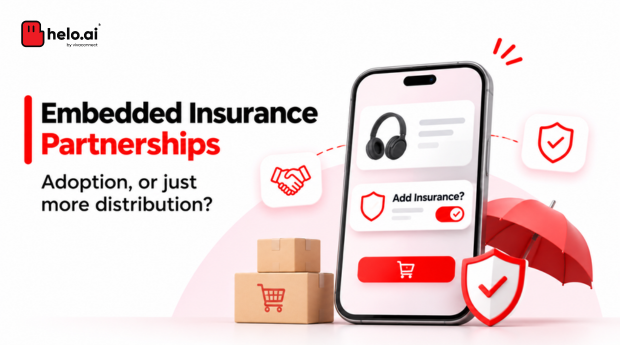
But an important question remains: Are these partnerships helping more people get meaningful insurance coverage, or simply creating more opportunities to distribute policies?
The distinction matters. A policy sold through a partner is a distribution outcome. Whether the customer understands the coverage, keeps the policy active and can use it when needed is a different measure of success.
Embedded insurance places cover inside a purchase journey, which widens distribution. Whether it widens meaningful adoption depends on customer need, understanding, activation, renewal and claims experience, not on policies sold alone.
- PwC India discusses embedded insurance as a potential access model but does not show measured adoption gains.
- IRDAI data shows partner channels matter: corporate agents brought 52.97% of private life insurers' individual new business premium in FY 2024–25. These figures are not embedded-specific.
- Judge each offer on genuine risk, suitability, clear terms and real choice.
- Measure first-time purchases, activation, persistency, claims and complaints, not just policy count.
- Agree who owns servicing, claims guidance and renewals between insurer and partner.
Why embedded insurance is attracting insurers and distribution partners
Embedded insurance places an insurance offer within the purchase or service journey of a non-insurance business. Instead of asking customers to visit a separate insurer's website or speak to an advisor, the coverage is offered where a related need may already exist.
The model can work across several industries:
Travel: Offering travel insurance during flight or hotel bookings.
E-commerce: Providing device protection or extended warranty options when customers purchase electronics.
Automotive: Making motor insurance available through vehicle dealerships.
Banking and lending: Offering eligible insurance products through financial service journeys.
Property and rental platforms: Providing protection for homes or personal belongings during a rental or property application process.
The attraction is not just convenience. Partners already have customer relationships, transaction data and established digital journeys. Insurers can use these relationships to reach potential policyholders without building every customer acquisition channel themselves.
PwC India's report, Insurance for All by 2047, identifies embedded insurance and B2B2C partnerships as distribution models that could improve access to insurance in India. It also points to opportunities in automotive, e-commerce and property-related services.
However, the report discusses the potential of these models. It does not establish that they have already delivered a measurable increase in active or adequately covered policyholders.
That distinction is important when evaluating the opportunity.
India's distribution network is expanding, but embedded adoption is harder to measure
India already has a large network of insurance distribution partners. The Insurance Regulatory and Development Authority of India's (IRDAI) Annual Report 2024–25 provides a useful picture of how these channels are developing.
As of 31 March 2025:
India had 661 active corporate agents, including 237 banks and 424 NBFCs and other eligible entities.
IRDAI Annual Report 2024–25
There were 26,316 registered Motor Insurance Service Providers (MISPs), recognising the role of automotive dealers in distributing and servicing motor insurance.
IRDAI Annual Report 2024–25
Active insurance web aggregators numbered 22. During FY 2024–25, they procured ₹83.43 crore in premiums and issued 3,31,498 policies.
IRDAI Annual Report 2024–25
The report also shows that corporate agents contributed 52.97% of the individual new business premium procured by private life insurers during FY 2024–25.
IRDAI Annual Report 2024–25
These figures demonstrate the importance of partner-led distribution in the Indian insurance market. But they should not be mistaken for embedded insurance adoption figures.
Corporate agents include several types of intermediaries, and their contribution is not limited to embedded journeys. Similarly, web aggregators and MISPs represent specific distribution arrangements, not a complete measure of insurance embedded across digital platforms.
The available public data does not consistently isolate how many policies originated from embedded offers, how many customers were purchasing insurance for the first time, or how many of those policies remained active.
This creates a measurement challenge. Insurers can report growth in partner-generated premiums and policies, but those numbers alone cannot establish whether embedded partnerships are expanding meaningful insurance coverage.
The real test is whether the product meets a genuine customer need
An insurance offer is more likely to be useful when it is connected to a risk the customer can recognise.
For example, travel insurance offered during an international trip booking has an understandable connection to the purchase. Device protection offered with an expensive smartphone may also be relevant to the buyer.
But relevance cannot be assumed simply because the offer appears at the right moment.
An insurer and its distribution partner need to consider:
- Does the coverage address a genuine risk associated with the purchase?
- Is the policy suitable for the customer's circumstances?
- Are the premium, benefits and exclusions clearly explained?
- Does the customer already have similar coverage?
- Can the customer make a genuine choice rather than feeling pressured to add the policy?
This is particularly important when insurance is presented as a small addition to a larger transaction. Customers may focus on completing the purchase and overlook important policy conditions.
IRDAI's Protection of Policyholders' Interests, Operations and Allied Matters of Insurers Regulations, 2024 reinforce the need for transparent solicitation and informed purchase decisions. The framework also addresses mis-selling, including misleading information, concealment of exclusions and failure to take reasonable care in assessing suitability.
IRDAI's Annual Report 2024–25 also flagged rising mis-selling complaints, according to Insurance Business. These counts cover insurers generally and are not specific to embedded journeys.
unfair business practices grievances against life insurers in FY 2024–25, up from 23,335 in FY 2023–24
IRDAI Annual Report 2024–25, as reported by Insurance Business
A convenient purchase journey should therefore make relevant protection easier to access without making the terms harder to understand.
A successful sale must be followed by a useful policy experience
The customer relationship does not end when the insurance premium is paid.
After purchase, customers may need their policy documents, confirmation of coverage, information about exclusions, servicing assistance, renewal reminders or guidance on making a claim.
This becomes more important in embedded partnerships because the customer may interact with one brand during purchase and another when seeking insurance support.
Consider a customer who purchases travel insurance through a booking platform. If a trip is cancelled, the customer needs to know whether the policy covers the situation, which documents are required and where to submit the claim.
Similarly, someone who purchases device protection through an e-commerce platform should be able to find the claims process when the device is damaged.
If customers struggle to access these details, the convenience of the original purchase loses value.
The insurer and distribution partner should establish clear responsibilities for:
Policy issuance and document access.
Customer queries and servicing requests.
Claims information and guidance.
Renewal and cancellation communication.
Complaint handling and escalation.
Policy documents, renewal reminders and claims guidance can reach customers by WhatsApp, SMS or Email, where they have agreed to receive them.
This is also where insurers need to consider the quality of the relationship after acquisition.
In its 2026 analysis, The Relationship Dividend: Rewiring India's Insurance Growth Engine, PwC India highlights the limitations of a purchase-led customer relationship. It describes a common experience in which customers buy a policy, hear little from the insurer until renewal and then compare alternatives largely on price.
The broader lesson applies to embedded distribution too: acquiring a customer through a partner is only the beginning. Insurers still need to build trust and demonstrate value throughout the policy lifecycle.
PwC's analysis adds two figures on what happens after the sale.
individual life policies lapsed in FY 2024–25, as reported by PwC India
PwC India, July 2026 (reported)
the authors say retention is 3–5 times more cost-effective than acquisition
PwC India, July 2026. Authors' estimate.
Keeping customers informed after the sale?
Read about Helo.ai's insurance solutions, or talk to the team about policy, renewal and claims communication.
What should insurers measure beyond policies sold?
Measuring embedded insurance only through policy count, premium collected or partner-generated revenue can create an incomplete picture.
A stronger approach is to evaluate the journey from the first offer to the customer's experience after purchase.
| Measure | What it reveals |
|---|---|
| Offer-to-purchase conversion | Whether customers find the offer relevant enough to select |
| First-time insurance purchases | Whether the partnership is reaching customers who were previously uninsured |
| Policy issuance and activation | Whether accepted offers successfully become active coverage |
| Customer understanding | Whether customers understand benefits, exclusions and conditions |
| Persistency and renewal | Whether customers continue coverage where renewal applies |
| Claims experience | Whether customers can access the protection they purchased |
| Complaints and cancellations | Whether the product or purchase journey is creating confusion or dissatisfaction |
| Partnership economics | Whether acquisition, integration and servicing costs make the arrangement sustainable |
These measures should be compared across partners and product categories. A travel insurance partnership may perform differently from a device protection programme or a motor insurance arrangement.
Insurers should also examine whether partner-generated policies represent genuinely additional customers or simply shift existing customers from one distribution channel to another.
Shifted route
For example, if a customer who would have purchased motor insurance directly now buys it through a dealership, the partnership may have changed the distribution route without expanding overall coverage.
Additional adoption
By contrast, if a customer who previously had no suitable protection purchases and maintains an appropriate policy through the partner, that is a stronger indication of additional adoption.
The distinction can only be established through customer-level and policy-level data, not sales volumes alone.
The regulatory and commercial structure matters
Embedded insurance partnerships involve more than integrating an offer into a website or app. The distribution arrangement must operate through the appropriate authorised entities and comply with applicable insurance regulations.
IRDAI's framework recognises different intermediary arrangements, including corporate agents and Motor Insurance Service Providers. For example, the regulator's annual report describes MISPs as a way to recognise and oversee the role of automotive dealers in distributing and servicing motor insurance.
Note: This matters because the distribution partner's role, responsibilities and permissions must be clear. The insurer remains accountable for its regulated insurance obligations, while the partner must operate within the scope of its authorised arrangement.
The commercial structure also needs to work for both sides.
Insurers need to consider partner commissions, technology integration, customer acquisition costs, servicing responsibilities and claims support. Distribution partners need a product that fits their customer journey without creating avoidable friction or damaging customer trust.
A partnership that generates high initial sales but creates confusion, complaints or poor renewal outcomes may not remain commercially attractive over time.
Conclusion: Distribution creates access, but customer outcomes establish value
Embedded insurance gives insurers an opportunity to reach customers through businesses and platforms they already use. India's growing network of corporate agents, automotive distribution partners and digital intermediaries shows that partner-led distribution has an established role in the market.
But the evidence needs to be interpreted carefully. Growth in distribution channels, policies issued or premiums collected does not automatically prove that embedded partnerships are increasing meaningful insurance adoption.
The stronger test is whether these partnerships reach customers who genuinely need coverage, help them make informed decisions and support them after the policy is issued.
Insurers should therefore look beyond the number of policies sold. First-time purchases, policy activation, persistency, claims experience, complaints and customer understanding offer a more complete view of whether the model is delivering value.
Embedded insurance will create lasting value when it does more than place policies inside existing transactions. It must make relevant protection easier to access, understand and use.
Planning post-sale communication for partner-led policies?
Tell the Helo.ai team about your policy journeys and channels, and they can help you plan how customers are kept informed.
Frequently Asked Questions
What is embedded insurance?
Embedded insurance offers cover inside the purchase or service journey of a non-insurance business, such as travel insurance at flight booking or device protection at checkout. PwC India describes it as a model where insurance is offered at the point of sale of another product or service.
How do embedded insurance partnerships work?
An insurer works with a retailer, travel platform, bank or dealership that offers its policy within the partner's customer journey. The arrangement must run through appropriately authorised entities, such as corporate agents or Motor Insurance Service Providers in India, and the insurer remains accountable for its regulated obligations.
What are the benefits of embedded insurance for insurers?
Partners already have customer relationships, transaction data and digital journeys, so insurers can reach potential policyholders without building every acquisition channel. The benefit is real only when customers understand the cover, keep it active and can claim on it.
How can insurers measure embedded insurance adoption?
Look beyond policies sold. Track offer-to-purchase conversion, first-time purchases, issuance and activation, customer understanding, persistency, claims experience, complaints and partnership economics. Customer-level and policy-level data are needed to separate new customers from shifted ones.
What challenges do insurers face with embedded insurance?
Public data does not consistently isolate embedded policies, first-time buyers or active policies. Other challenges include poorly explained or unsuitable offers, unclear servicing responsibilities between insurer and partner, and partnership economics that depend on commissions and servicing costs.
How does embedded insurance improve customer experience?
It can when the cover is relevant to the purchase, the terms are clear, and customers can easily find policy documents, servicing and claims guidance afterwards. If they cannot, the convenience of the original purchase loses value.
Note. This article is an editorial guide and general information, not legal or financial advice. Regulations, figures and reports change, so confirm current requirements with IRDAI and your advisers. Helo.ai is a CPaaS provider and publishes this guide. Facts were checked on 13 November 2026.