.jpeg)


For Indian B2C brands, email marketing is more than sending promotional offers. It helps businesses introduce products, build customer relationships, share updates and encourage repeat purchases.
But an effective email marketing strategy needs the right audience, relevant content and a clear understanding of when to use other channels.
Here's how to build one.
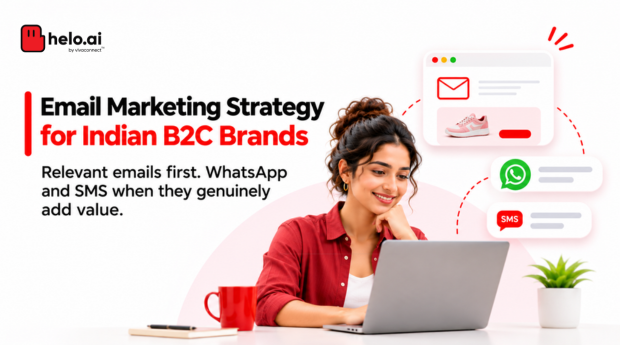
A good email marketing strategy for Indian B2C brands starts with one clear objective per campaign and a permission-based, segmented list. Measure clicks and conversions, not opens alone. Use WhatsApp or SMS only when the message, the customer's preference and their permission support it.
- Match each email to one objective: awareness, sales, recovery, retention, engagement or support.
- Segment by purchase history and product interest, and keep marketing permission separate from transactional messages.
- There is no universal best send time. Test morning, afternoon and evening windows with comparable audience groups.
- WhatsApp business-initiated messages need approved templates, and commercial SMS in India must follow TRAI rules.
- Google requires SPF or DKIM for all senders to Gmail and recommends a spam rate below 0.1%.
Start with a clear objective
Every email campaign should have a purpose. Decide what you want customers to do before creating the email.
| Objective | Email campaign | Example |
|---|---|---|
| Build awareness | Welcome email | Introduce your brand |
| Generate sales | Promotional email | Announce a festive sale |
| Recover sales | Abandoned-cart email | Remind customers about their cart |
| Improve retention | Product recommendations | Suggest relevant products |
| Build engagement | Newsletter | Share updates and useful content |
| Support customers | Confirmation email | Confirm an order or registration |
Avoid treating every email as a sales opportunity. Match the message to the customer's needs.
Build and segment your email list
A relevant email list is more valuable than a large list of uninterested contacts.
You can grow your email list through:
- Website signup forms and newsletters.
- Optional checkout subscriptions.
- Loyalty programmes.
- Downloadable guides and other useful resources.
- QR codes at retail stores and events.
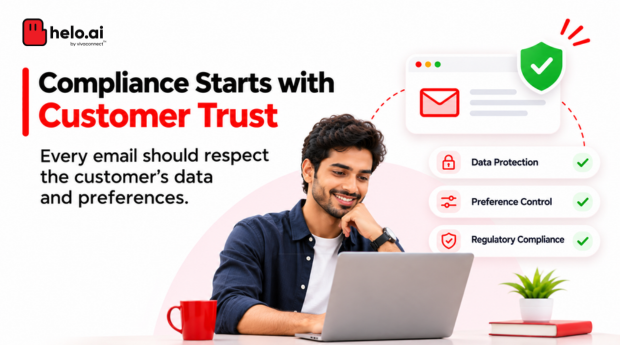
Collect only the information you need and clearly explain what subscribers will receive. Keep marketing permissions separate from essential transactional communication.
India's DPDP Rules were notified in November 2025. Their notice and consent standards take effect on 13 May 2027, so design consent capture and records now.
Once your list grows, segment it to make campaigns more relevant.
| Customer segment | Relevant communication |
|---|---|
| New subscribers | Welcome emails |
| First-time buyers | Product guidance |
| Repeat customers | Recommendations and loyalty offers |
| Inactive customers | Re-engagement emails |
| Cart abandoners | Cart reminders |
Even basic segmentation based on purchase history and product interest can improve campaign relevance.
Use different email campaigns
A good email marketing strategy includes different campaigns across the customer lifecycle.
- Welcome emails: Introduce your brand and explain what subscribers can expect.
- Promotional emails: Share product launches, offers and seasonal campaigns. Keep the offer and CTA clear.
- Abandoned-cart emails: Remind customers about products they left behind. Include a direct link to their cart.
- Product recommendations: Suggest products based on relevant interests or previous purchases.
- Re-engagement emails: Reach out to inactive subscribers with relevant updates or preference options.
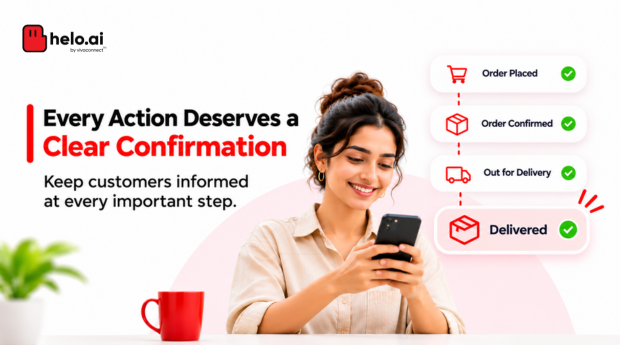
- Confirmation emails: Confirm orders, payments, registrations or appointments.
- Sales follow-up emails: Respond to customer interest with useful information and a clear next step.
A simple marketing email format
Most marketing emails can follow this structure:
- Subject line: Give the reader a reason to open.
- Preview text: Add useful context.
- Opening: Introduce the message.
- Main content: Explain the offer or information.
- CTA: Make the next action clear.
- Footer: Include contact details and an unsubscribe option.
For example, a confirmation email should clearly state what was confirmed, provide the relevant reference details and explain what happens next.
Keep emails easy to read on mobile. Avoid clutter, excessive offers and multiple competing CTAs.
Find the right time and frequency
What is the best time to send an email? There is no universal answer.
Your audience, product category and campaign objective all influence email timing.
You can start by testing different windows:
| Time | Suggested test |
|---|---|
| Morning | 8 AM–10 AM |
| Afternoon | 12 PM–2 PM |
| Evening | 6 PM–9 PM |
These are testing windows, not guaranteed best times. Test different days and timings with comparable audience groups. Evaluate clicks and conversions, not just opens.
The same applies to email newsletters. Use your campaign data to understand when subscribers are most responsive.
Also plan frequency carefully. A monthly calendar might include a newsletter, a product campaign, a promotional email and a customer engagement update. Adjust the schedule based on customer preferences and results.
Use WhatsApp and SMS when they make more sense
Email works well for detailed information, newsletters and product discovery. WhatsApp and SMS can support communication when another channel is more suitable.
| Channel | Suitable communication |
|---|---|
| Newsletters, offers and detailed product information | |
| Relevant reminders and customer conversations | |
| SMS | Short, time-sensitive updates |
For example, a retail brand launching a festive collection could:
- Send an email with product images and collection details.
- Share a relevant WhatsApp update with customers who have opted in.
- Use SMS for suitable time-sensitive information.
Do not automatically send a WhatsApp or SMS message every time an email goes unopened. Choose the channel based on the message, customer preference and permission.
Important: WhatsApp business-initiated messages require approved templates. Free-form replies are allowed within the 24-hour customer service window after a customer's message. Commercial SMS in India must follow applicable TRAI requirements, including sender registration, headers, content templates and consent or preference rules.
For more detail, read our guide to WhatsApp Marketing Strategy.
Measure campaign performance
Track metrics that reflect the purpose of each campaign.
| Metric | What it measures |
|---|---|
| Delivery rate | Emails accepted for delivery |
| Bounce rate | Emails that could not be delivered |
| Click-through rate | Recipients clicking links |
| Conversion rate | Recipients completing the intended action |
| Unsubscribe rate | Recipients opting out |
| Spam complaint rate | Emails reported as unwanted |
Also maintain good deliverability practices:
- Send to appropriately subscribed contacts.
- Remove invalid email addresses.
- Configure SPF, DKIM and DMARC.
- Include working unsubscribe options.
- Monitor bounce rates and spam complaints.
Google requires SPF or DKIM authentication for all senders. Bulk senders sending more than 5,000 messages per day to Gmail accounts have additional requirements, including SPF, DKIM, DMARC and one-click unsubscribe for relevant marketing messages.
Google also recommends keeping the user-reported spam rate below 0.1% and never letting it reach 0.3%. See the Google sender guidelines FAQ.
For more on engagement challenges, read Why Customers Ignore Marketing Emails.
Choose the right email marketing tool
The best tool for email marketing depends on your business requirements.
Before choosing one, consider:
- Email creation and automation.
- Contact and sending limits.
- Segmentation and personalisation.
- Campaign analytics.
- Integrations with your existing systems.
- Support for other communication channels.
If your business uses email alongside WhatsApp and SMS, an omnichannel platform can help bring communication activities together.
Helo.ai offers email as part of its wider communication platform, alongside WhatsApp, SMS, RCS and Voice. Helo Inbound lets teams manage conversations across SMS, WhatsApp and email from a single platform.
Want to explore how email fits into your wider communication strategy?
Talk to the Helo.ai team about how your channels fit together.
Frequently asked questions
What is a good email marketing strategy for B2C brands?
Build a permission-based list, segment customers, send relevant campaigns and measure conversions. Improve your approach using campaign results.
How often should businesses send marketing emails?
There is no fixed frequency. Start with a manageable schedule and adjust it based on customer preferences and engagement.
What is the best time to send emails in India?
Test morning, afternoon and evening windows. Your own audience data is more useful than a universal timing recommendation.
How can I build an email list?
Use website forms, optional checkout subscriptions, loyalty programmes, QR codes and useful downloadable resources.
Should WhatsApp and SMS be used as email fallback channels?
They can support email when the message requires another channel and the customer has the appropriate permissions. Do not automatically duplicate every email across channels.
Do marketing emails need an unsubscribe option?
Yes. Include a working unsubscribe option in every marketing email. Google also requires one-click unsubscribe for marketing messages from bulk senders sending more than 5,000 messages a day to Gmail accounts.
What spam complaint rate should B2C brands stay under?
Google recommends keeping the user-reported spam rate below 0.1% and never letting it reach 0.3% or higher.
Final takeaway
A strong email marketing strategy is not about sending more emails. It is about sending relevant messages to the right customers at the right time.
Build a quality list, understand customer behaviour, plan useful campaigns and use WhatsApp or SMS when they genuinely add value.
Planning email alongside WhatsApp and SMS?
Explore Helo.ai email and Helo Inbound to manage email with your other channels.
Disclaimer. This article is general information, not legal or technical advice. Consent, messaging and platform rules change, so confirm current requirements with your legal adviser, Google, Meta and your messaging provider. Reviewed 12 November 2026. Helo.ai is the publisher and offers email and messaging products. Product and company names belong to their owners.