.jpeg)
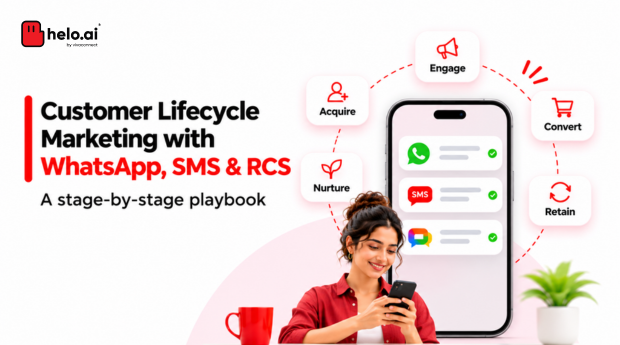


A customer discovering your brand for the first time needs a different message from someone who has already purchased from you.
Yet many businesses continue sending the same promotions and updates to both.
Customer lifecycle marketing helps solve this problem. It allows businesses to communicate based on where customers are in their relationship with the brand.
WhatsApp, SMS and RCS offer different ways to manage these interactions.
This guide explores the key marketing life cycle stages, the messages that work at each stage and how businesses can build a more relevant communication strategy.
Customer lifecycle marketing means sending each customer the message that fits their stage with your brand. Use WhatsApp, SMS and RCS for what each does best, and measure every stage against its own goal.
- Six stages: awareness, consideration, conversion, onboarding, retention, and loyalty and advocacy. Businesses can adapt them.
- WhatsApp suits conversations, SMS suits alerts, confirmations and OTPs, and RCS suits rich product discovery.
- Segment by behaviour, give each stage one objective, plan timing and frequency, and track stage-specific metrics.
- Check opt-in rules for WhatsApp, DLT registration for commercial SMS in India, and RCS availability by device and carrier.
- Helo.ai is a CPaaS provider and publishes this guide, so weigh its section accordingly.
What are the stages of customer lifecycle marketing?
Customer lifecycle marketing focuses on engaging customers as their relationship with a business develops.
A practical framework includes six stages:
- Awareness
- Consideration
- Conversion
- Onboarding
- Retention
- Loyalty and advocacy
These stages are not a fixed formula. Some businesses combine stages or use different models depending on their industry, products and customer behaviour.
The objective remains the same: communicate according to what customers need at that point in their relationship with the brand.
The six stages: A WhatsApp, SMS and RCS messaging playbook
Each stage below shows what the customer is thinking, what to communicate, which channel suits it and an example message. For a WhatsApp-only view, read Helo.ai's WhatsApp marketing funnel guide.
Stage 1: Awareness – Introduce your brand
Customer mindset: "What does this brand offer?"
Customers are discovering your business. They may have seen an advertisement, visited your website or come across your products for the first time.
Marketing objective: Build awareness and encourage further exploration.
What to communicate:
- Brand and product introductions.
- New collection announcements.
- Product highlights.
- Relevant introductory offers.
Choosing the channel:
Showcase products through rich cards, images and carousels.
Share a short introduction with a link to your website.
Invite interested customers to start a conversation through a website, advertisement or other entry point.
"Meet our latest collection! Explore new arrivals and find something that fits your style."
Stage 2: Consideration – Help customers evaluate
Customer mindset: "Is this the right choice for me?"
Customers are exploring products, comparing options and looking for information before making a decision.
Marketing objective: Answer questions and reduce purchase hesitation.
What to communicate:
- Product details and demonstrations.
- Pricing and available options.
- Customer reviews.
- Frequently asked questions.
- Relevant product comparisons.
Choosing the channel:
Answer product questions and share relevant information through conversations.
Present product features and comparisons using rich cards.
Send a short follow-up linking to a product page or brochure.
"Looking for the right laptop? Explore the features, compare available models and find one that suits your needs."
Stage 3: Conversion – Encourage the purchase
Customer mindset: "Should I complete my purchase?"
The customer has shown purchase intent but hasn't completed the transaction.
Marketing objective: Help customers take the next step.
What to communicate:
- Abandoned-cart reminders.
- Relevant promotional offers.
- Product availability updates.
- Purchase links.
- Clear information about the next step.
Choosing the channel:
Send a relevant cart reminder or help resolve purchase-related questions.
Display selected products with a direct shopping action.
Send a concise reminder with a purchase link.
"Your selected items are still in your cart. Complete your purchase whenever you're ready."
Stage 4: Onboarding – Make the first experience count
Customer mindset: "What happens after I sign up or purchase?"
The customer has completed a purchase or registration. Now they need to understand what happens next.
Marketing objective: Help customers get started and make their first experience easier.
What to communicate:
- Welcome messages.
- Order and registration confirmations.
- Account or service information.
- Product usage instructions.
- Setup guidance and next steps.
Choosing the channel:
Send order confirmations, OTPs and important transactional updates.
Share welcome information, product guidance and support options.
Present visual instructions or interactive next steps where supported.
"Welcome aboard! Your registration is complete. Follow these steps to get started."
Stage 5: Retention – Give customers a reason to return
Customer mindset: "Why should I choose this brand again?"
The first purchase is complete, but the relationship shouldn't end there. Businesses need to stay relevant without overwhelming customers.
Marketing objective: Encourage repeat purchases and continued engagement.
What to communicate:
- Replenishment reminders.
- Relevant recommendations.
- New product announcements.
- Loyalty rewards.
- Personalised offers.
Choosing the channel:
Share relevant recommendations and loyalty updates.
Send short, timely reminders.
Showcase new products and promotions through rich media.
"Running low on your favourite products? Explore your previous purchases and reorder with ease."
Stage 6: Loyalty and advocacy – Build lasting relationships
Customer mindset: "I enjoy this brand. What else can I get from it?"
Customers who repeatedly choose your brand may be more interested in exclusive benefits and willing to recommend it to others.
Marketing objective: Reward loyalty and encourage recommendations.
What to communicate:
- Exclusive membership benefits.
- Birthday rewards.
- Early access to new launches.
- Referral invitations.
- Feedback and review requests.
Choosing the channel:
Share membership benefits and referral invitations.
Send concise reward and benefit notifications.
Showcase exclusive offers and member benefits through rich content.
"Thank you for being a valued customer! Enjoy your exclusive member benefits and share the experience with a friend."
WhatsApp vs SMS vs RCS: Which channel should you use?
Each channel has a different strength. The right choice depends on the message, customer preference, availability and communication objective.
| Channel | Best suited for | Key advantage |
|---|---|---|
| Conversations, reminders, offers and customer updates | Two-way conversational engagement | |
| SMS | Alerts, confirmations, OTPs and short reminders | Direct text communication |
| RCS | Product discovery, promotions and interactive messages | Rich media, branded experiences and suggested actions |
Consider a retailer launching a new collection:
- It could use RCS to showcase products through a carousel.
- It could use SMS to share a short announcement and shopping link.
- It could use WhatsApp to answer customer questions and share relevant recommendations.
The channels should complement one another rather than compete for the same message.
A note on availability: RCS features depend on supported devices, operating systems and carrier availability. SMS fallback can be configured where supported, but businesses should verify that their messaging provider and routing setup support it.
SMS fallback delivers a message as plain SMS when the recipient cannot receive the RCS version. Helo.ai's glossary page on RCS SMS fallback notes that it is not a guarantee of delivery and depends on the RCS partner, campaign setup, carrier and market. For the basics, read Helo.ai's guide to what RCS messaging is.
Check these channel rules before you send
Rules and prices differ by channel and change often. These points were checked on 13 November 2026.
- Meta says businesses can only message users who have opted in.
- Template messages fall into marketing, utility and authentication categories.
- From 1 October 2026, Meta charges for utility templates sent inside an open customer service window. They were free until 30 September 2026.
- Messages sent in the free entry point window, which opens when a customer starts a chat from a click-to-WhatsApp ad, are not charged.
Source: Meta pricing documentation
SMS in India
- Commercial SMS needs DLT registration of your entity, headers and templates.
- Messages are sent against registered templates, so plan templates for every lifecycle stage.
Sources: Plivo DLT guide and Helo.ai's promotional SMS guide.
RCS
- Features depend on devices, operating systems and carriers.
- In India, operators set commercial RCS pricing. Inc42 reported that Jio changed its business RCS rates for iPhone users from 1 September 2026.
- Confirm current rates and iPhone availability with your provider.
Source: Inc42, 9 September 2026 (reported).
India's DPDP Rules make notice and consent standards effective from 13 May 2027. Keep a record of when and how each customer agreed to hear from you.
How to build an effective lifecycle messaging strategy
Understanding the stages is only the beginning. Businesses also need a clear plan for deciding which customers receive which messages.
Here are five steps to get started.
1. Segment customers by behaviour
Group customers based on actions such as registrations, purchases, browsing activity, purchase frequency and inactivity.
For example, first-time buyers and repeat customers should not automatically receive the same campaign.
2. Define one objective for every stage
A welcome message should help a new customer get started. A retention campaign should encourage an existing customer to return.
Give every communication a clear purpose.
3. Match the message to the right channel
Consider the type of information, customer preference, consent and channel availability.
A detailed product conversation may work better on WhatsApp, while a short confirmation may be more appropriate for SMS.
4. Plan timing and frequency
A relevant message can still become irritating if it arrives too often.
Set communication intervals, avoid unnecessary follow-ups and respect customer preferences and opt-out requests.
5. Measure performance
Track metrics that match the objective of each stage.
| Lifecycle objective | Metrics to track |
|---|---|
| Awareness | Reach, clicks and website visits |
| Consideration | Product enquiries and engagement |
| Conversion | Purchase and conversion rate |
| Onboarding | Activation and completion rate |
| Retention | Repeat purchase and retention rate |
| Loyalty | Redemption, referrals and active membership |
Review these results regularly to understand which messages are working and where communication needs improvement.
Planning lifecycle messaging across channels?
Read the Enterprise Messaging Playbook on channel strategy, cost and delivery, or talk to the Helo.ai team about your lifecycle stages.
Managing lifecycle communication through one platform
As businesses grow, managing WhatsApp, SMS and RCS campaigns through separate tools can become difficult.
Different teams may use different systems, making it harder to coordinate communication, manage customer segments and review campaign performance.
A centralised communication platform can help bring these activities together.
Helo.ai supports businesses with:
- Omnichannel broadcasts: Manage WhatsApp, SMS and RCS campaigns through one console.
- Customer segmentation: Organise audiences for more relevant communication.
- Channel fallback: Configure fallback between supported channels where required.
- Campaign analytics: Monitor delivery and campaign performance.
For example, a business can create a campaign for customers who haven't purchased recently, segment the audience, select an appropriate communication channel and monitor the campaign results.
The goal is to make lifecycle communication easier to manage and more consistent across channels.
Campaign sends run through Helo Broadcast, which lists SMS, WhatsApp, RCS and Email. The scope for segmentation, fallback and reporting depends on your setup, so confirm it with the team for your use case.
Want to bring your lifecycle communication together?
Talk to an expert at Helo.ai to explore omnichannel broadcasts, segmentation and analytics for your business.
Making every stage of the customer lifecycle count
Customer lifecycle marketing isn't about sending more messages. It's about sending communication that makes sense at the right time.
A new customer needs information. Someone considering a purchase needs clarity. An existing customer needs a reason to return.
WhatsApp, SMS and RCS give businesses different ways to support these interactions.
When communication is planned around customer behaviour, supported by relevant segmentation and measured consistently, businesses can build stronger relationships throughout the customer lifecycle.
The goal is simple: move beyond one-time campaigns and make every customer interaction more relevant.
Frequently Asked Questions
What is customer lifecycle marketing?
Customer lifecycle marketing is communicating with customers based on where they are in their relationship with a brand. A first-time visitor, a buyer and a loyal customer each receive a different message.
What are the main marketing life cycle stages?
A commonly used model includes awareness, consideration, conversion, onboarding, retention, and loyalty and advocacy. Businesses can adapt these stages to their requirements.
What is the difference between customer lifecycle marketing and customer journey mapping?
Customer lifecycle marketing focuses on communicating with customers at different stages of their relationship with a brand. Customer journey mapping identifies and visualises customer touchpoints and interactions.
How can WhatsApp support customer lifecycle marketing?
WhatsApp can support welcome messages, product enquiries, purchase reminders, customer updates, loyalty communication and other relevant interactions. Businesses must follow applicable WhatsApp messaging policies and customer communication preferences.
Why should businesses use SMS and RCS alongside WhatsApp?
SMS provides direct text communication, RCS supports rich and interactive messaging, and WhatsApp enables conversational engagement. Using multiple channels can help businesses reach customers through suitable communication methods.
How do you measure customer lifecycle marketing performance?
Businesses can track clicks, conversions, activation, repeat purchases, customer retention, loyalty redemptions and referrals to measure performance across different stages.
Do customers need to opt in before a business messages them?
For WhatsApp, Meta says businesses can only message users who have opted in. Commercial SMS in India needs DLT registration, and DPDP notice and consent standards apply from 13 May 2027. Keep records of how each customer agreed.
What happens if a customer's phone cannot receive RCS?
The message can be sent as plain SMS if your provider and campaign setup support SMS fallback. Fallback is not a guarantee of delivery, so check it with your provider before relying on it.
Disclaimer. This article is an editorial guide and general information, not legal or financial advice. Channel rules, prices and availability change, so confirm current requirements with your advisers and providers. Helo.ai is a CPaaS provider and publishes this guide. Facts about Meta, DPDP and Jio's RCS rates were checked on 13 November 2026. Product and company names belong to their owners.