.jpeg)
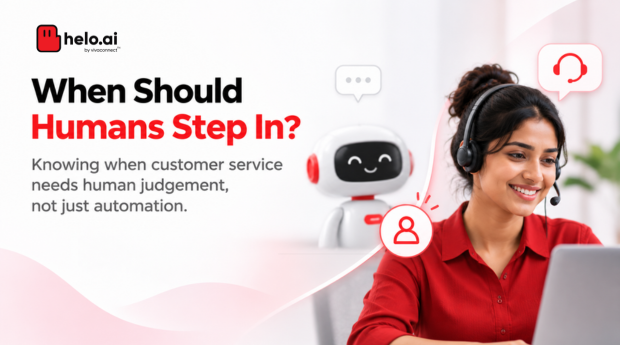


Keep interactions human-led when customers are distressed, decisions carry serious consequences, complaints are complex or a customer asks for a person. Routine, predictable tasks can be automated. In Capgemini's 2026 survey, 66% of customers ranked human support among their top three channels.
Human-led customer service keeps a trained person responsible for understanding and resolving the issue, with automation supporting the work.
Imagine a customer contacting their bank because a fraudulent transaction has affected their account.
An automated system can verify their identity, register a complaint and explain the next steps. But the customer is anxious, needs reassurance and wants someone to take responsibility.
The technology may be capable of handling the entire interaction. But should it?
As AI-powered customer service becomes more capable, businesses face a different question. Instead of asking what can be automated, they need to decide what should be automated.
Routine enquiries can benefit from speed and efficiency. But situations involving emotional distress, significant consequences, complex complaints or personal vulnerability require something more: human judgement, context and accountability.
1. When customers are distressed or emotionally vulnerable
Not every customer interaction is simply about getting information.
A disputed insurance claim, an unexpected financial problem or the loss of an essential service can create considerable stress. Customers in these situations may need reassurance, patience and an understanding of their circumstances.
The report’s findings reinforce the continuing importance of human support, particularly in industries where customer interactions can involve sensitive or consequential situations.
Automation can acknowledge a concern, collect information and route a case. But customers should have access to a trained person when they need emotional support or individual attention.
Source: Capgemini Research Institute, Reimagining Customer Experience: Human-led, AI-powered, 2026
2. When a decision can significantly affect a customer's life
Some interactions involve money, health, legal rights or access to essential services.
Examples include:
- Disputes involving significant financial transactions.
- Complex insurance claim decisions.
- Loan difficulties and repayment-related concerns.
- Healthcare billing and access-related decisions.
- Disconnection of essential services.
- Complaints involving potential financial or personal harm.
Automation can collect documents, retrieve records and help identify missing information. But decisions with serious consequences need appropriate human oversight, clear accountability and a way for customers to challenge the outcome.
The UK's Competition and Markets Authority guidance on using AI agents makes an important point: businesses remain responsible for how their AI agents interact with consumers. Consumer protection obligations do not disappear when an automated system handles an interaction.
The CMA published the guidance on 9 March 2026. It says that if an AI agent a business uses does something illegal, the business is responsible.
Although this guidance relates to UK consumer law, the broader business lesson is relevant across industries: using automation does not transfer responsibility away from the organisation.
Source: UK Competition and Markets Authority, Complying with Consumer Law When Using AI Agents
3. When complaints and unusual requests require human judgement
A customer complaint rarely follows a predictable sequence.
One customer may be unhappy about a delayed delivery. Another may have received the wrong product, experienced repeated service failures and already contacted support several times.
An automated system can categorise complaints, retrieve previous interactions and suggest possible resolutions. But cases involving repeated failures, conflicting information, unusual requests or exceptions may require someone to investigate and decide what happens next.
The same applies when a customer's situation does not fit a standard workflow.
A telecom customer may report a billing issue that is actually connected to a service disruption. A bank customer may report an unfamiliar transaction that requires investigation across multiple accounts.
A 2026 meta-analysis in Psychology & Marketing examined how customers perceive automated and human agents across different tasks and risk levels. Its analysis included 1,191 effect sizes.
The authors are Sandra Miederer, Katja Gelbrich, Holger Roschk and Masoumeh Hosseinpour. The abstract reports that functional or psychological risk largely weakens the negative perceptions of automated agents. Social risk strengthens them for warmth and competence.
The findings examine how task-related risk influences perceptions of automated versus human agents. They support a more careful approach to automation: suitability depends on the nature and consequences of the interaction, not simply on whether the technology can perform it.
The distinction is between processing a complaint and actually resolving it.
4. When customers need an explanation or want to speak to a person
Customers should not be left navigating an automated loop when they disagree with an outcome.
This is particularly important when an automated system has rejected a request, flagged a transaction, applied a penalty or denied a claim.
Customers need to understand why a decision was made, what information was considered and how they can request a review.
Businesses should also respect a customer's request to speak to a person. They may have already tried self-service, may not trust the automated response or may simply find it easier to explain their situation to someone.
Automation can retrieve records and explain standard policies. However, there should be a clear route to human assistance and review, particularly when decisions have meaningful consequences.
5. What should businesses automate, and what should remain human-led?
Not every interaction needs the same level of human involvement. Businesses should evaluate tasks based on complexity, customer impact and the consequences of an incorrect response.
A practical model has three levels:
Fully automated
Order status, appointment reminders, routine FAQs and basic account information
Recommended approach
Automate predictable tasks with appropriate verification
AI-assisted, human-reviewed
Complex complaints, unusual requests, disputed transactions and exceptions
Recommended approach
Use AI to gather information and assist, with human review where needed
Human-led
Emotionally sensitive conversations, urgent vulnerability situations and high-impact decisions
Recommended approach
Keep a trained person involved in understanding and resolving the issue
This is an operational framework, not a universal legal classification. The appropriate level of human involvement will depend on the industry, regulatory requirements and potential consequences for the customer.
Before automating an interaction, ask:
- Could a wrong answer harm the customer financially or personally?
- Is the customer likely to be distressed or vulnerable?
- Can the customer challenge the outcome?
- Is there a clear route to a person?
How should businesses build the right balance?
Automation and human support should work as part of one connected customer experience.
Businesses should establish five principles:
Automate predictable tasks: Use automation for repetitive enquiries, information retrieval and routine updates.
Define escalation triggers: Identify distress, repeated failures, high-impact decisions and requests outside standard workflows.
Preserve conversation context: Give human representatives access to previous messages, customer information and actions already taken.
Maintain accountability: Define who reviews decisions, handles exceptions and takes responsibility for unresolved cases.
Monitor outcomes: Track repeat contacts, unresolved complaints, incorrect responses and customer feedback to identify where human intervention is needed.
Escalation triggers at a glance:
- Distress or vulnerability
- A customer reporting a fraudulent transaction
- Repeated failures
- A wrong product and several earlier contacts
- High-impact decision
- A complex insurance claim or loan difficulty
- Disagreement with an automated outcome
- A denied claim or flagged transaction
- Request for a person
- A customer who has already tried self-service
- Request outside the standard workflow
- A billing issue tied to a service disruption
Human oversight should also be supported by clear access controls, conversation records and regular reviews of automated decisions.
The transition between automated and human support should feel like one continuous conversation, not a fresh start for the customer.
Where Helo.ai fits
Helo.ai's communication capabilities can help businesses automate suitable customer interactions across messaging and voice.
Helo Convo supports AI-led customer conversations with workflows, business integrations, guardrails and human handoff.
Helo Convo
Agents are built from one prompt and run on WhatsApp, web and app. Guardrails are shown before anything goes live
Helo Inbound
Manage incoming SMS, WhatsApp and email messages from a single platform.
Helo Convo and Helo Voice
Chat handoff carries the full thread and fetched data. Helo Voice hands over the full transcript so callers do not repeat themselves
Deciding which cases go to a person remains the business's responsibility.
This allows businesses to automate routine interactions while routing cases that need additional attention to the relevant teams.
The objective is not to remove people from customer communication. It is to reduce repetitive work so teams can focus on conversations that need judgement, context and personal attention.
Final takeaway
Just because an interaction can be automated does not mean it should be.
Routine questions, status updates and predictable tasks can benefit from automation. But situations involving emotional distress, significant consequences, unresolved complaints and complex decisions need meaningful human involvement.
The strongest customer experience is neither entirely automated nor entirely human-led. It combines the speed of technology with the judgement and accountability of people.
The real measure of automation is not how many interactions it can handle. It is whether it knows when a person needs to step in.
Frequently asked questions
Which customer service tasks should not be automated?
Tasks involving distress, serious financial or personal consequences, complex complaints or a request to speak to a person should stay human-led. Routine updates and predictable enquiries suit automation.
When should AI transfer a customer to a human agent?
AI should transfer when it detects distress, repeated failures, a high-impact decision, disagreement with an outcome or a request outside the standard workflow. The human agent should see the earlier conversation.
What is the difference between human-led and AI-powered customer service?
Human-led service keeps a person responsible for resolving the issue. AI-powered service uses automation to handle tasks, and the strongest models combine both.
Why is human intervention important in customer support?
Humans provide judgement, context and accountability. Customers also need someone who can explain a decision and review it when they disagree.
How can businesses balance automation with human customer service?
Automate predictable tasks, define escalation triggers, preserve conversation context, assign accountability and monitor outcomes such as repeat contacts and unresolved complaints.
What is human-in-the-loop customer service?
Human-in-the-loop customer service lets AI handle routine steps while a trained person reviews, decides or takes over when judgement or accountability is needed.