.jpeg)


Businesses today interact with customers across websites, mobile apps, messaging platforms and other digital touchpoints. But managing these interactions requires more than just communication tools.
Businesses also need to understand customer behaviour, organise customer data and deliver relevant experiences.
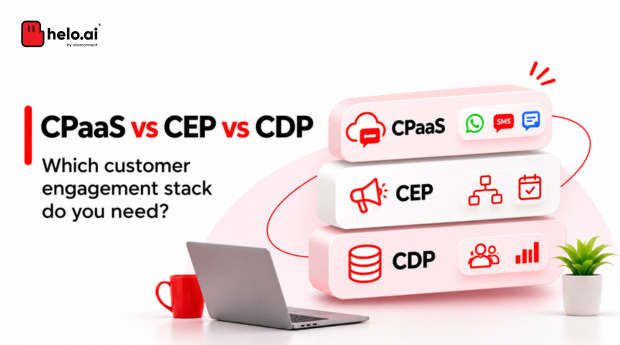
This is where three technology platforms come into the picture: CPaaS, CEP and CDP.
Although their capabilities can overlap, each serves a different purpose. Understanding these differences can help businesses choose the right technology for their customer engagement needs.
CPaaS, CEP and CDP solve different problems. CPaaS delivers messages across channels, a CEP plans campaigns and journeys, and a CDP unifies customer data. Start with your biggest gap.
- CPaaS answers: how do we reach customers?
- CEP answers: when and how should we engage them?
- CDP answers: what do we know about our customers?
- They can work together, but not every business needs all three. Capabilities can overlap depending on the vendor.
- Helo.ai is a CPaaS provider and publishes this guide, so weigh its section accordingly.
What are CPaaS, CEP and CDP?
Let's start with what each platform does.
CPaaS (Communications Platform as a Service)
CPaaS enables businesses to communicate with customers through channels such as WhatsApp, SMS, RCS, Voice and Email.
It provides communication APIs and infrastructure that businesses can integrate into their existing applications and workflows.
For example, a bank can use CPaaS to send transaction alerts, OTPs and service updates across different channels.
CEP (Customer Engagement Platform)
A CEP helps businesses manage customer interactions through campaigns, segmentation and automated journeys.
It uses customer behaviour and available data to help businesses decide when and how to engage customers.
For example, an e-commerce business can create an automated journey for customers who add products to their cart but don't complete the purchase.
CDP (Customer Data Platform)
A CDP collects customer information from different sources and brings it together into unified customer profiles.
It can connect information from websites, mobile apps, CRM systems and purchase records.
For example, a retailer can use a CDP to connect a customer's website activity with their purchase history and mobile app interactions.
For a fuller definition of the first platform, read Helo.ai's guide to what CPaaS is. CDP.com's glossary describes a CDP as software that collects customer data from multiple sources, uses identity resolution to build profiles, and makes them available across channels.
CPaaS vs CEP vs CDP: What's the difference?
The easiest way to understand these platforms is to look at the problem each one solves.
| Area | CPaaS | CEP | CDP |
|---|---|---|---|
| Main purpose | Customer communication | Customer engagement | Customer data management |
| Focus | Communication channels | Campaigns and journeys | Unified customer profiles |
| Key capabilities | Messaging APIs, voice and channel delivery | Segmentation, automation and personalisation | Data collection, identity resolution and profiling |
| Primary users | IT and product teams | Marketing and CRM teams | Data and marketing teams |
| Main question | How do we reach customers? | When and how should we engage them? | What do we know about our customers? |
In simple terms:
They solve different problems and can work together.
How do these platforms work together?
Consider an e-commerce business that wants to improve repeat purchases.
Each platform can contribute to the process.
- CDP: Brings together customer information from the website, app and purchase history.
- CEP: Uses available customer data to identify relevant segments and plan engagement journeys.
- CPaaS: Enables the business to communicate through channels such as WhatsApp, SMS or Email.
For example, a customer who hasn't purchased in a while could be identified through available customer data, included in a re-engagement journey and contacted through a suitable communication channel.
The result is a connected approach where customer data, engagement decisions and communication work together.
The exact setup depends on the platforms and integrations a business uses. Not every business needs all three.
Teams that want data, campaigns and channels in one view can look at Helo Clarity, which lists five modules: Behaviour, SCV, Analyse, Communicate and Automate. It is a separate product from Helo.ai's CPaaS channels, so confirm its scope for your use case on the Helo Clarity page.
Which platform does your business need?
The right choice depends on your biggest business requirement.
| If your business needs to... | Consider |
|---|---|
| Send notifications and updates across multiple channels | CPaaS |
| Integrate messaging and voice into applications | CPaaS |
| Automate campaigns and customer journeys | CEP |
| Personalise customer interactions | CEP |
| Combine customer information from multiple systems | CDP |
| Build unified customer profiles | CDP |
| Connect data, engagement and communication | A combination of all three |
For example:
- A bank looking to manage customer alerts across SMS, WhatsApp and other channels may prioritise CPaaS.
- An e-commerce business looking to improve abandoned-cart campaigns may prioritise CEP.
- A retailer struggling with disconnected customer records may prioritise CDP.
Businesses with more complex requirements may eventually need all three platforms.
Planning your messaging layer?
Read the Enterprise Messaging Playbook on channel strategy, cost and delivery, or compare CPaaS providers before you choose.
What should you consider before choosing?
Before investing in a platform, ask a few important questions:
What problem are we solving?
Identify whether your biggest challenge is communication, customer engagement or fragmented data.
Does it integrate with existing systems?
Check whether the platform works with your CRM, website, mobile app and other business tools.
Which channels does it support?
Evaluate whether it supports the communication channels your customers actually use.
Can it scale with the business?
Consider security, reliability, data management and growing communication requirements.
Can we measure the results?
Check whether the platform provides the information needed to evaluate communication delivery, campaign performance or customer data quality.
A platform should address a clear business requirement, not simply add more features to your technology stack.
Whichever platform you choose, check how it handles consent. India's DPDP Rules make notice and consent standards effective from 13 May 2027, and WhatsApp messaging needs customer opt-in.
Building the right customer engagement stack
CPaaS, CEP and CDP are not competing solutions in the traditional sense. They serve different purposes within the broader customer engagement ecosystem.
A business may need CPaaS to strengthen its communication infrastructure, CEP to coordinate customer journeys or CDP to connect fragmented customer information.
For businesses looking to improve omnichannel communication, Helo.ai provides CPaaS capabilities across WhatsApp, SMS, RCS, Voice and Email. Its channels include WhatsApp, SMS, RCS and Email.
The important thing is to understand which part of your customer engagement process needs improvement before choosing a platform.
The right technology stack isn't about having more platforms. It's about having the right platforms working together.
Which part of your engagement process needs work?
Tell the Helo.ai team about your channels and use case, and they can help you plan the messaging layer.
Frequently Asked Questions
Is CPaaS the same as CEP?
No. CPaaS provides communication infrastructure and channels, while CEP focuses on managing customer engagement through campaigns and journeys.
Can CDP replace CEP?
Not necessarily. CDP focuses on unifying customer data, while CEP focuses on coordinating customer interactions. Some platforms offer overlapping capabilities.
Can CPaaS, CEP and CDP work together?
Yes. A CDP can provide connected customer data, a CEP can use it to plan engagement and CPaaS can enable communication across channels.
Does every business need all three?
No. Businesses should choose platforms based on their requirements, existing systems and customer engagement goals.
Which platform should a business choose first?
Start with the biggest gap. Choose CPaaS for communication, CEP for engagement management and CDP for customer data unification.
What is CPaaS?
CPaaS stands for Communications Platform as a Service. It provides communication APIs and infrastructure for channels such as WhatsApp, SMS, RCS, Voice and Email.
Are CPaaS, CEP and CDP the same as a CRM?
No. A CRM stores customer relationships and sales activity, while a CDP unifies data from many sources, a CEP manages engagement and CPaaS delivers messages. A CRM can be one source of data for a CDP.
How does consent apply when using these platforms in India?
Consent applies to the data you hold and the messages you send, whatever the platform. WhatsApp requires opt-in, and DPDP notice and consent standards apply from 13 May 2027.
Note. This article is an editorial guide and general information. Capabilities vary by vendor and change over time, so confirm scope with each provider. Helo.ai is a CPaaS provider and publishes this guide. Facts were checked on 13 November 2026.