


A shopper lands on your product page at 11 PM. She has three questions: sizing, delivery to her city, and whether COD is available. Your FAQ page does not answer them. Your contact form promises a reply in 24 hours. She leaves and does not come back.
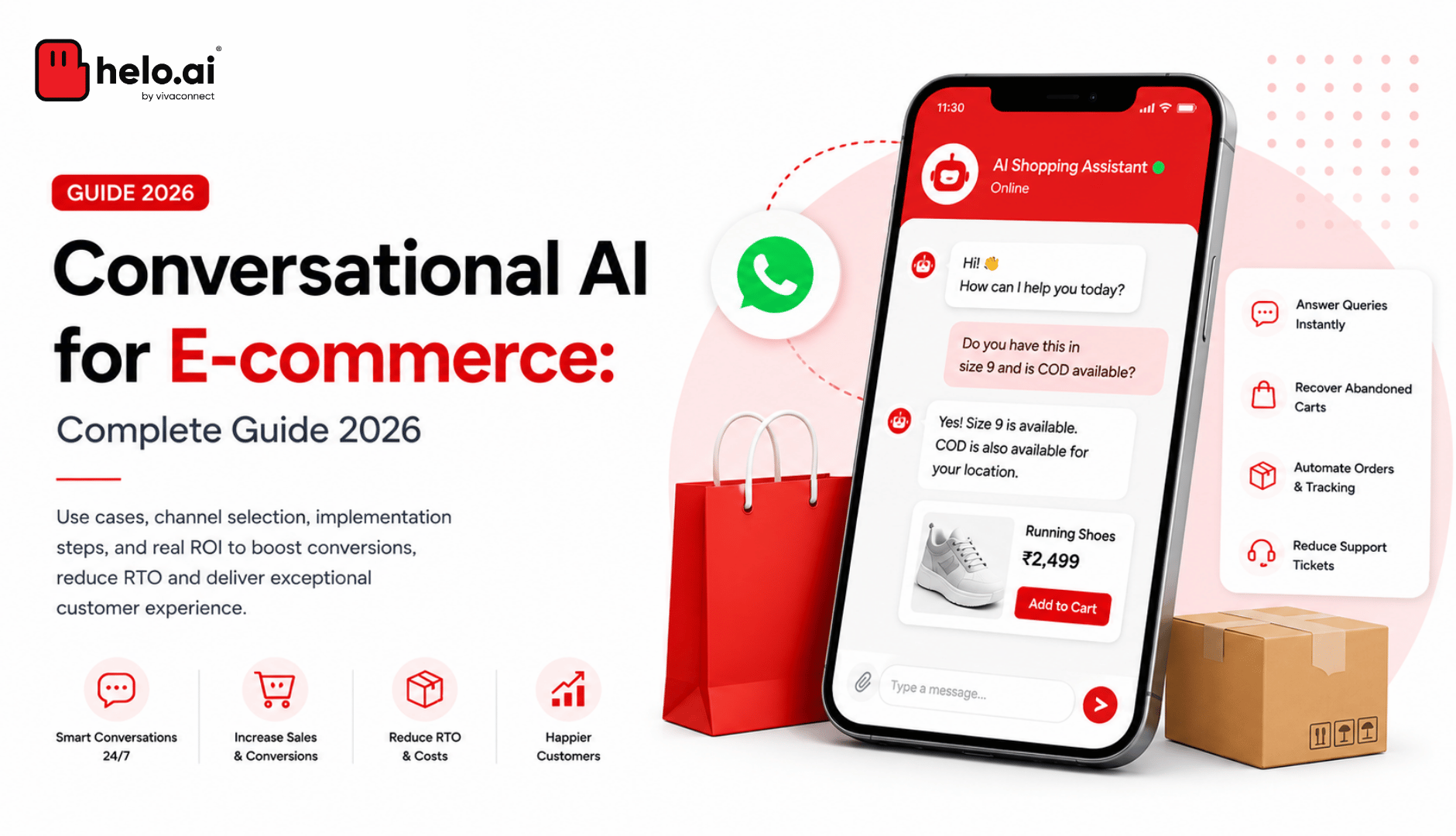
This happens constantly. Conversational AI for e-commerce is software that answers those questions in real time through chat, voice or messaging, then recommends products, takes orders and resolves issues in the same conversation.
This guide covers seven use cases, channel selection for Indian shoppers, the real economics of COD and RTO, implementation steps and how to measure ROI.
What Is Conversational AI for E-commerce?
Conversational AI is software that understands natural language and completes tasks through dialogue. It differs from a rule-based chatbot, which follows a fixed decision tree and fails when a customer phrases things differently.
The practical test is simple. Consider two messages: "I want to return this" and "this doesn't fit, can I get a bigger size?" A rule-based bot often routes both to the same dead end. A conversational AI system sends the first to returns and the second to exchange, without the customer repeating themselves.
For the full technical breakdown, see chatbots vs conversational AI.
How it actually works
- Natural language understanding reads the query despite typos or language mixing. "Where's my order?", "when will my package arrive?" and "mera order kab aayega?" all hit the same tracking workflow.
- Context management holds the thread. Ask about running shoes, then ask "do you have these in size 9?" and it knows what "these" means.
- Intent recognition decides what the customer wants: browse, track, return, refund, or reach a human.
- Backend integration pulls live data from your catalog, OMS, CRM, payment gateway and courier API.
- Response generation writes the reply in your brand voice.
That fourth point is where most deployments fail. An AI that cannot see live order status is a script with good grammar.
Why It Matters: The Conversion Gap
E-commerce conversion rates average 2-3% globally. Between 97 and 98 of every 100 visitors leave without buying. The usual causes are product confusion, unanswered questions, checkout friction and doubt about returns.
Indian cart abandonment runs around 68%, and fashion return rates reach 38%, according to 2026 Indian e-commerce market data. Those two numbers define the problem: people abandon when unsure, and they return when the product does not match expectations.
Conversational AI attacks both. It answers the sizing question before checkout and sets accurate expectations after it.
The Market, Honestly Sized
The most widely quoted figure puts the global conversational commerce market at $10.1 billion in 2026, reaching $39.8 billion by 2036 at a 14.8% CAGR, from Future Market Insights.
That number is defensible, but it is not consensus. Other research firms size the same year considerably higher, which is normal in a market this young:
Source | 2026 estimate | Forecast |
|---|---|---|
$10.1B | $39.8B by 2036 (14.8%) | |
$12.64B | $22.56B by 2031 (12.28%) | |
$14.11B | $18.39B by 2030 (6.9%) |
[UNIQUE INSIGHT] The useful number here is not the global total. FMI's country table puts India's conversational commerce CAGR at 17.8% - the highest of any market they track, ahead of China at 16.3% and the US at 14.1%. If you sell into India, that gap matters more than the headline valuation.
7 Use Cases, Ranked by Speed to ROI
Ranked by how quickly you can prove value, not by how impressive they sound.
1. Cart Abandonment Recovery
Start here. Roughly 68% of carts are abandoned, and email typically recovers 5-15%. A WhatsApp message that names the product, flags low stock and answers objections performs materially better because it opens a conversation instead of closing one.
For the mechanics, see AI-powered cart recovery with WhatsApp and message templates that work.
2. Order Tracking and WISMO Automation
"Where is my order?" is consistently the largest single support category in e-commerce. Wire the AI to your courier API and it answers with live status instead of a promise. See how to build an order tracking chatbot.
3. Guided Product Discovery
Instead of filters, the customer describes the need. For example: "a waterproof jacket under ₹3,000 for trekking." The AI asks two or three questions about size and features, then returns three to five options with reasons. This is the closest thing to a knowledgeable shop assistant at scale.
4. Returns, Exchanges and Refunds
The AI checks eligibility against your policy, generates the label and schedules pickup inside one conversation. No forms, no email thread. For the workflow design, see simplifying returns and exchanges for D2C.
5. 24/7 Support Coverage
Shipping timelines, payment methods, warranty terms, coupon validity. Routine questions answered instantly at 2 AM during a Diwali sale, with clean escalation and full context handover when a human is needed.
6. Personalised Recommendations
Post-purchase cross-sell based on genuine compatibility. For instance, "most buyers of this phone added a tempered glass and a flip cover" works because the recommendation is specific, not because the wording is clever.
7. Post-Purchase Engagement
Care instructions, review requests at the right moment, loyalty reminders, replenishment nudges. Review generation alone compounds: see how to increase product reviews automatically.
What Actually Works in India
This is where generic global advice falls apart. Four things shape Indian e-commerce in 2026.
COD is smaller than you think
Cash on delivery now accounts for roughly 18-30% of Indian e-commerce orders, down from about 45% in 2021, according to 2026 payment data. Many guides still quote 60-70%. That figure is several years out of date.
COD still matters disproportionately in Tier 2 and Tier 3 cities and among first-time buyers. But if you are building your whole strategy around COD volume, you are solving a shrinking problem.
RTO is the real cost, and it is 20-30%
Return-to-origin on COD orders runs at 20-30% in India, with estimated industry losses above ₹20,000 crore annually, per 2026 COD market analysis. RTO turns a 25-30% gross margin operation into a 5-15% net margin one.
A pre-shipment confirmation message or voice call is the cheapest intervention available. The same analysis suggests a systematic approach can pull RTO from 25-30% down to 15-18%, which roughly doubles net margin per order.
UPI is far bigger than "10 billion"
UPI processed 16.2 to 18.4 billion transactions in a single month in 2026, per NPCI-derived 2026 data. It now covers roughly 60 to 73% of e-commerce payments. Any guide still quoting 10 billion monthly is working from 2024 figures.
In-chat UPI collection removes the redirect that kills checkout. See WhatsApp UPI payment gateway integration.
Language is the acquisition lever
WhatsApp is Meta's largest market in India. The next wave of buyers is in Tier 2 and Tier 3 cities, and they type in Hindi, Tamil, Telugu, Bengali or Marathi - often mixed with English in the same sentence. Code-switching support is not a nice-to-have, it is the difference between an addressable market and a metro-only one.
Choosing Your Channel
Channel | Best for | Notes |
|---|---|---|
Website chat | Pre-purchase questions, checkout help | Catches visitors before they bounce |
Post-purchase, cart recovery, catalog, UPI | Highest reach and engagement in India | |
SMS | OTP, delivery updates, time-sensitive alerts | Universal fallback |
Voice AI | COD confirmation, escalation, feedback | Builds trust faster in Tier 2/3 |
Instagram DM | Fashion, beauty, lifestyle | Impulse categories |
For Indian e-commerce, WhatsApp plus website chat covers most scenarios. Add voice when COD confirmation becomes your bottleneck. See enterprise AI voice agents.
Implementation: 8 Steps
- Pick one use case. Cart recovery or WISMO. Both have clean, measurable baselines.
- Set a number, not a vibe. "Cut WISMO tickets 50% in 90 days" beats "improve support."
- Choose build vs buy. Custom AI takes 6-12 months. No-code platforms 1-3 months. Purpose-built e-commerce platforms 2-4 weeks.
- Integrate the backend. Catalog first, then OMS, then payments and logistics. Live data or nothing.
- Write the flows. Include fallback paths and human escalation with context transfer.
- Train on your data. Product catalog, FAQs, real past conversations, policy documents.
- Test the ugly cases. Typos, code-switching, ambiguous requests, angry customers.
- Soft launch at 10%. One category or one traffic slice. Review logs weekly before scaling.
For a no-code start, see how to build a WhatsApp chatbot without code.
Measuring ROI
Metric | What it tells you |
|---|---|
Conversion lift (assisted vs unassisted) | Requires a control group to mean anything |
Cart recovery rate | Compare against your email baseline |
WISMO deflection | Tickets avoided, multiplied by cost per ticket |
RTO reduction | The highest-margin number in Indian e-commerce |
Average order value | Only meaningful with a pre-launch baseline |
Auto-resolution rate | Below 60% suggests your flows have gaps |
The ROI formula is simple:
(Revenue from AI-assisted conversions + support savings - platform cost) / platform cost x 100
Most vendors claim 300-500% first-year ROI. Some businesses hit it. The ones that do almost always started with a single use case that had a measurable baseline. The ones that do not usually launched four channels at once.
Reading Vendor Case Studies Carefully
You will see claims like "Nykaa achieved 35% conversion on recommendations" or "Flipkart saved ₹15 crore with AI tracking." Treat every such number with care.
Three problems recur. First, named-brand performance figures are rarely published by the brand itself, so they are hard to verify. Second, vendor case studies are not audited and often lack a control group. Third, results are usually from a specific campaign, category and time window that will not generalise to your catalog.
A more reliable approach: ask any vendor for a pilot on your own traffic with an agreed baseline. Two months of your data beats ten polished logos.
Frequently Asked Questions
What does conversational AI cost for e-commerce?
Basic chatbot deployments typically start around ₹10,000-50,000 per month. Multi-channel enterprise platforms with high volumes run higher. Price against ticket volume and order count, not features.
How long does implementation take?
Two to four weeks for a single channel with standard integrations. Two to three months for custom work. Three to six months for multi-channel enterprise rollouts.
Will it replace human agents?
No. It absorbs routine volume and hands over context for complex or emotional cases. The win is capacity, not headcount reduction.
Which channel should an Indian e-commerce brand start with?
WhatsApp plus website chat. Add voice when COD confirmation is your constraint.
Can it handle returns and refunds?
Yes, including eligibility checks, label generation and pickup scheduling. Escalate disputes and high-value refunds to humans.
Final Thoughts
Conversational AI turns e-commerce from a self-service maze into a guided conversation. In India the case is strongest for three reasons: WhatsApp-first buyers, regional language demand, and RTO economics that reward every confirmation message you send.
Start with one use case. Measure against a baseline you recorded before launch. Expand only when the first number holds up.
Helo.ai's e-commerce solutions cover WhatsApp commerce, regional language support, UPI collection and voice AI on one platform. And for the broader strategic case, read why conversational commerce is the future of D2C.


.jpeg&w=96&q=75)