


Customer engagement isn’t what it used to be.
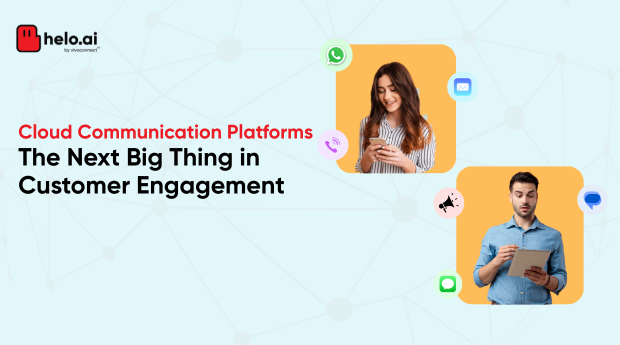
A decade ago, a simple email or call-back was enough to satisfy most users. Today, expectations are higher, faster, and more fragmented than ever. Customers expect real-time conversations across WhatsApp, RCS, SMS, email, and even voice — and they want each interaction to feel seamless, consistent, and personalized.
But here’s the problem: most businesses still rely on disconnected systems to handle these conversations. Marketing uses one tool, support uses another, and sales has something entirely different. The result? Slow replies, repeated questions, and inconsistent experiences — both for the customer and the internal team.
Cloud communication platforms solve this.
By unifying channels and workflows into a single, scalable layer, these platforms help businesses respond instantly, automate intelligently, and engage customers wherever they are — without the complexity.
In this blog, we’ll break down what cloud communication platforms are, why they’re becoming essential, and how AI-powered CPaaS is changing the game.
👉 Explore how Helo.ai powers seamless, AI-first customer engagement
What Is a Cloud Communication Platform?
A cloud communication platform is a technology solution that lets businesses manage and deliver messages across multiple channels — all from one unified, cloud-based system. Instead of using separate tools for email, SMS, WhatsApp, voice calls, or RCS, a cloud communication platform brings everything together under one roof.
It eliminates the need for complex infrastructure or on-premise hardware. Everything runs in the cloud, which means teams can access it anytime, from anywhere — and scale it instantly as their needs grow.
Here’s what a cloud communication platform typically handles:
- WhatsApp support automation: Instantly respond to FAQs, send delivery updates, or trigger reminders
- RCS promotions: Deliver rich, interactive messaging that drives higher engagement than SMS
- Voice call notifications: Auto-dial appointment reminders or payment alerts
- Email and SMS: Send order confirmations, account updates, or campaigns — in real-time and at scale
This kind of platform is designed for today’s customer expectations — where speed, personalization, and consistency matter across every channel.
And for businesses, the payoff is big: faster implementation, lower overhead, and easier automation without needing a large dev team or long IT cycles.
Why Traditional Communication Systems Fall Short
Most businesses today still rely on outdated, siloed systems to manage customer communication and it shows.
Legacy call centers, email-only workflows, and disconnected tools may have worked in the past, but they weren’t built for the speed, scale, or complexity of modern customer expectations. Today’s users don’t want to wait 24 hours for a reply or repeat themselves across channels. They want real-time, cross-platform conversations and they want them now.
The core problems with traditional systems:
- Disjointed channels: Support teams use one tool, marketing uses another, and there’s no single source of truth.
- Slow, manual processes: Emails pile up. Phone queues grow. Teams get overwhelmed.
- Rising costs: More inquiries mean more headcount — unless automation is built in.
- Zero visibility: Without unified data, tracking performance or improving CX becomes guesswork.
And the impact isn’t just on customers, internal teams suffer too.
From duplicated efforts to inconsistent messaging, the lack of a connected system slows down everything.
That’s why businesses are moving to cloud communication platforms — because scaling support without smart technology is no longer sustainable.
5 Reasons Why Cloud Communication Platforms Are Gaining Attention
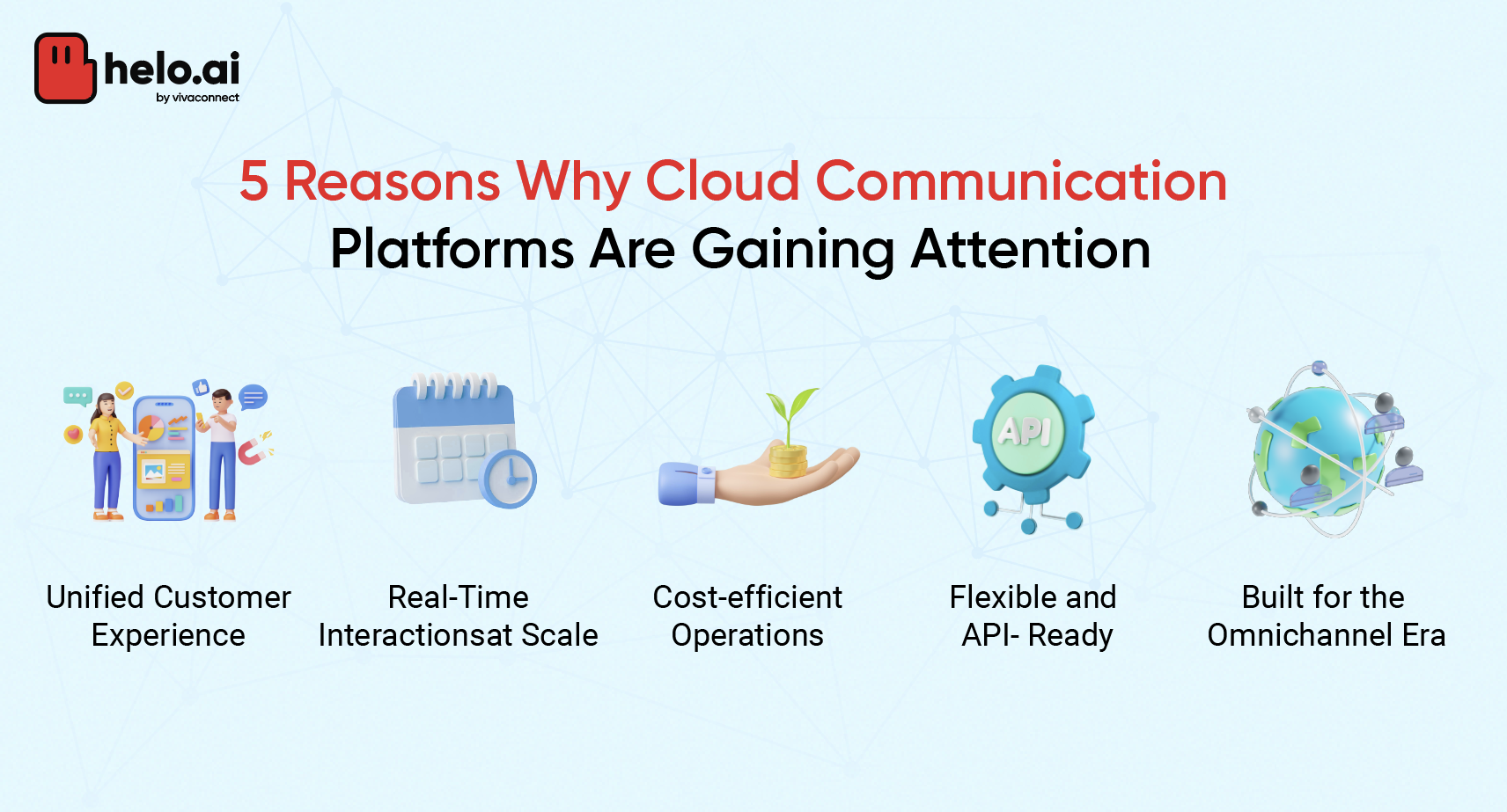
Businesses across industries are turning to cloud communication platforms, not because it’s trendy, but because it’s practical. These platforms solve real operational problems while unlocking scalable, personalized customer engagement.
Here’s why adoption is accelerating:
1. Unified Customer Experience
Customers shouldn’t feel like they’re starting over every time they switch channels.
Cloud communication platforms centralize interactions across WhatsApp, RCS, SMS, email, and voice — so every touchpoint feels connected.
Whether it’s a marketing message or a support reply, the experience remains consistent and seamless.
2. Real-Time Interactions at Scale
Customers want replies in seconds, not hours.
With automation built in, cloud platforms can trigger flows, send updates, and handle thousands of conversations simultaneously — all without expanding your support team.
Think: order status updates, OTPs, or follow-ups, all firing in real-time across multiple channels.
3. Flexible and API-Ready
Every business stack looks different. A good cloud communication platform integrates easily with:
- CRMs (like HubSpot, Zoho, Salesforce)
- Support systems (like Zendesk, Freshdesk)
- Payment gateways, logistics tools, and custom APIs
It adapts to your workflows, not the other way around.
4. Cost-Efficient Operations
Automation reduces the need for manual replies, escalations, and agent handovers.
That means:
- Lower support costs
- Faster issue resolution
- More bandwidth for high-value conversations
In short, you scale smarter, not just bigger.
5. Built for the Omnichannel Era
Your customers might start a conversation on RCS, follow up via email, and confirm a payment on WhatsApp.
Cloud platforms are designed to maintain context across those touchpoints, enabling frictionless, end-to-end experiences without losing track of the customer journey.
Where AI Comes In: The Rise of AI-Powered CPaaS
Traditional automation was built around rules like “if this, then that.” It worked, but only in controlled, predictable scenarios. Today, that’s no longer enough.
Modern customer conversations are dynamic. People switch channels, ask open-ended questions, and expect context-aware replies. That’s where AI-powered CPaaS changes the game.
By layering artificial intelligence into cloud communication platforms, businesses can move from basic automation to intelligent, adaptive, and truly conversational engagement.
Common Use Cases:
- Personalized replies via WhatsApp based on user profile, purchase history, or behavior.
- Smart routing of support queries to the right team or channel, based on sentiment or intent.
- Campaign optimization with AI predicting the best time, channel, and message type for each user.
- Proactive re-engagement: Automatically following up with users who drop off mid-flow.
- Sentiment-aware messaging: Escalating unhappy users to human agents in real time.
- Multilingual auto-replies: Detecting and responding in a customer’s preferred language.
Unlike static workflows, AI adapts with each interaction. It learns patterns, refines flows, and gets smarter over time, reducing friction, increasing conversions, and improving customer satisfaction.
That’s why businesses aren’t just adopting cloud communication, they’re looking for AI-powered CPaaS platforms that bring the intelligence layer baked in.
With Helo.ai, you get that intelligence from day one.
Key Use Cases Across Industries
Cloud communication platforms aren’t one-size-fits-all — they’re flexible enough to serve a wide range of industries, each with its own customer engagement challenges. Here’s how different sectors are leveraging AI-powered CPaaS to streamline operations and improve customer experience:
1. E-commerce
- Automated order confirmations and shipping updates
- Return and refund handling without agent intervention
- Abandoned cart recovery campaigns via WhatsApp or SMS
2. BFSI (Banking, Financial Services & Insurance)
- Secure transaction alerts through SMS or RCS
- Lead qualification flows for credit cards, loans, or policies
- Onboarding journeys that guide users step-by-step with zero friction
3. Utilities
- Bill due reminders via WhatsApp and SMS
- Outage alerts with geo-targeted notifications
- Self-service support for FAQs, service requests, or account updates
4. Healthcare
- Appointment confirmations and rescheduling
- Prescription refill reminders
- Pre-consultation checklists or follow-up instructions via chat
5. Education
- Enrollment support: capturing leads and sharing course info
- Fee reminders sent through RCS or email
- Real-time query resolution for admissions, exams, or results
These use cases show how a cloud communication platform doesn’t just simplify messaging — it automates business-critical workflows, improves customer responsiveness, and reduces manual overhead at scale.
What to Look for in a Cloud Communication Platform
Choosing the right cloud communication platform isn’t just about sending messages — it’s about building the foundation for consistent, scalable customer engagement.
Here’s what to look for when evaluating your options:
✅ Supports all key channels
Ensure the platform covers the full customer engagement stack — RCS, WhatsApp, SMS, email, and voice — so you can meet users wherever they are.
✅ Offers a drag-and-drop flow builder
You shouldn’t need developers to build automations. Look for a no-code interface that lets your team design, test, and launch conversational workflows quickly.
✅ Provides analytics and reporting
Data drives improvement. The right platform should show you what’s working — and what’s not — with real-time visibility into delivery rates, response times, drop-offs, and conversions.
✅ Scales with your business
Start small and expand fast. Your platform should handle volume spikes, new channels, and more users without bottlenecks or pricing complexity.
✅ AI-powered automation with human fallback
Intelligent automation is great — but seamless escalation to human agents is critical when things get complex. Look for platforms that blend AI with live agent takeover for a balanced experience.
Conclusion
If you’ve made it this far, one thing is clear, you understand that customer engagement is no longer about reacting, it's about being ready, responsive, and everywhere your users are.
Cloud communication platforms aren’t just a tech upgrade, they’re a shift in how businesses connect with customers. And when you layer in AI? That’s where things really start to scale.
Whether you’re leading CX, marketing, or operations, the next move isn’t about adding more tools — it’s about choosing the right one to unify everything.
So what’s your next step?
Start with something simple:
✅ Automate a support flow on WhatsApp
✅ Launch a cart recovery message via RCS
✅ Or build a multi-channel campaign — no code required
The point is, once you see what’s possible with an AI-powered CPaaS, it’s hard to go back.
👉 Want to see how an AI-powered CPaaS can elevate your customer engagement?
FAQs
1. What is a cloud communication platform?
A cloud communication platform is a software-based solution that enables businesses to manage and automate messaging across multiple channels — like WhatsApp, RCS, SMS, email, and voice — all from a single, cloud-hosted system. It removes the need for complex infrastructure and helps unify customer interactions at scale.
2. What’s the difference between CPaaS and UCaaS?
CPaaS (Communications Platform as a Service) is built for external customer engagement — automating conversations across channels.
UCaaS (Unified Communications as a Service) focuses on internal team collaboration — things like video calls, team messaging, and VoIP.
Think CPaaS for your customers, UCaaS for your employees.
3. Is AI necessary for modern communication automation?
Not strictly — but without AI, automation is limited to basic, rule-based flows. AI enables chatbots and platforms to understand context, personalize responses, route queries intelligently, and continuously learn. For scalable, human-like interactions, AI is essential.
4. Can small businesses benefit from CPaaS?
Absolutely. In fact, small and growing teams benefit the most from automation and unified tools. CPaaS platforms make it easy to automate support, reduce costs, and manage campaigns — without needing large teams or technical expertise.
5. How secure is cloud-based customer messaging?
Leading cloud communication platforms use enterprise-grade encryption, compliance with data protection laws (like GDPR), and secure APIs to keep your customer data safe. Always choose a provider that prioritizes security and transparency.

.jpg&w=828&q=75)