.jpeg)


Your business number is active. Your team is making calls. Customers are receiving them. But instead of answering, some see a warning: Spam.
For a business that depends on phone calls to reach customers, this can quickly become a problem. Sales conversations get missed, service updates go unanswered and contact-centre teams spend time trying to reach people who may never pick up.
If you're searching for why my number is showing spam, the first thing to know is that there may be more than one reason. Your number could have received repeated spam reports, your calling pattern may be creating complaints, or the caller information associated with it may be incorrect.
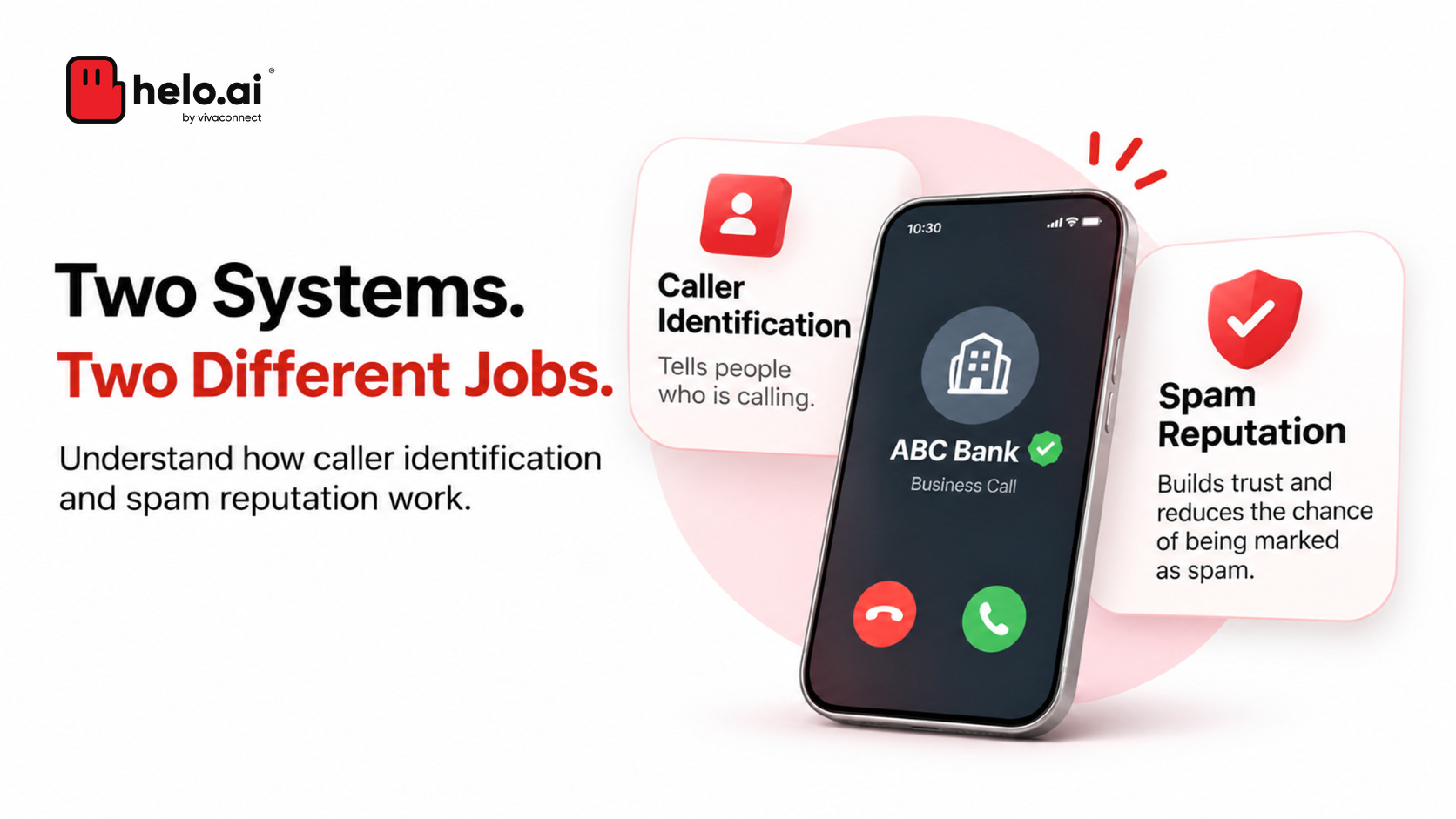
There is another complication in India: caller name presentation and spam identification now operate through different systems. Truecaller uses its own caller identification and spam detection processes, while the Department of Telecommunications (DoT) has introduced Calling Name Presentation (CNAP) through telecom operators.
A correctly displayed business name does not automatically mean a number has a good spam reputation. And correcting a spam label on one platform does not necessarily update the information shown elsewhere.
This guide explains why business numbers get flagged, how to identify where the problem is coming from, how to raise a correction request and what businesses should know about Truecaller, CNAP and TRAI's latest calling rules.
Regulatory position reviewed as of 16 November 2026.
A business number shows as spam when recipients report it, its calling pattern looks like telemarketing, or its caller identity is wrong. Truecaller spam labels, CNAP caller names and TRAI network flags are separate systems with separate fixes. Find where the label appears, then correct the calling practices behind it.
Why is my number showing spam? Common reasons for business numbers
A phone number can develop a spam reputation when people repeatedly receive calls they consider unwanted or when its calling behaviour resembles common telemarketing or spam activity.
For example, a company may use one number to contact hundreds of customers every day. Some customers expect those calls, but others may not recognise the number, may not remember giving permission or may simply not want to be contacted.
If recipients repeatedly report or block the number, caller identification services may start displaying a spam warning.
Here are some common reasons.
Too many calls in a short period
A business that makes a large number of calls from the same number may appear to be running an aggressive calling campaign.
This can happen when:
- A sales team makes repeated attempts to reach the same customer.
- An automated dialler calls a large list in a short period.
- Multiple agents use the same outbound number.
- A campaign continues calling people who have not responded.
High call volume alone does not prove that a number is spam. But the pattern, frequency and recipient response can influence how people perceive those calls.
Customers are reporting the number
Truecaller says its spam lists are created through reports from its user community. When a number is repeatedly reported for nuisance, marketing or spam calls, it may be listed as spam.
Truecaller also explains that its spam identification system does not rely on a fixed number of reports that automatically triggers a spam label. It considers broader calling patterns and behaviour over time.
This means a business can have a legitimate reason to call and still develop a poor caller ID reputation if recipients find those calls intrusive.
Customers do not recognise the number
Think about a customer who has just submitted a loan enquiry online. They may expect a follow-up call from the bank.
But if the call arrives from an unfamiliar number without a recognisable business identity, the customer may assume it is unwanted.
This becomes more likely when:
- The number changes frequently.
- Different teams call from unrelated numbers.
- The customer has no context about the call.
- The caller does not clearly introduce the organisation.
A recognisable caller identity does not guarantee that people will answer, but it helps them understand who is contacting them.
Your calling list contains outdated or incorrect numbers
Old databases can create problems.
A number that once belonged to an interested prospect may now belong to someone else. A customer may have withdrawn consent, changed their contact details or already completed the transaction.
Continuing to call such numbers can lead to complaints and unnecessary repeat attempts.
The calling approach feels like spam
Even when the contact list is accurate, the way a business calls can affect how recipients respond.
Examples include:
- Calling outside reasonable hours.
- Making repeated calls without a meaningful reason.
- Using misleading introductions.
- Continuing promotional calls after a customer has opted out.
- Using automated or prerecorded calls without meeting applicable telecom requirements.
The number itself may be valid, but the calling programme can still create a poor experience.
The number has an incorrect or inconsistent identity
A number may show an outdated business name, an unfamiliar label or an identity that does not match the organisation making the call.
This can happen when:
- The number was previously assigned to another user or business.
- The telecom subscriber record is outdated.
- A business uses multiple numbers without consistent caller information.
- The number has been reassigned.
- A caller ID platform has old or incorrect information.
It is important to identify whether the issue is a spam warning, an incorrect name or both. They require different fixes.
How does Truecaller decide whether a number is spam?
Truecaller maintains its own caller identification and spam identification system. Its spam directory is built using reports from users who identify calls as unwanted, nuisance, marketing or potentially fraudulent.
The platform says it considers reports alongside broader patterns and behaviour. It does not publish a fixed number of reports that automatically marks a number as spam.
The recipient's experience matters. For example:
- A customer who requested a loan callback may welcome a call from the bank.
- Someone who never enquired about the product may consider the same call unsolicited.
- A customer receiving several calls about the same offer may find the frequency intrusive.
- A person who does not recognise the caller may block or report the number.
That is why businesses should not treat caller ID reputation as a technical issue alone. The calling strategy and customer experience matter too.
Does Truecaller mark every high-volume business number as spam?
No. High call volume does not automatically mean a number will be marked as spam.
However, large-scale calling combined with repeated reports, unwanted outreach or poor calling practices can affect how a number is identified.
There is no guaranteed number of calls or reports below which a business can assume its number is safe.
Official Truecaller resources:
- Why is my number listed as spam?
- How is spam calculated on Truecaller?
Truecaller vs CNAP: What is the difference?
With CNAP being introduced in India, businesses need to understand that caller name presentation and spam identification are not the same thing.
Truecaller and CNAP may both display information about an incoming caller, but they get that information through different systems.
| Feature | Truecaller | CNAP |
|---|---|---|
| Full name | Truecaller caller identification | Calling Name Presentation |
| Managed by | Truecaller | Telecom service providers under DoT directions |
| Main purpose | Help users identify callers and recognise or avoid unwanted calls | Display the caller name recorded in telecom subscriber records |
| Information source | Truecaller databases, user reports and its identification systems | Name recorded in the originating telecom operator's subscriber database |
| Spam identification | Yes, through its own system | Does not independently provide a Truecaller-style spam score |
| Business identity | Verified Business Caller ID with brand information | Eligible business and bulk-connection users may apply for a verified preferred name |
| Does it guarantee a call is genuine? | No | No |
The important difference is this: CNAP displays a caller name; it does not establish that a caller has a good spam reputation.
A caller may have a correctly displayed name and still make unwanted calls. Similarly, a number may have a legitimate business identity but still receive spam reports on a third-party caller ID platform.
What is CNAP and how does it affect business caller ID in India?
Calling Name Presentation (CNAP) is a telecom network feature that displays the calling name along with the phone number when someone receives a call.
Previously, a recipient who had not saved a number often saw only the phone number unless a caller ID app supplied additional information.
Under Circular No. 01/Licensing Policy/2026, dated 13 October 2026, the Department of Telecommunications directed telecom service providers to introduce CNAP across their service areas from 1 November 2026 on wireless networks using 4G and higher technologies.
The initial rollout does not cover 2G, 3G or landline networks. Their implementation is to be considered separately.
Source check: Coverage of the DoT circular, including the 1 November 2026 start, the display order and the preferred-name rule, is available in ThePrint's report.
What name appears on the recipient's phone?
The DoT circular specifies the following order:
- If the caller's number is saved in the recipient's contact list, the saved contact name is displayed.
- If the number is not saved and the call is domestic, the caller name identity recorded by the originating TSP is displayed.
- If the call is international, the words "International Call" are displayed.
The originating TSP maintains the database of calling names mapped to phone numbers. The terminating TSP retrieves the name and presents it to the recipient.
There are also privacy and security requirements. Telecom operators must follow a security-by-design approach so that the calling name information is not retained after the incoming call is completed. The name of a caller using Calling Line Identification Restriction (CLIR) is not presented.
Can a business display its brand name through CNAP?
Eligible business and bulk-connection users may be offered the option to display a preferred name instead of the name recorded in their subscriber data.
The DoT circular specifies two permitted bases for the preferred name:
- A trademark registered in the name of the business with the Trade Marks Registry.
- A trade name registered in the business's name on the GST portal.
The originating telecom operator must verify the preferred name and supporting documents before approving it.
For new connections: The preferred name and supporting proof must be recorded as part of the connection documentation and subscriber data.
For existing connections: The operator must establish a process through which eligible users can submit an application and supporting documents. The preferred name may be updated after examination and verification.
This is not an automatic branding facility for every business. The organisation should contact its originating TSP to confirm eligibility, documentation and the application process.
Does CNAP replace Truecaller?
No. They serve different purposes.
CNAP displays the name held in the telecom operator's subscriber records. Truecaller has its own caller identification and spam identification systems.
A business may have its name correctly displayed through CNAP and still receive a spam label on Truecaller.
Likewise, a verified business identity on Truecaller does not automatically determine the name that appears through CNAP.
Businesses should treat them as separate parts of their caller identity setup.
How to check why your business number is showing as spam
Before trying to remove a spam label, identify where it is appearing and whether the problem affects one number or several.
Follow these checks.
Step 1: Check the number on different phones
Ask a few employees or trusted contacts to check how the business number appears on their phones.
Check:
- Truecaller on Android.
- Truecaller on iPhone, where supported.
- The default phone dialler.
- Different telecom networks, if possible.
- CNAP display on supported connections.
Do not rely on a single screenshot. A label may vary depending on the app, network, device or caller ID database.
Step 2: Separate the spam label from the caller name
Check whether the number is showing:
- A red spam warning.
- An incorrect personal or business name.
- An outdated business identity.
- No caller name at all.
- A business name alongside a spam warning.
These are different problems.
For example, correcting a name in the telecom subscriber record may help with CNAP, but it does not automatically change a spam score maintained by Truecaller.
Step 3: Check whether the number is being used by multiple teams
Find out which departments use the number and what types of calls they make.
A single number may be used for sales, customer support, collections and service reminders. These teams may have different calling frequencies, scripts and customer lists.
If one team is making repeated or unwanted calls, the resulting complaints may affect the reputation of the shared number.
Step 4: Review call frequency and customer feedback
Look at:
- Calls made per number per day.
- Repeat attempts to the same customer.
- Unanswered calls followed by repeated redialling.
- Customer complaints and opt-outs.
- Calls made to outdated or unverified lists.
- Differences between promotional and service calling campaigns.
This helps identify whether the issue is isolated to a particular campaign or affects the entire outbound calling operation.
Step 5: Check your telecom records
Ask your telecom service provider to verify:
- The subscriber or business name associated with the number.
- The KYC details recorded for the connection.
- Whether the number has been reassigned or has an old identity.
- Whether there are suspected UCC or spam-related flags on the telecom network.
- Whether the number is correctly provisioned for its intended calling purpose.
If the number is part of a PRI, SIP or bulk-calling arrangement, review the associated number ranges and account details as well.
How to remove a spam label from your business number on Truecaller
If your number has been incorrectly marked as spam, you can raise a request with Truecaller.
The process is different from correcting the subscriber name with your telecom operator.
Check the number's current listing
Search for the business number on Truecaller and confirm how it appears.
Record:
- The exact phone number.
- The displayed business name.
- The spam warning or label.
- Screenshots showing the issue.
- The date when you checked it.
This gives you a clear record of the problem.
Raise a support request
Truecaller provides a support process for numbers that businesses believe have been incorrectly marked as spam.
Use its official support article:
Truecaller – Why is my number listed as spam?
You can also use the Truecaller support portal to submit a ticket.
Provide accurate business and number information, explain how the number is used and attach relevant evidence.
Explain how the number is used
A useful support request should include:
- Registered business name.
- Business website.
- The phone number in question.
- The purpose of the calls.
- The nature of the customer relationships.
- Evidence of the business's ownership or control of the number.
- Screenshots of the incorrect spam label.
Keep the explanation factual. Do not claim that every recipient has consented unless you can substantiate it.
Review the outcome
Follow the support team's instructions and check the number again after the review.
Truecaller controls its own spam identification system. A support request does not guarantee that the label will be removed, and the platform does not promise a fixed resolution time for every case.
Does Truecaller Verified Business Caller ID remove spam labels?
No. This is an important distinction.
Truecaller's Verified Business Caller ID helps businesses display their brand name, logo and industry information. It can make a business easier to recognise and help protect its identity from impersonation.
However, Truecaller explicitly states that verification does not guarantee spam removal or number whitelisting. A verified business number can still carry a spam warning if its calling behaviour or user reports result in that classification.
Read: Can Truecaller Verified Caller ID help in removing spam from my number?
Verification is useful for brand identity. It is not a shortcut around poor calling practices.
What do TRAI's spam rules mean for business numbers?
Truecaller reports and telecom network spam flags are not the same thing. This distinction is particularly important for businesses making large volumes of calls.
Under the TCCCPR Third Amendment Regulations, 2026, TRAI introduced a framework for Access Providers to identify calling line identities (CLIs) suspected of being used for unsolicited commercial communication (UCC).
The framework uses AI/ML-based detection systems and allows suspected CLI information to be shared between Access Providers for further investigation.
Are 140, 1600 and 1601 numbers protected from spam flags?
Yes, under the Access Provider framework.
The September 2026 amendment specifies that CLIs from the 140xx, 1600xx and 1601xx series, along with other specially designated commercial communication series, should not be flagged as "Suspected UCC/spam" for recipients under that framework.
This is intended to help legitimate commercial and government calls made through the designated series reach customers without being incorrectly flagged by the telecom network.
However, this protection has a specific scope.
It does not mean that Truecaller or every other independent caller ID application must display these numbers without a spam warning. Third-party platforms operate their own caller identification and spam reporting systems.
Businesses should therefore distinguish between:
- A suspected UCC flag raised within the telecom Access Provider framework.
- A spam label shown by Truecaller or another caller ID app.
- An incorrect or missing caller name in CNAP.
Each requires a different correction route.
What happens when five or more business numbers are flagged within ten days?
The September 2026 amendment introduced a sender-level investigation process.
When five or more CLIs associated with the same sender are identified as suspected high-probability UCC CLIs within a ten-day period, the Access Providers initiate further investigation and graded action.
This can include:
- KYC re-verification.
- Physical verification.
- Barring of outgoing services.
- Disconnection of telecom resources in cases of repeated violations and misuse.
The process is based on the telecom resources associated with the sender. It is not a rule that five Truecaller user reports automatically trigger action.
The regulations also provide a mechanism for senders to submit a representation with justification when their CLIs are flagged. Access Providers are required to unflag the CLIs where the justification is found to be in order.
If your business receives a suspected UCC notification, contact your TSP promptly and follow its representation process. Do not treat it as a Truecaller appeal.
What the regulation text says: In the Third Amendment text, the first instance leads to KYC re-verification within three business days. The second leads to physical verification within five business days, and outgoing services can be barred for fifteen days if details do not match or misuse is confirmed. Later instances can lead to disconnection for one year and blacklisting. The originating Access Provider decides a representation within seven business days.
What about AI voice calls and automated dialling?
The 2026 amendment defines Application-to-Person (A2P) calls as voice calls initiated by an application, software system or automated platform without direct human dialling. This includes autodialling, robocalls and prerecorded or artificial voice technologies.
Businesses using these systems must follow the applicable declaration requirements. The sender must notify the originating Access Provider in advance about its A2P calling arrangement, including relevant calling line identity details and the intended purpose.
Declaration timing: The regulation text says A2P users must declare the CLI ranges they will use, and calls made without a prior declaration are treated as unsolicited commercial communication. That requirement takes effect sixty days after Gazette publication.
An AI voice agent does not become exempt from telecom rules simply because the conversation is automated or sounds natural.
Businesses should confirm the latest requirements with their TSP before launching or expanding automated calling programmes.
Is the CMA spam-tagging rule already in force?
Not yet, as of 16 November 2026.
The September 2026 Third Amendment inserted Regulation 35A concerning Call Management Applications (CMAs). However, TRAI's Fourth Amendment, dated 4 November 2026, states that Regulation 35A will come into force only on a date separately appointed by the Authority through a notification in the Official Gazette.
Businesses should not treat the CMA-specific provision as an already operational rule. Check for a subsequent TRAI commencement notification before relying on it.
Check the regulation number: In the Third Amendment text, the call management application rule is Regulation 34A and Regulation 35A is the A2P termination charge. The Fourth Amendment defers only Regulation 35A to a notified date. The Third Amendment generally takes effect thirty days after Gazette publication, so confirm the current status of Regulation 34A with TRAI before relying on either position.
How to improve your business number's caller ID reputation
Removing an incorrect spam label is one part of the solution. Businesses should also address the calling practices that may have caused the problem.
Here are practical steps to build a more consistent caller identity.
Use a consistent business calling identity
Customers should be able to recognise the organisation contacting them.
Use a consistent, approved calling identity across customer-facing teams wherever the telecom setup permits it.
Avoid unnecessary changes in outbound numbers. If a customer receives a call from a different number every time, it becomes harder to recognise the business.
For eligible bulk or business connections, check whether your operator supports a preferred name through CNAP and what documents are required.
Clean your calling database
Review customer and prospect lists regularly.
Remove:
- Invalid and disconnected numbers.
- Duplicate contacts.
- Numbers belonging to people who are not the intended customer.
- Contacts who have opted out of promotional communication.
- Old leads that no longer have a valid business purpose for contact.
A clean database reduces unnecessary calls and gives teams a better starting point.
Control repeat calling
A customer who does not answer the first call does not necessarily want another call five minutes later.
Create clear rules for:
- The number of attempts.
- The interval between attempts.
- The reason for calling again.
- When an agent should stop trying.
- When a customer should be moved to a different follow-up channel.
The objective is not to maximise the number of attempts. It is to reach the right customer at a reasonable time with a relevant reason.
Match the call to the customer's expectation
A customer who requested a callback should know why the business is calling.
For example:
- Reference the customer's loan enquiry.
- Mention the service request or ticket.
- Explain the purpose of a delivery update.
- Identify the account or policy context without disclosing sensitive information.
A clear introduction gives the recipient context before the conversation begins.
Separate promotional and service calling
Do not use a single generic calling workflow for every purpose.
A promotional campaign, a customer support callback and a transaction-related notification have different requirements.
For commercial voice calls in India, businesses must also follow applicable TRAI requirements, including the relevant designated number series, customer preferences and rules for automated calling.
Review the current requirements with your TSP and compliance team before changing the calling setup.
Respect customer preferences
Maintain a reliable process for recording and acting on opt-outs, complaints and contact preferences.
If a customer has asked not to receive promotional calls, that preference should be reflected in the calling list and campaign setup.
Do not assume that a customer who answered one call has agreed to receive every future campaign.
Monitor number-level performance
Do not review only total calls and successful connections.
Track how individual numbers are performing.
| Metric | What it helps identify |
|---|---|
| Answer rate | Whether customers are picking up |
| Repeat-call rate | Whether the same people are being contacted too frequently |
| Complaint rate | Whether recipients are unhappy with the calling approach |
| Opt-out rate | Whether customers want fewer promotional calls |
| Number-level spam reports | Whether a particular CLI is developing a reputation issue |
| Callback conversion | Whether calls are reaching customers with relevant intent |
| Incorrect identity reports | Whether the displayed caller name needs correction |
Review these metrics by campaign, team and number range. This helps identify problems before they affect the wider outbound calling operation.
What should contact centres do when using AI voice agents?
AI voice agents can handle high volumes of inbound and outbound conversations. They can help businesses manage enquiries, reminders, service updates and customer follow-ups.
But automation does not automatically improve caller ID reputation.
If an AI voice agent makes repeated calls to an outdated list, contacts people without a valid purpose or continues calling after an opt-out, it can create the same problems as a poorly managed human calling operation.
Before scaling an AI voice programme, contact centres should:
- Confirm the purpose and regulatory category of each calling workflow.
- Use the appropriate number resources and telecom setup.
- Declare A2P calling to the originating Access Provider in advance, where required.
- Check the CLI ranges used by each workflow.
- Set sensible retry limits and calling windows.
- Keep customer preferences and opt-outs updated.
- Provide a clear introduction when the call begins.
- Make human handoff available where the workflow requires it.
- Monitor call outcomes and complaints by number and campaign.
The September 2026 amendment makes it especially important for businesses to know which CLIs are associated with their calling systems and how those numbers are being used.
How Helo Voice fits into a better calling operation
Improving caller ID reputation requires more than changing the number displayed on a phone. Businesses need to manage the complete calling process, from customer data and campaign planning to agent behaviour and call outcomes.
Helo Voice supports enterprise inbound and outbound voice workflows, integrations and live handoff to human teams.
For contact centres, the focus should be on using voice automation responsibly: connecting calls to relevant customer journeys, keeping workflows organised and giving teams visibility into how conversations are progressing.
Helo Voice does not assign a designated telecom number, remove a Truecaller spam label or guarantee caller ID reputation. Number eligibility, CNAP registration and telecom compliance remain the responsibility of the business and its service providers.
Explore Helo Voice
See how Helo Voice handles inbound and outbound calls with live handoff to your team.
Common mistakes businesses make when trying to fix spam labels
Changing the number immediately
A new number may appear clean initially, but it does not fix the calling practices that caused the previous number to receive complaints. The same problem can return.
Buying caller ID verification and expecting spam removal
A verified business profile helps establish brand identity. It does not guarantee that a spam label will disappear.
Assuming CNAP will remove spam warnings
CNAP displays a name from telecom subscriber records. It does not reset a third-party platform's spam classification.
Assuming a designated number series is immune to every spam label
The telecom protection for 140xx, 1600xx and 1601xx applies within the Access Provider's suspected UCC framework. It does not guarantee that independent caller ID apps will never show a spam warning.
Calling more frequently to improve answer rates
Repeated attempts can make the experience worse and increase the likelihood of customers blocking or reporting the number.
Ignoring the reason behind complaints
A support request may help correct an inaccurate label, but the business should still investigate why customers are reporting the calls.
Using different numbers without a clear strategy
Frequent number changes can make it harder for customers to recognise the organisation and can complicate number-level monitoring.
Confusing a Truecaller spam label with a telecom UCC flag
These are different systems. A business should identify where the problem is appearing before deciding whom to contact.
Frequently asked questions
Why is my number showing spam on Truecaller?
Truecaller says its spam lists are created through user reports. Repeated reports about nuisance, marketing or spam calls can lead to a spam listing. The platform also considers broader calling patterns rather than using a fixed number of reports as an automatic trigger.
How can I remove my business number from Truecaller spam?
If you believe the label is incorrect, raise a support request through Truecaller's official support portal. Provide the number, business details, evidence of ownership and an explanation of the calling activity. Removal is subject to Truecaller's review and is not guaranteed.
Does Truecaller Verified Business Caller ID remove spam labels?
No. Verified Business Caller ID helps display the business name, logo and industry information. Truecaller states that verification does not guarantee spam removal or whitelisting.
What is CNAP in India?
CNAP stands for Calling Name Presentation. It is a telecom network feature that displays the caller's name along with the phone number. Under DoT's circular dated 13 October 2026, telecom operators were directed to introduce CNAP on 4G and higher-generation wireless networks from 1 November 2026.
Does CNAP replace Truecaller?
No. CNAP displays the name recorded in the telecom operator's subscriber database. Truecaller has its own caller identification and spam identification systems. They are separate services.
Can a business display its brand name through CNAP?
Eligible business and bulk-connection users may apply for a preferred name supported by a trademark registered in the business's name or a trade name registered on the GST portal. The originating telecom operator must verify the documents before approving the name.
Can a verified business number still show as spam?
Yes. Business verification and spam classification are separate. A verified business identity does not prevent users from reporting calls or guarantee that a number will not be marked as spam.
Are 140, 1600 and 1601 numbers protected from spam labels?
These designated series are protected from being flagged as suspected UCC/spam under the telecom Access Provider framework. This does not guarantee that every third-party caller ID application will display them without a spam warning.
What happens if five or more business numbers are flagged within ten days?
Under the 2026 TCCCPR amendment, when five or more CLIs associated with a sender are flagged as suspected high-probability UCC CLIs within ten days, Access Providers initiate further investigation and graded action. This is separate from Truecaller's user-report process.
Does the new CMA rule prevent apps from marking business numbers as spam?
Regulation 35A, which concerns Call Management Applications, was inserted by the September 2026 Third Amendment. However, the November 2026 Fourth Amendment says it will commence only on a date separately notified by TRAI. Businesses should check for that notification before treating the CMA provision as operational.
Do AI voice calls affect business number reputation?
They can. Automated calls are still experienced by customers as business calls. Unwanted or repeated calls can generate complaints, and automated calling systems must follow applicable telecom requirements, including A2P declaration obligations.
How can a business check whether its number has a poor caller ID reputation?
Check the number across different caller ID platforms and devices, review customer complaints, examine call frequency and repeat attempts, and ask the telecom provider to verify the number's subscriber records and any network-level flags.
Note on question 10: The regulation number for the call management application rule is 34A, not 35A. See the regulation-number note in the TRAI section above.
A better caller identity starts with better calling practices
A spam warning can affect more than the number displayed on a customer's screen. It can make people hesitate before answering a genuine service call, delay important conversations and reduce the effectiveness of a contact centre.
The right response is not simply to replace the number or buy a verification badge. Businesses need to understand where the label is coming from, correct inaccurate caller information and review how their teams are contacting customers.
With CNAP adding another layer of caller identification in India, businesses have a fresh reason to check their telecom records and make their calling identity consistent. But recognition is only the beginning. Customers are more likely to welcome a call when they know who is calling, why they are calling and why the conversation matters.
Related resource
Business Caller ID & Spam Reputation Checklist
A practical checklist for contact-centre and telecom teams covering number ownership, caller identity, CNAP readiness, Truecaller support requests, call frequency, customer preferences and number-level monitoring.
Further reading
- What is Caller ID?
- Truecaller – Why is my number listed as spam?
- Truecaller – How is spam calculated?
- DoT – CNAP implementation circular, 13 October 2026
- TRAI – Third Amendment to TCCCPR, 2026
- TRAI – Fourth Amendment to TCCCPR, 2026
Plan your calling setup with Helo.ai
Talk to the Helo.ai team about voice automation, call workflows and live handoff for your business.
This article is an informational guide. Businesses should confirm their specific telecom, registration and calling obligations with their TSP and compliance team.
Helo.ai offers an AI voice product, Helo Voice, mentioned above. Regulatory points were checked against TRAI documents on 21 November 2026.