.jpeg)
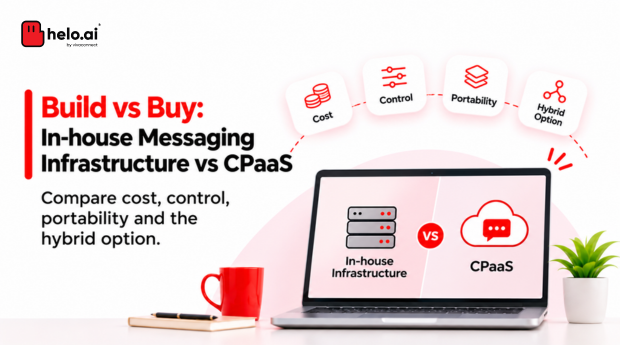


As businesses expand their customer communication across WhatsApp, SMS, RCS, Voice and Email, managing the infrastructure behind these channels becomes a bigger decision.
Should you build your own messaging infrastructure or use a CPaaS provider?
Building in-house gives you greater control over the technology and architecture. Buying through CPaaS can reduce the effort involved in developing and maintaining multiple channel integrations.
But the decision is not just about development costs or the number of features a platform offers. It is about who manages the infrastructure, what your team needs to own, and what it will cost to operate the system over time.
Let's compare both approaches and look at when each makes sense.
Build only the messaging components that differentiate your product, and buy CPaaS for the communication infrastructure that supports it. Compare total cost of ownership over the same period and decide component by component.
- Building means your team owns development, hosting, channel connectivity, delivery monitoring, security and compliance.
- Buying CPaaS means a provider runs the channel connections, while your team still integrates it and owns business logic.
- A hybrid keeps applications, customer data and consent records with you, and uses CPaaS for communication infrastructure.
- In India, either route needs DLT registration for commercial SMS and a plan for DPDP consent standards.
- Helo.ai is a CPaaS provider and publishes this guide, so weigh its section accordingly.
What does building messaging infrastructure in-house involve?
Building in-house means developing and maintaining the systems your business uses to send, receive and manage customer communications.
Depending on your requirements, this may include:
- Connecting directly with messaging providers and channels.
- Building APIs to send and receive messages.
- Managing delivery reports, failures, retries and webhooks.
- Maintaining sender identities, templates and channel configurations.
- Managing communication preferences, consent records and opt-outs.
- Monitoring performance, security and infrastructure availability.
- Updating integrations as channel requirements change.
The work does not end when the first message is successfully delivered. Your team must continue managing the system as message volumes grow, providers change their APIs and new channels are introduced.
For technology companies where messaging is part of the product they sell, building selected parts of this infrastructure may make sense. For businesses that primarily use messaging to communicate with customers, developing the entire stack may be a significant ongoing commitment.
What does buying CPaaS infrastructure mean?
Communications Platform as a Service (CPaaS) provides communication capabilities through APIs and a platform.
Instead of developing every channel integration independently, your business connects to a provider that offers access to supported communication channels such as WhatsApp, SMS, RCS, Voice and Email.
Depending on the provider and agreement, the platform may also offer message delivery events, reporting, channel management and other communication capabilities.
Your engineering team still needs to integrate the platform with your applications and internal systems. However, it does not have to build every underlying channel connection from scratch.
The distinction is important: buying CPaaS does not mean handing over your customer experience or business logic. It means using an existing communication layer to support them.
In-house messaging infrastructure vs CPaaS: What's the difference?
The main difference is who builds, operates and maintains the communication infrastructure.
| Evaluation area | Build in-house | Buy through CPaaS |
|---|---|---|
| Initial investment | Requires development, integration and infrastructure setup | Requires provider onboarding, integration and platform fees |
| Time to launch | Depends on development, testing and provider onboarding | Can be faster when required channels and APIs are already supported |
| Customisation | Greater control over architecture and internal components | Depends on available APIs, configuration and provider flexibility |
| Channel connectivity | Your team manages provider relationships and integrations | Provider offers access to its supported channels |
| Maintenance | Your team maintains the messaging stack | Provider maintains its platform; your team maintains its applications and integrations |
| Delivery monitoring | Your team builds and operates monitoring and recovery processes | Depends on the provider's reporting, events, support and service commitments |
| Scalability | Your team designs and manages capacity | Depends on provider capacity, limits and service terms |
| Compliance | Your team manages applicable obligations and controls | Provider may offer supporting tools, but your business retains its obligations |
| Vendor dependency | Less dependence on one platform, but more internal operational responsibility | Greater provider dependency; portability depends on architecture and contract |
| Long-term costs | Engineering, infrastructure, maintenance and provider costs | Platform fees, usage charges, integration and internal management costs |
Neither approach automatically costs less. The right comparison is the total cost of ownership over the period you expect to use the infrastructure.
The real cost of building your own messaging infrastructure
An in-house build can look economical when the initial estimate only includes development. But the actual investment includes much more.
1. Development and engineering
Your team needs to design the architecture, build APIs, connect providers, test integrations and maintain the system. The more channels you support, the more integration work may be involved.
2. Infrastructure and hosting
Servers, databases, security, monitoring, backups and capacity management all contribute to ongoing costs.
3. Channel connectivity
WhatsApp, SMS, RCS, Voice and Email have different technical and operational requirements. Your team needs to account for provider onboarding, channel-specific configurations and changes over time. Since 1 July 2025, Meta has charged for WhatsApp Business Platform messages on a per-message basis. Templates fall into marketing, utility or authentication categories.
4. Delivery monitoring and recovery
A messaging system needs more than a successful API response. Your team may need to track delivery events, identify failed messages, manage retries and investigate provider or network issues.
5. Maintenance and support
APIs change, integrations fail and new requirements emerge. Your business needs people who can manage these issues and support the system when problems occur.
6. Security and compliance
Your business must manage applicable data protection, communication permissions, security and audit requirements. Using an external provider does not remove these responsibilities. In India, TRAI requires commercial SMS senders to register their entity, headers and templates on a DLT platform. India's DPDP Rules make notice and consent standards effective from 13 May 2027, so plan consent records now.
7. Opportunity cost
Engineering time spent maintaining communication infrastructure is time that cannot be spent on your core product, applications or customer-facing capabilities.
How to calculate the total cost of ownership
Before comparing an in-house build with a CPaaS proposal, include these costs in your estimate:
| Cost component | Questions to consider |
|---|---|
| Initial development | What will it cost to build and test the infrastructure? |
| Integration | How many channels and external providers need to be connected? |
| Infrastructure | What will hosting, security, monitoring and backups cost? |
| Engineering | How much ongoing time will maintenance require? |
| Operations | Who handles delivery failures, incidents and support? |
| Compliance | What controls, records and reviews must your business maintain? |
| Expansion | What will adding another channel or market involve? |
| Exit and migration | What will it take to move providers or migrate the system? |
For CPaaS, use the same discipline. Include setup and integration costs, recurring platform charges, message or usage fees, additional services, support and potential migration costs.
A fair comparison looks at the same business requirements over the same time period. It should not compare an in-house development estimate with only the monthly CPaaS subscription.
Comparing build and buy costs for your messaging?
Talk to the Helo.ai team about your channels, volumes and integration needs, or read the Enterprise Messaging Playbook on cost, compliance and engagement.
When does building in-house make sense?
Building your own messaging infrastructure may be worth considering when:
- Messaging technology is a core part of the product you sell.
- Your requirements cannot be met by available providers or APIs.
- You need specialised architecture or control over specific infrastructure components.
- You have an experienced engineering and operations team.
- You can justify the long-term cost of maintaining the system.
For example, a technology company developing a communications product may need to build its own routing logic or specialised messaging components because these capabilities are central to its offering.
However, even businesses with strong engineering teams do not necessarily need to build every layer. Direct channel connectivity, specialised integrations and internal orchestration can be evaluated separately.
When should you choose CPaaS?
CPaaS is often a practical option when communication supports your core business rather than being the product itself.
Consider it when:
- You need access to multiple communication channels.
- Your team wants to avoid building every channel integration independently.
- You want to reduce the operational effort involved in maintaining messaging infrastructure.
- Your communication requirements are growing.
- You need APIs that can connect with existing business applications.
- Your engineering resources are better used on core business capabilities.
For example, a retail business may use SMS for order updates, WhatsApp for customer communication, RCS for rich promotional messages, Voice for notifications and Email for written updates.
A CPaaS provider can help bring these channels together through a common communication layer. The business still needs to define its communication strategy, integrate its systems and manage customer permissions.
Don't overlook vendor dependency and portability
Buying CPaaS reduces some infrastructure responsibilities, but it introduces a different consideration: dependence on an external provider.
Before choosing a platform, ask:
- Can you export message history and relevant delivery records?
- Can your consent and communication preference records be accessed independently?
- Are APIs and integration documentation clearly available?
- Can you switch providers without rewriting your entire application?
- Are there minimum commitments, volume tiers or exit charges?
- What happens to your service if the provider experiences an outage?
- What support and escalation commitments are included in the agreement?
One practical way to reduce dependency is to keep a thin communication interface within your own application. Your internal systems call that interface, and it connects to the selected CPaaS provider.
This does not eliminate migration work, but it can prevent provider-specific API formats from spreading throughout your application.
Your business should also retain access to important customer records, communication history and consent evidence rather than relying entirely on a provider's dashboard.
There is a third option: Build what differentiates you, buy what supports it
The decision does not have to be entirely one or the other.
A hybrid approach allows your business to own its core applications, business logic and customer experience while using CPaaS for communication infrastructure.
| What to build and own | What to use CPaaS for |
|---|---|
| Internal applications and business systems | Supported messaging APIs and channel connectivity |
| Business rules and specialised workflows | Communication infrastructure |
| Customer data and communication preferences | Available channel management and delivery reporting |
| Consent records and audit requirements | Provider-supported messaging capabilities |
| Internal integrations and application logic | Access to supported channels such as WhatsApp, SMS, RCS, Voice and Email |
For example, an e-commerce business can retain its customer database, order management system and business rules. It can then connect those systems to a CPaaS provider for customer notifications across supported messaging channels.
This keeps the business in control of its customer experience without requiring it to build every communication integration itself.
Build vs buy: A practical decision framework
Before making a decision, evaluate these questions.
| Ask yourself | What it means for your decision |
|---|---|
| Is messaging technology part of the product we sell? | If yes, consider building the specialised components that differentiate your product. |
| Do we have a team to maintain the infrastructure long term? | If not, the operational commitment of an in-house build may be difficult to justify. |
| Do we need multiple channels or provider connections? | Evaluate CPaaS platforms that support the channels and markets you need. |
| Are our requirements highly specialised? | Identify which components genuinely need custom development. |
| Is faster implementation important? | An established CPaaS platform may reduce the work required to build channel integrations. |
| Do we need to retain control over customer data and business logic? | A hybrid approach can keep these responsibilities in-house. |
| Can we move providers if our requirements change? | Check API portability, data exports, contract terms and migration costs. |
| Have we compared long-term operating costs? | Compare total cost of ownership, not just initial development or subscription fees. |
The answers may point towards a complete in-house build, CPaaS or a combination of both. The important thing is to decide at the component level rather than treating the entire messaging stack as one indivisible investment.
How Helo.ai fits into the decision
Helo.ai provides a CPaaS platform for businesses that want to manage communication across WhatsApp, SMS, RCS, Voice and Email.
Instead of developing separate communication integrations for every channel, businesses can use Helo.ai as a common communication layer.
Its platform supports businesses looking to bring their messaging channels together, with capabilities such as broadcast campaigns through Helo Broadcast, and segmentation and analytics in its email product.
The choice of CPaaS does not mean giving up ownership of your applications, customer data or business logic. It gives your team another way to manage the communication infrastructure that connects your business with customers.
Evaluating whether to build or buy your messaging infrastructure?
Talk to an expert at Helo.ai.
For a wider view of the market, read Helo.ai's guide to the best CPaaS providers or its explainer on what CPaaS is. The enterprise messaging guide covers choosing channels and launching.
Frequently asked questions
Is CPaaS better than building messaging infrastructure in-house?
It depends on your requirements. CPaaS can be more practical when you need established communication channels without maintaining the entire infrastructure yourself. Building may make sense when messaging technology is central to your product or requires specialised control.
Is building messaging infrastructure cheaper than buying CPaaS?
Not necessarily. In-house development involves engineering, hosting, integrations, maintenance, security and operational costs. CPaaS involves provider, usage and integration charges. Compare the total cost of ownership over the same period before deciding.
Can a business use CPaaS and its own infrastructure together?
Yes. A business can retain its applications, customer data and business logic while using CPaaS for communication APIs and channel connectivity. This hybrid approach can balance control and operational effort.
Does CPaaS eliminate the need for an engineering team?
No. Engineering teams may still be needed for application development, integrations, business logic, security and internal systems. CPaaS can reduce the need to build and maintain the underlying communication infrastructure.
How can a business avoid becoming too dependent on one CPaaS provider?
Keep provider-specific integrations behind an internal communication interface where practical. Also check data export options, API documentation, contract terms, message history access and migration requirements before choosing a provider.
What is CPaaS?
CPaaS stands for Communications Platform as a Service. It provides communication capabilities through APIs and a platform, giving access to channels such as WhatsApp, SMS, RCS, Voice and Email.
What must Indian businesses handle whether they build or buy?
Commercial SMS in India requires DLT registration of your entity, headers and templates. DPDP notice and consent standards apply from 13 May 2027, and consent records remain the business's responsibility.
Can a business integrate with WhatsApp directly instead of using a CPaaS?
Yes. Meta's pricing documentation refers to Solution Partners and directly-integrated clients. With direct integration, your team owns templates, retries, delivery monitoring and consent records, so compare that workload with a provider's total cost.
The takeaway
Building messaging infrastructure gives your business direct control, but also makes your team responsible for its development, maintenance and operations.
CPaaS offers another route: use an established communication layer while retaining ownership of your applications, customer data and business logic.
For many businesses, the decision is not about building everything or outsourcing everything. It is about identifying which parts genuinely need to be built in-house and which are better handled by a specialist communication platform.
Disclaimer. This article is an editorial comparison and general information, not legal, financial or engineering advice. Costs, compliance rules and platform terms change, so confirm current requirements with your advisers and providers. Helo.ai is a CPaaS provider and publishes this guide. Facts about Meta, TRAI and India's DPDP Rules were checked on 13 November 2026. Product and company names belong to their owners.