.jpeg)
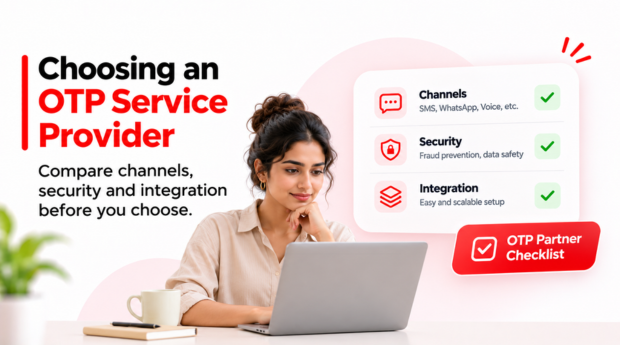


OTP verification is an important part of customer onboarding, account access and transaction security. For fintech companies, e-commerce businesses and mobile applications, a delayed or failed OTP can interrupt a signup, block a login or leave a transaction incomplete.
Choosing an OTP service provider involves more than comparing SMS rates. Businesses need to consider supported verification channels, delivery reliability, fallback options, fraud controls, API integration and compliance with Indian telecom regulations.
Several providers offer OTP services in India, but their capabilities differ. This guide compares four options to help product, engineering and fraud teams shortlist a provider based on their requirements.
There is no single best OTP service provider in India. Shortlist by the channels you need, how failover works, fraud controls, DLT support and cost per successful verification, then test with your own users.
- Helo Verify lists SMS, WhatsApp and email OTP with SIM binding and flash calls.
- Infobip's 2FA API lists SMS, voice and email.
- MSG91 lists SMS, voice, email, WhatsApp and invisible OTP.
- Twilio Verify lists SMS, WhatsApp, voice, email and Silent Network Authentication. Its automatic SNA-to-SMS fallback is a pilot feature.
What should you look for in an OTP service provider?
Before comparing providers, evaluate these six areas:
Watch for SMS pumping: Fraudsters can trigger large volumes of OTP requests to inflate message traffic and costs. Ask each provider how it detects this, and how such traffic is billed.
The best provider is not necessarily the one offering the lowest SMS rate. It is the one that balances successful verification, security, user experience and operating cost.
If you are new to OTP verification, start with Helo.ai's explainer on SMS verification.
4 OTP service providers to consider in India
How we compared: We reviewed each provider's public product pages and documentation in November 2026. This is not a delivery, speed or price test. When a capability is missing from a page, it means our review did not establish it, not that it is unavailable. Helo.ai publishes this guide and offers Helo Verify.
Helo.ai – Helo Verify
Best to evaluate for: Multi-channel verification and SIM-binding security
Helo Verify is an authentication solution for generating, delivering and validating verification codes. Its public product documentation describes multi-channel verification alongside SIM-binding security.
Publicly listed capabilities:
- OTP verification through SMS, WhatsApp and email.
- SIM-binding security to associate authentication with a user's registered SIM.
- Real-time user verification.
- Flash-call-based verification as a way to reduce authentication costs.
- API-based integration.
- Real-time insights on authentication success, delivery rates and fraud attempts, according to the product FAQ.
SIM binding can help mitigate risks associated with unauthorised access and SIM-related attacks. Its effectiveness depends on the implementation and the security checks used alongside it.
What to evaluate
- Confirm whether voice OTP is available as a delivery channel.
- Understand the SIM-binding process and its compatibility with different devices and networks.
- Check whether channel fallback is automatic or configurable.
- Review available verification analytics and integration requirements.
Helo Verify
Multi-channel OTP verification with SIM-binding security.
- SMS, WhatsApp and email verification.
- SIM-binding security.
- Real-time authentication.
- Flash-call-based verification.
Explore the product and discuss your verification requirements. The product FAQ says a trial is available.
Infobip
Best to evaluate for: Enterprise 2FA APIs and global communication infrastructure
Infobip offers a dedicated Two-Factor Authentication service that allows businesses to generate PINs, deliver them and verify the codes entered by users.
Documented 2FA capabilities:
- SMS OTP delivery.
- Voice OTP delivery.
- Email verification.
- API-based PIN generation and verification.
Infobip also offers a wider communications platform that includes channels such as WhatsApp. However, its dedicated 2FA documentation lists SMS, voice and email as the supported 2FA channels. Businesses should confirm the exact WhatsApp authentication integration rather than assuming it is included in the same 2FA workflow.
What to evaluate
- Which channels are available within the dedicated 2FA service.
- Whether WhatsApp authentication is available for the required integration.
- Country-specific coverage, routing and pricing.
- Sender identity and template requirements.
MSG91
Best to evaluate for: Configurable OTP workflows and India-focused delivery
MSG91 offers OTP APIs and an OTP Widget that businesses can integrate into websites and mobile applications.
Its documentation describes configurable verification workflows, including primary-channel selection, resend settings and OTP expiry.
Documented capabilities:
- SMS OTP.
- Voice OTP.
- Email OTP.
- WhatsApp OTP, listed in its integration guide and on its OTP Widget pricing page, subject to account setup.
- Invisible OTP for supported mobile-app implementations.
One point needs attention: MSG91 describes invisible OTP as a mobile-network-based verification option for supported mobile apps, which falls back to the primary mobile channel if it fails. It should not automatically be treated as equivalent to every provider's Silent Network Authentication offering.
What to evaluate
- Confirm current WhatsApp availability for your account and subscription.
- Check whether invisible OTP supports your target devices and networks.
- Understand the difference between default and custom configurations.
- Review resend limits, expiry settings and billing arrangements.
Twilio Verify
Best to evaluate for: Developer-led verification and a broad range of authentication channels
Twilio Verify is a managed verification API designed to handle OTP generation, delivery and verification across multiple channels.
It is relevant to engineering teams that want to integrate authentication into their applications without building the entire verification workflow themselves.
Documented capabilities:
- SMS verification.
- WhatsApp verification.
- Voice verification.
- Silent Network Authentication.
- Email and other authentication options.
- Verification channel selection and fallback capabilities.
Twilio's documentation describes automatic channel selection that attempts Silent Network Authentication and uses SMS as a fallback when needed. However, its automatic SMS fallback is currently marked as a pilot feature and requires access from Twilio.
What to evaluate
- Country-specific channel support and pricing.
- Whether the required fallback feature is generally available or still in pilot.
- Configuration requirements for Silent Network Authentication.
- Integration, data and operational requirements.
OTP service providers in India: Comparison
The table below compares capabilities documented for the providers' respective products. It is not an independent performance ranking. Channel availability, configuration and country coverage can differ.
| Provider | SMS OTP | WhatsApp OTP | Voice OTP | Silent / SIM-based |
|---|---|---|---|---|
| Helo.ai – Helo Verify | Yes | Yes | Not listed on the product page | SIM binding; flash calls |
| Infobip 2FA | Yes | Not listed in dedicated 2FA channel documentation | Yes | Not established in dedicated 2FA documentation |
| MSG91 OTP Widget | Yes | Yes (integration guide and pricing page) | Yes | Invisible OTP for supported mobile apps |
| Twilio Verify | Yes | Yes | Yes | Silent Network Authentication |
A few distinctions are important:
- Helo Verify publicly lists SMS, WhatsApp and email, alongside SIM binding and flash calls. Voice OTP and automated failover need confirmation.
- Infobip's dedicated 2FA API lists SMS, voice and email. WhatsApp is part of its wider communications platform, but the specific authentication integration needs to be checked.
- MSG91 lists WhatsApp OTP in its integration guide and OTP Widget pricing. Confirm setup requirements for your account before committing.
- Twilio supports Silent Network Authentication. Its automatic SNA-to-SMS fallback is currently a pilot feature, not a universally available default.
For WhatsApp as a verification channel, see Helo.ai's guides to WhatsApp vs SMS for OTP and sending WhatsApp verification codes.
How much does an OTP service cost in India?
OTP pricing varies by provider, channel, destination, traffic volume and commercial agreement. A low SMS rate does not necessarily translate into a low verification cost.
When requesting quotations, ask providers to separate these charges:
| Cost component | What to check |
|---|---|
| Platform fee | Monthly subscription or verification fee |
| SMS charges | Rate per message and destination |
| WhatsApp charges | Applicable authentication-message and provider charges |
| Voice charges | Whether calls are billed by attempt or duration |
| Retry charges | Whether resend attempts are charged separately |
| Failed attempts | Whether unsuccessful delivery or verification attempts are billed |
| Integration | Setup, implementation and support fees |
For WhatsApp, Meta has charged per message since 1 July 2025, and authentication-template rates vary by market and volume tier. India is one of the markets where a separate authentication-international rate can apply. Check Meta's pricing page and ask whether a quote includes Meta's charge.
A useful comparison metric is cost per successful verification:
Cost per successful verification = Total verification costs ÷ Successful verifications
- Total verification costs: platform fees plus every channel charge, including retries and channel switching.
- Successful verifications: codes that users actually entered and verified, not messages sent.
Include retries, channel switching and platform fees in the calculation. A provider that looks inexpensive per message may cost more when actual verification outcomes are considered.
Ask for pricing based on your monthly verification volume, destination mix, expected channel usage and retry patterns.
For what drives SMS costs in India, see Helo.ai's guide to SMS API pricing in India.
India-specific requirements: Don't overlook DLT compliance
Businesses sending bulk SMS in India must account for applicable requirements under TRAI's Telecom Commercial Communications Customer Preference Regulations (TCCCPR), 2018.
TRAI's sender guidance explicitly includes OTP, transactional and service-message traffic within the relevant Principal Entity requirements.
These include:
- Principal Entity registration.
- Header registration and assignment.
- Content template registration.
- Passing the required Principal Entity, header and content-template information to telecom service providers.
- Consent-template registration and consumer consent acquisition, where applicable.
Businesses should confirm the correct message classification and implementation with their telecom service provider. Do not assume OTP messages are automatically exempt from the applicable framework.
For help with headers and templates, see Helo.ai's DLT management service.
How to choose the right OTP service provider
Your choice should reflect your application, users and security requirements.
| Business requirement | What to prioritise |
|---|---|
| Fintech and financial applications | Strong authentication controls, SIM-related risk signals and auditability |
| E-commerce and retail applications | Quick verification, configurable retries and suitable channel alternatives |
| High-volume consumer applications | API scalability, monitoring, rate limits and cost per successful verification |
| Mobile-first applications | Invisible or network-based verification where supported |
| Businesses with international users | Country-wise channel coverage, routing and local compliance |
| Applications with delivery issues | Configurable fallback between supported verification channels |
Before signing a contract, run a proof of concept using your actual user base.
Test different operators, devices, locations and network conditions. Measure delivery time, successful verification rate, retry frequency, failure reasons and total cost.
This gives you a more realistic picture than relying only on advertised delivery claims.
Frequently asked questions
Which is the best OTP service provider in India?
There is no single best provider for every business. Helo.ai, Infobip, MSG91 and Twilio offer different verification capabilities. Compare channel availability, fraud controls, API integration, India coverage and cost per successful verification before deciding.
What is the difference between an OTP SMS API and an OTP service?
An OTP SMS API primarily handles sending a verification code through SMS. An OTP service can manage more of the verification process, including code generation, expiry, retries, validation, channel selection and fraud controls.
Can OTPs be delivered through WhatsApp and voice?
Yes. Providers such as MSG91 and Twilio document WhatsApp and voice verification options. However, availability depends on provider configuration, market support and applicable platform requirements.
What is silent authentication?
Silent authentication verifies access to a mobile number through supported mobile-network and SIM-related checks without requiring the user to enter an OTP. Availability depends on operator coverage, device conditions and provider integration.
What should businesses check before integrating an OTP API?
Review API documentation, supported channels, code expiry, retry controls, rate limits, webhooks, security practices, delivery reporting, pricing and compliance requirements.
Is DLT registration required for OTP SMS in India?
TRAI's sender guidance includes OTP and transactional bulk communications within the relevant Principal Entity requirements under TCCCPR, 2018. Businesses should confirm their registration, header, template and consent obligations with their telecom service provider.
How much does WhatsApp OTP cost in India?
Meta charges WhatsApp authentication-template messages per message, with rates that vary by market and volume tier, and India has a separate authentication-international rate in some cases. Providers may add their own fee, so ask for the total per-message cost.
What is SMS pumping in OTP verification?
SMS pumping is fraud in which attackers trigger large numbers of OTP requests to inflate message traffic. Rate limits, resend cooldowns and number-risk checks help reduce it.
Conclusion
Choosing an OTP service provider is ultimately about balancing successful verification, security, integration and cost.
A basic SMS API may be enough for a simple login flow. Applications handling large user bases or sensitive transactions may need multiple verification channels, fallback mechanisms and additional fraud controls.
Compare providers against your actual requirements, test their performance with your users and calculate the cost per successful verification before making a decision.
Looking for an OTP verification solution for your application?
Explore Helo Verify or talk to the Helo.ai team to discuss your requirements.
Disclaimer. This article is general information, not legal, compliance or procurement advice. Provider capabilities, availability and pricing change, so confirm them with each provider before you decide. The comparison reflects public documentation reviewed in November 2026, not a performance test. Helo.ai is the publisher and offers Helo Verify. Product and company names belong to their owners.