.jpeg)
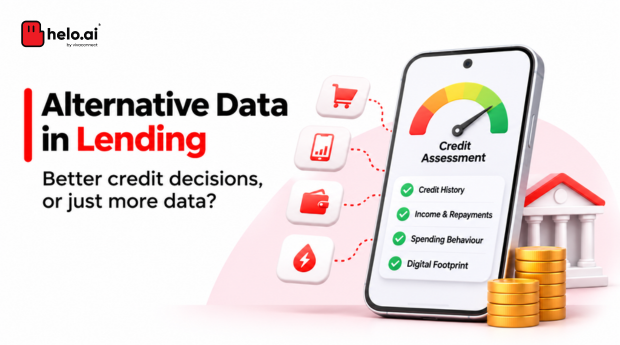


A borrower may have a regular income, make frequent business transactions and repay suppliers on time, yet have a limited credit history. A traditional credit report may not capture the complete picture of that borrower's financial position.
This is one reason lenders are looking beyond conventional credit information. Bank statements, digital payment transactions, GST records and other financial data can offer additional insights into a borrower's income, cash flow and repayment capacity.
In India, this shift is becoming more visible through the Account Aggregator framework, digital lending infrastructure and the growing use of transaction data in credit assessment.
But there is an important distinction between having access to more information and making better lending decisions. Alternative data in lending is changing how some borrowers are assessed. The larger question is whether it is consistently improving credit access, risk assessment and loan performance.
Alternative data, such as bank transactions, GST records and Account Aggregator feeds, adds context to credit decisions but rarely replaces bureau data. Reported evidence shows growing use and some measurable gains, yet adoption alone does not prove better lending outcomes.
- A reported FACE survey found 84% of lenders combine traditional and alternative data, and 3% use alternative data alone.
- On 31 March 2026, 989 institutions were live as Financial Information Users on the Account Aggregator network.
- One fintech lender study linked Account Aggregator eligibility to a 3.4-point lower NPA rate. It should not be generalised.
- Measure approvals, risk-adjusted defaults, pricing, thin-file outcomes, model performance and fairness.
Why lenders are looking beyond traditional credit information
Traditional credit assessment relies heavily on credit bureau reports, income documents, existing liabilities and repayment history.
These remain important because they help lenders understand how a borrower has handled credit obligations in the past. However, they may provide an incomplete picture for people who are new to formal credit or have limited borrowing histories.
Consider a small business owner who has never taken a formal business loan. The borrower may have regular customer payments, consistent business transactions and predictable operating expenses. But without an established credit history, a lender may have limited information to assess the business's financial position.
A similar challenge exists for first-time borrowers, self-employed professionals and individuals with irregular income patterns.
Alternative data can help fill some of these information gaps.
For example:
Bank transaction data can help lenders understand cash inflows, spending patterns and account balances.
GST records can provide information about business turnover and filing patterns.
Digital payment history can offer insights into transaction frequency and cash-flow activity.
Utility payment records may provide additional evidence of payment behaviour.
Employment and income-related information can help lenders assess financial stability.
These sources do not replace credit bureau information. They add context that may not be visible in a conventional credit assessment.
What alternative data is actually being used by lenders?
Alternative data is not one category of information. It includes different sources that serve different purposes in the lending process.
A Business Standard report published in April 2025, citing data from the Fintech Association for Consumer Empowerment (FACE), reported that 84% of lenders surveyed used a combination of traditional and alternative data for underwriting. Only 3% reportedly relied on alternative data alone.
The report also shared the following findings about data sources used by lenders:
Data source: Share of lenders reportedly using it
These findings suggest that alternative information is increasingly being added to conventional underwriting rather than replacing it.
There is an important limitation, however. These are reported survey findings, not a census of every lender in India. The underlying report does not provide enough information about the survey's sample size and methodology to establish how representative the results are across the entire lending market.
The figures also indicate reported use of different data sources. They do not establish how frequently each source influences an approval decision or whether its use improves loan performance.
That distinction matters when evaluating the actual impact of alternative data.
Account Aggregators are changing how financial information is shared
One of the most important developments in India's financial data ecosystem is the Account Aggregator (AA) framework.
Introduced by the Reserve Bank of India in 2016, the framework allows individuals and businesses to share financial information between institutions through a consent-based system.
RBI's Master Direction for NBFC-Account Aggregators is dated 2 September 2016.
For example, a borrower applying for a business loan may authorise a lender to access relevant bank account information through an Account Aggregator. Instead of collecting and manually reviewing multiple statements, the lender can receive financial information digitally, subject to the borrower's consent and the applicable framework.
The framework is designed to give customers control over what information is shared and with whom. Account Aggregators facilitate the transfer of financial information; they do not independently decide whether a borrower qualifies for credit.
The ecosystem has also expanded considerably.
According to the Department of Financial Services, as of 31 March 2026:
- 179 financial institutions had gone live as Financial Information Providers.
- 989 financial institutions had gone live as Financial Information Users.
- More than 2.88 billion financial accounts were enabled for data sharing.
- 284.6 million accounts had been linked by users to the framework.
These figures indicate the scale of the infrastructure. However, enabled accounts and linked accounts should not be confused with the number of active borrowers receiving loans through the framework.
The Account Aggregator ecosystem makes financial information easier to access with consent. Whether that information changes the quality of a lending decision depends on how lenders interpret and use it.
Where alternative data can make a measurable difference
The value of alternative data becomes clearer when it helps lenders answer questions that traditional information cannot fully address.
Assessing borrowers with limited credit histories
For new-to-credit borrowers, a limited credit file does not necessarily mean an inability to repay.
Cash-flow information, employment records and transaction patterns may provide additional evidence of financial activity. This can help lenders distinguish between borrowers who genuinely present higher risk and those who simply have limited formal credit histories.
Understanding MSME cash flows
Small businesses may have irregular income, seasonal sales and multiple payment channels. A conventional income document may not fully reflect their operating position.
Bank transactions, GST filings and digital payment records can help lenders understand business activity more closely.
A study published in August 2026 in The IUP Journal of Bank Management examined 214,836 loan applications from one Indian fintech MSME lender between 2019 and 2024.
Its abstract reported that eligibility under the Account Aggregator framework was associated with:
A 4.1-percentage-point increase in loan approval probability.
A 94-basis-point reduction in offered interest rates.
A 21% increase in sanctioned amounts.
A 3.4-percentage-point reduction in non-performing asset rates.
These are meaningful findings because they go beyond measuring data adoption and examine lending outcomes.
The authors report a 19% relative gain in approval probability. They use a difference-in-differences design, with staggered bank onboarding between September 2021 and March 2023. Gains were about twice as large for Tier-2 and Tier-3 borrowers and first-generation entrepreneurs.
However, the study covers one fintech lender's applications. Its results should not automatically be generalised to the entire Indian lending market. The reported associations should also be interpreted in the context of the study's methodology rather than treated as proof that Account Aggregator access alone caused every improvement.
Monitoring repayment capacity
Alternative information can also help lenders understand changes in a borrower's financial position after a loan is disbursed.
For example, transaction patterns may reveal changes in business cash flows or regular income credits. This can help lenders identify accounts that may require closer monitoring.
However, transaction activity should not be treated as a direct measure of repayment ability. A high volume of transactions does not necessarily mean a borrower has sufficient disposable income after expenses and existing obligations.
More data does not automatically mean better credit decisions
Alternative data can improve the information available to lenders, but it also introduces new challenges.
Data quality: Bank transactions, digital payment records and third-party information may contain gaps, inconsistencies or incomplete descriptions. Incorrect or outdated information can affect the assessment.
Context: A high number of transactions does not always indicate strong financial health. A business may have substantial inflows but equally high operating expenses and outstanding liabilities.
Borrower consent and privacy: Financial information should only be collected and used in accordance with applicable regulatory requirements and the borrower's consent. More data should not become a reason to collect information that is unnecessary for the lending purpose.
Bias and fairness: Some data sources may disadvantage borrowers who have limited digital activity, irregular income or different financial habits. A model that treats low digital activity as a sign of higher risk may exclude otherwise creditworthy applicants.
Model explainability: Lenders need to understand why a model has approved or rejected an application. If the decision depends on multiple data sources and complex calculations, explaining the outcome and identifying errors can become more difficult.
The RBI's Digital Lending Directions, 2025 place clear responsibilities on regulated entities around data collection and usage. Digital lenders must ensure that data collection is need-based, supported by prior and explicit borrower consent, and accompanied by appropriate privacy safeguards.
The regulated lender remains responsible for its lending decisions, including where technology providers or lending service providers support parts of the process.
According to law firm S.S. Rana & Co., the Directions allow camera, microphone or location access only once, for KYC, with explicit consent. They bar lending service providers from accessing files and call logs.
Planning borrower communication around consent?
Consent requests, onboarding steps and repayment updates can reach borrowers by WhatsApp or SMS. Read Helo.ai's WhatsApp Business API guide for fintech, or talk to the team.
Why the overall impact is still difficult to measure
The growing use of alternative data is visible. Measuring its actual contribution to better lending outcomes is more complicated.
There are several reasons for this.
- First, alternative data is usually combined with traditional credit information. When a lender approves an application, it can be difficult to isolate whether the decision changed because of bank transactions, GST records, credit bureau information or the combination of these sources.
- Second, lenders use different data sources and underwriting models. A model that works well for salaried personal-loan applicants may not produce the same results for small businesses or first-time borrowers.
- Third, approval rates alone do not establish better lending outcomes. A lender may approve more applications, but the impact must also be assessed through repayment behaviour, delinquencies, defaults and portfolio performance over time.
- Fourth, access to data is not the same as meaningful adoption. A financial account may be enabled for sharing without being linked by a customer or used in an actual credit decision.
Research also shows why the impact needs to be examined carefully.
A 2026 study published in the Journal of Financial Intermediation, titled Beyond the Bureau: Interoperable Payment Data for Loan Screening and Monitoring, examined payment histories linked to non-bank small-business loans in India.
The study used transaction data from January 2015 to February 2019, drawn from a fintech payment ecosystem serving merchants. It found that payment data improved lenders' ability to screen and monitor loans beyond traditional information sources. It also identified a trade-off: borrowers with poor credit scores and limited payment histories could be disadvantaged when lenders relied more heavily on payment-based screening.
The study offers useful evidence, but its underlying data comes from a specific lending and payment ecosystem over a historical period. Its findings should not be treated as representative of every borrower, lender or current credit market in India.
This is an important reminder that additional information can improve risk assessment for some borrowers while creating new barriers for others.
To understand the real impact, lenders need to measure more than the number of data sources connected to their systems.
Useful measures include:
| Measure | The question it answers |
|---|---|
| Approval rates | Are more creditworthy borrowers being approved? |
| Risk-adjusted default rates | Are additional approvals translating into acceptable repayment performance? |
| Pricing | Are better-informed assessments helping lenders offer more appropriate interest rates? |
| Thin-file borrower outcomes | Are people with limited credit histories gaining access to formal credit? |
| Model performance | Does the assessment remain accurate across different borrower groups and economic conditions? |
| Fairness | Are certain customer groups being unfairly excluded because of limited digital or financial data? |
These measures help distinguish genuine improvements in underwriting from a simple increase in data availability.
Conclusion
Alternative data is becoming an important part of India's lending ecosystem. Account Aggregators, digital payment infrastructure and business transaction records are giving lenders access to information that traditional credit assessments may not capture.
There is also emerging evidence that these sources can improve credit access and risk assessment, particularly for MSMEs and borrowers with limited credit histories.
But wider adoption does not automatically establish better lending outcomes. The real impact depends on data quality, borrower consent, model accuracy, fairness and the ability to measure repayment performance over time.
For lenders, the opportunity is not to collect as much information as possible. It is to identify which information genuinely improves their understanding of a borrower.
Alternative data will matter most when it helps lenders make better-informed decisions, not simply when it gives them more data to work with.
Reaching borrowers clearly at every stage
Tell the Helo.ai team which borrower moments matter most, from onboarding and consent to repayment, and they can help you plan the communication.
Frequently Asked Questions
What is alternative data in lending?
It is financial and behavioural information beyond a credit bureau report, such as bank transactions, GST records, digital payment history, utility payments and income information. It adds context rather than replacing bureau data.
How do lenders use alternative data for credit scoring?
Mostly alongside traditional data. A 2025 survey reported by Business Standard, citing FACE, found 84% of lenders combined both and 3% used alternative data alone. The sample size was not disclosed.
What is the Account Aggregator framework in India?
It is a consent-based system, introduced by RBI in 2016, for sharing financial information between institutions. Account Aggregators transfer data. They do not decide whether a borrower qualifies for credit.
How does alternative data help MSME lending?
Bank transactions, GST filings and digital payment records can show business activity that income documents miss. One study of a single fintech MSME lender linked Account Aggregator eligibility to higher approval and lower NPA rates.
Can alternative data improve credit access for new-to-credit borrowers?
It can help separate genuinely risky borrowers from those with thin files. Evidence is mixed: one study found borrowers with poor credit scores and limited payment histories could be disadvantaged, so thin-file outcomes should be measured.
Note. This article is an editorial guide and general information, not legal or financial advice. Regulations and research change, so confirm current requirements with the RBI and your advisers. Helo.ai is a CPaaS provider and publishes this guide. Figures come from the sources named, not from Helo.ai. Facts were checked on 13 November 2026.