.jpeg)
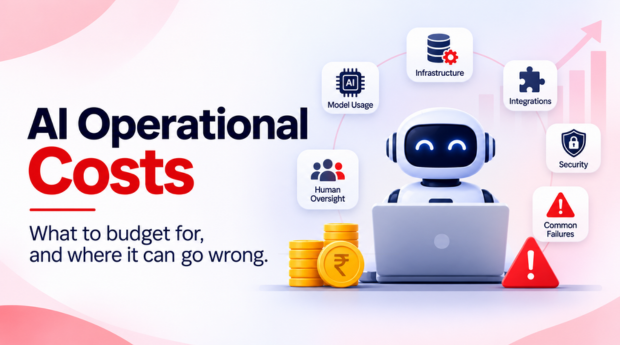


Quick answer: After an AI system goes live, the main costs are model usage, infrastructure, integrations, monitoring, human oversight and security. Common failures include inaccurate outputs, poor data, broken integrations and unclear accountability. Track cost per successful task, not just the total AI bill.
AI operational costs are the ongoing expenses of running an AI system after launch, including model usage, infrastructure, integrations, monitoring, human oversight and security.
An AI system passes testing, receives approval and goes live. It starts responding to requests, automating tasks and reducing manual effort.
Then usage grows. API bills increase. Connected systems need maintenance. Responses become inconsistent in certain situations. Teams discover that someone needs to monitor performance, investigate failures and manage exceptions.
The initial implementation budget rarely accounts for all of this.
For enterprises, launching an AI system is not the end of the investment. It is the beginning of an ongoing operational commitment.
The real challenge is not simply getting AI to work. It is keeping it reliable, secure and commercially useful as business conditions change.
1. AI adoption is growing. Scaling it is a different challenge.
McKinsey's November 2025 report, The State of AI: Agents, Innovation, and Transformation, surveyed 1,993 participants across 105 countries.
Its findings show the gap between adoption and enterprise-wide implementation:
- 88% said their organisations regularly used AI in at least one business function.
- Nearly two-thirds said their organisations had not yet begun scaling AI across the enterprise.
- 23% reported scaling an AI agent system in at least one business function.
- 39% reported some enterprise-level EBIT impact from AI.
These findings suggest that AI experimentation is becoming common, but turning individual deployments into organisation-wide capabilities remains difficult.
A system that works in one department may face very different demands when introduced across multiple teams, applications and customer workflows.
Scaling introduces more users, data sources, integrations, permissions and operational responsibilities.
McKinsey’s 2026 State of AI survey covered 1,719 participants in 97 countries. It reports that 44% say their organisations are scaling AI across the enterprise, up from 38% a year earlier. It also reports that 37% see some enterprise-level EBIT impact. Read the 2026 survey.
2. What does it actually cost to operate AI?
The cost of an AI system goes beyond development and model access. Once it is live, several expenses continue to build.
Model usage and infrastructure
Every request processed by an AI model consumes computing resources. Costs can increase with higher usage, longer conversations, larger documents and workflows that require multiple model calls.
Infrastructure adds another layer: cloud capacity, storage, databases, networking and system availability.
Integrations and maintenance
Enterprise AI systems often depend on CRM platforms, databases, payment systems, internal applications and external APIs.
These connections need to be maintained. Changes to an application, API or authentication process can interrupt an otherwise functional AI workflow.
Monitoring and human oversight
Teams need to evaluate output quality, investigate errors, update prompts and workflows, review model changes and handle exceptions.
Human oversight also has an ongoing cost. Employees may need to verify sensitive decisions, investigate complaints or take over when an AI system cannot complete a task.
Security and governance
Access controls, audit trails, data protection, security testing and incident response all contribute to the operating cost.
These requirements become particularly important when AI systems access customer records or perform actions in business applications.
The cost structure
Model usage
API calls, tokens and processing
Infrastructure
Cloud capacity, storage and availability
Integrations
API maintenance and connected systems
Monitoring
Testing, evaluation and performance reviews
Human oversight
Escalations, reviews and exception handling
Security and governance
Permissions, audits and incident management
Deloitte's State of AI in the Enterprise 2026 highlights an important gap in how organisations measure these expenses. Among 3,500 senior leaders surveyed, 71% reported tracking total AI inference and API spending, but only 44% tracked per-unit inference cost.
The current Deloitte report page confirms the 3,500-leader sample and distinguishes total AI inference and API spending from per-unit inference cost.
Knowing the total AI bill is useful. Knowing what it costs to complete an individual task or deliver a successful outcome is more useful for making operational decisions.
For example, a customer-facing AI agent that handles 10,000 conversations may appear cost-effective. But businesses also need to know how many conversations it resolved, how many required human intervention and what each successful resolution cost.
Cost per successful resolution, as a template:
| Measure | How to calculate it |
|---|---|
| MeasureConversations handled | How to calculate itTotal conversations in the period |
| MeasureResolved without a person | How to calculate itConversations closed by the AI agent with the outcome confirmed |
| MeasureNeeded human intervention | How to calculate itEscalations, overrides and hand-offs |
| MeasureTotal operating cost | How to calculate itModel usage, infrastructure, integrations, monitoring and oversight |
| MeasureCost per successful resolution | How to calculate itTotal operating cost divided by resolved conversations |
Cost per successful resolution
Use the same reporting period and workflow scope for both terms. Define whether the measure covers AI-only resolutions or AI-assisted outcomes, and include the corresponding human costs. Do not count a handoff alone as a successful resolution.
3. What can go wrong after deployment?
Pre-launch testing cannot reproduce every situation a system will encounter with real users, changing data and connected applications.
NIST's March 2026 report, Challenges to the Monitoring of Deployed AI Systems, examines why monitoring needs to continue after deployment. It highlights challenges including performance changes, fragmented logging and the difficulty of scaling human oversight.
Some common failure scenarios illustrate the risks.
Inaccurate or inconsistent outputs: An AI assistant may give outdated policy information, misunderstand a request or produce different answers to similar questions.
Poor data quality: An AI system connected to an outdated customer database may retrieve incorrect information, even when the model itself is functioning normally.
Integration failures: A customer-facing agent may correctly identify that a refund is needed but fail to complete it because the payment API is unavailable.
Unexpected changes in performance: A model update, prompt change or new data source may affect responses that previously worked well.
Security and misuse: A system with access to internal records or business tools may expose sensitive information or respond to manipulated instructions.
Unclear accountability: When an AI system makes a mistake, teams may struggle to identify who is responsible for investigating and correcting it.
These are illustrative enterprise scenarios, not claims that every AI deployment will experience every failure. Their purpose is to show why model performance alone is not enough to assess system reliability.
Suggested early signals and first responses:
Inaccurate or inconsistent outputs
Rising complaints or unsupported answers
Review prompts and knowledge sources; add human review
Poor data quality
Wrong account or policy details
Fix the source data; pause the affected workflow
Integration failures
API errors, timeouts, incomplete tasks
Retry only when safe and designed to avoid duplicate actions; otherwise hand off to a person.
Unexpected performance change
Quality drops after a model, prompt or data change
Roll back and retest
Security and misuse
Unusual access or policy violations
Restrict access; start incident response
Unclear accountability
Cases with no owner
Assign an owner to each workflow
The report is NIST AI 800-4, Challenges to the Monitoring of Deployed AI Systems: Center for AI Standards and Innovation, published on 6 March 2026. Its analysis draws on practitioner workshops and a literature review.
Source: NIST, Challenges to the Monitoring of Deployed AI Systems, March 2026
Plan what happens after your AI agent goes live.
Discuss workflows, connected systems, guardrails and human handoff as part of your customer-facing AI deployment.
4. An AI system depends on more than its model
A deployed AI system operates within a wider business environment. Its performance depends on the systems, information and people supporting it.
KPMG's Q1 2026 Global AI Pulse identifies several barriers to scaling AI. Among surveyed organisations, 42% cited data privacy and cybersecurity, 34% cited data quality and 31% cited regulatory uncertainty.
These findings show that the challenges are not limited to model capability. Enterprise AI also depends on whether organisations can provide reliable data, secure access and appropriate controls.
KPMG has since published Q2 and Q3 2026 editions. The Q3 edition surveyed 2,131 senior leaders in 20 countries between 23 July and 26 August 2026. It says cybersecurity is a barrier for a third of organisations still experimenting and half of those with established returns.
Consider an AI agent designed to help a bank answer customer queries. It may rely on:
- A language model to understand requests.
- A customer database to retrieve account information.
- An authentication service to verify identity.
- Internal APIs to retrieve transaction details.
- A human support team to investigate exceptions.
If the customer database contains outdated information or the transaction API is unavailable, the agent may understand the request correctly but still fail to complete it.
The model is only one dependency.
Data sources
SupportsAccurate information
If it failsIncorrect or outdated responses
APIs and integrations
SupportsBusiness actions
If it failsIncomplete workflows
Cloud infrastructure
SupportsAvailability and performance
If it failsDowntime or delays
Model providers
SupportsAI processing
If it failsChanges in availability, cost or behaviour
Internal teams
SupportsOversight and exception handling
If it failsDelayed resolution
Governance processes
SupportsPermissions and accountability
If it failsUncontrolled or unclear actions
This is why enterprises need to evaluate the complete operating environment, including external vendors and internal dependencies, before scaling AI.
5. What should businesses monitor after launch?
Monitoring should cover more than whether the AI system is online.
The NIST AI Risk Management Framework recommends ongoing monitoring, user feedback, incident response, recovery and change management.
In the framework, MANAGE 4.1 calls for post-deployment monitoring plans that capture user input. MANAGE 4.3 calls for documented tracking of, and recovery from, incidents and errors.
Businesses can translate this into a practical monitoring approach:
Output quality
Accuracy, relevance and unsupported responses
System performance
Availability, latency and failed requests
Operating costs
Spend per workflow or successful task
Integrations
API failures, timeouts and authentication errors
Business outcomes
Tasks completed and resolution rates
Security
Unusual access, policy violations and incidents
Human intervention
Escalation rates, overrides and unresolved cases
Monitoring also needs an action plan.
When something goes wrong, teams should know who investigates it, how affected workflows can be restricted, when the system should be rolled back and what must be tested before normal operations resume.
Who investigates?
A named owner for each workflow
How are workflows restricted?
Pause or limit the affected workflow
When is the system rolled back?
Agreed thresholds for quality, cost and errors
What is tested before restart?
Regression checks on data, prompts and integrations
A dashboard can identify a problem. It cannot replace the people and processes needed to resolve it.
6. Prepare for operations before deployment
The best time to plan for ongoing AI operations is before the system goes live.
Enterprise teams should establish six essentials:
Calculate the full operating cost: Include model usage, infrastructure, integration maintenance, monitoring and human oversight.
Assign clear ownership: Define who manages the technology, business outcomes, vendors and incidents.
Set performance baselines: Record expected quality, availability, cost and business results before launch.
Test dependencies: Check data sources, APIs, permissions and what happens when connected systems become unavailable.
Plan escalation and recovery: Define when human intervention is needed and how workflows can be paused or rolled back.
Review continuously: Retest after model, prompt, data or integration changes and investigate recurring failures.
NIST's guidance also reinforces the importance of monitoring and recovery throughout the AI lifecycle. Deployment should be treated as the start of ongoing management, not the end of implementation.
7. From AI implementation to AI operations
Enterprise AI discussions often focus on what organisations can build and how quickly they can deploy it.
But long-term value depends on what happens afterwards.
For businesses building customer-facing AI agents, this means connecting conversations with the systems that support actual business actions.
Helo Convo supports AI-led customer conversations, workflows, business integrations, guardrails and human handoff. These capabilities can help businesses structure automated interactions while retaining routes for human intervention.
Helo.ai's broader communication ecosystem also supports customer engagement across channels.
Helo Voice
Hands calls to a person with the full transcript; logs every action; writes outcomes back to the CRM
Helo Inbound
Manages incoming SMS, WhatsApp and email messages from one platform, with a dashboard for real-time insights.
Helo integrations
APIs, CRM and ERP integration, a customer data platform and dedicated support
Helo.ai SLA
A 99.99% monthly uptime target and 24/7 support, with stated exclusions such as third-party outages
Helo Convo's page lists guardrails shown before go-live, a handoff with the full thread attached and immutable audit logs. Features, uptime targets and availability vary by plan and agreement, so confirm details with Helo.ai.
However, the technology is only one part of the operating model. Reliable outcomes still depend on data quality, connected systems, clear ownership and ongoing monitoring.
Want to plan the operating model for your customer-facing AI agent? Talk to the Helo.ai team.
Final takeaway
An AI system going live is not the finish line. It is the point at which the organisation begins managing its performance in real operating conditions.
Model usage, infrastructure, integrations, security, monitoring and human oversight all contribute to the cost of keeping it useful and reliable.
Businesses that plan for these responsibilities from the beginning are better prepared to manage failures, control operating costs and sustain value.
The real cost of AI is not just what it takes to build and launch a system. It is what it takes to keep that system working well.
Frequently asked questions
What are the hidden costs of deploying AI in an enterprise?
They include model usage, infrastructure, integration maintenance, monitoring, human oversight, security and governance. These continue after launch and grow with usage.
What happens after an AI system goes live?
Usage grows, bills increase and connected systems need maintenance. Teams must monitor performance, investigate failures and handle exceptions.
How do businesses monitor AI systems after deployment?
They track output quality, system performance, cost per workflow, integration errors, business outcomes, security events and human interventions. They also need an action plan for when something goes wrong.
What are the common failure modes of enterprise AI systems?
Common failure modes include inaccurate outputs, poor data quality, integration failures, performance changes after updates, security misuse and unclear accountability.
Why do AI systems need continuous maintenance?
Pre-launch testing cannot reproduce every real situation. NIST's AI 800-4 report explains why monitoring must continue after deployment, including for performance changes.
What operational dependencies affect enterprise AI performance?
Data sources, APIs and integrations, cloud infrastructure, model providers, internal teams and governance processes all affect performance. A failure in any of them can stop a workflow.
Design the operating model—not just the agent.
Want to plan the operating model for your customer-facing AI agent? Talk to the Helo.ai team.