
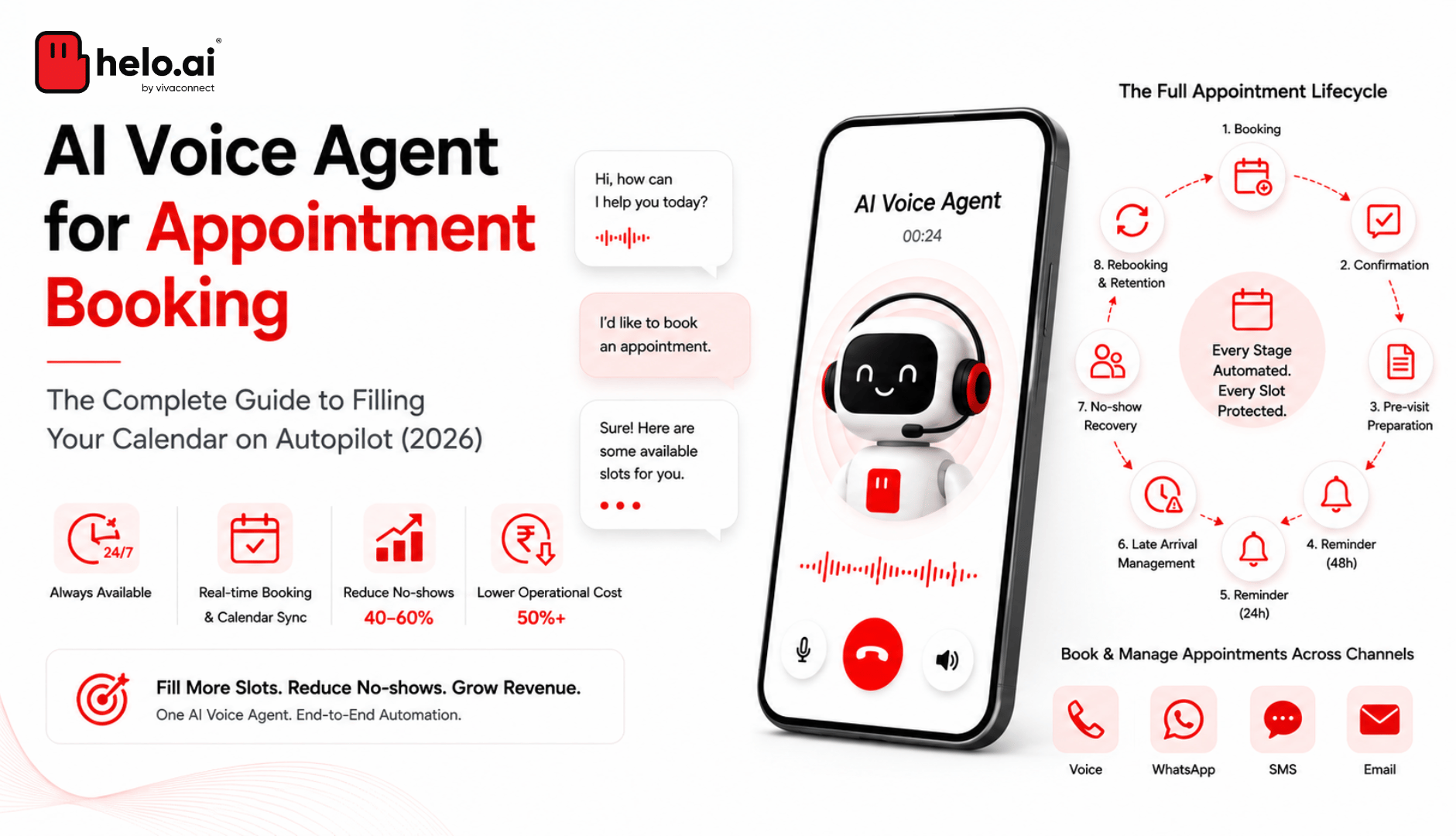


An AI voice agent for appointment booking answers the call, checks live availability, and confirms the slot in a natural conversation. That part is now well understood — and we have covered it in detail in our guide to AI voice agents for appointment scheduling.
This guide is about what happens next.
Booking is one stage out of eight. A slot that gets booked and then no-shows is not a success. A reminder in the wrong language is not a reminder. A cancellation that leaves an empty slot unfilled is revenue that you already earned and then lost.
Most appointment automation stops at the booking. That is the gap this guide addresses: the confirmation, the reminder sequence, the no-show recovery, the waitlist fill, and the compliance rules that decide whether any of it can legally run in India.
The Appointment Lifecycle: Eight Stages, Eight Leaks
An appointment is not an event. It is a sequence, and revenue escapes at each step.
# | Stage | Where the revenue leaks |
|---|---|---|
1 | Booking | After-hours calls hit voicemail and never convert |
2 | Confirmation | No written record, so the customer forgets or double-books |
3 | Pre-visit prep | Customer arrives without documents; the appointment fails or overruns |
4 | First reminder | No reminder at all — the largest single leak |
5 | Final reminder | Notification with no easy way to confirm or move the slot |
6 | Late arrival | No grace-period rule, so the day's schedule collapses |
7 | No-show recovery | Empty slot stays empty. Nobody is called |
8 | Rebooking | The customer is simply lost |
A system that only books is a scheduling tool. A system that runs all eight is an appointment operation.
Most vendor demos show stage 1 beautifully. Ask to see stage 7.
What the Evidence Says About Reminders
This field is full of confident percentages. Most are unsourced. Here is what the peer-reviewed evidence actually supports.
Finding | Source |
|---|---|
Average no-show rate 23% across 105 studies; range 5.5%–50% by setting | Systematic review (PMC/NIH) |
No reminder 23.1% → automated reminder 17.3% → live staff call 13.6% (n=9,835) | Parikh et al., American Journal of Medicine, 2010 |
Reminder systems produce a weighted mean 34% relative reduction in non-attendance | Hasvold & Wootton systematic review |
Two reminders (3-day + 1-day) 4.4% missed vs 5.3% and 5.8% for one (n=54,066) | Randomised trial, AJMC |
AI-driven no-show prediction: 20.8% → 10.25% (50.7% reduction, p<.001) | JMIR Formative Research, 2025, UAE primary care |
Three honest conclusions from that table.
Reminders work, and the effect is real. A ~34% relative reduction is a large operational win at any volume.
A single reminder underperforms two. The dual-reminder finding is one of the most robust results in this literature, and it costs almost nothing to implement.
Reminders plateau. In the AJMC trial's highest-risk quartile, two reminders still left 20.5% missing their appointment. Once you are reminding people properly, the remaining no-shows are not caused by forgetting. They are caused by the customer having no easy way to act — which is why stages 7 and 8 matter more than a third reminder.
A note on the 50% claims. You will see "reduce no-shows by 50%" widely quoted, including in some of our own earlier material. The strongest support for a figure that high is the 2025 JMIR study, which used predictive targeting rather than reminders alone. Reminders by themselves centre closer to 34%. Treat 50% as achievable with prediction and recovery, not as a baseline for sending texts.
Designing the Reminder Sequence
The evidence points to a specific shape rather than "more reminders."
Immediate confirmation, in writing. Sent within minutes of booking, on a channel the customer keeps. This is the cheapest stage and the most commonly skipped.
First reminder at 48–72 hours. Far enough out that the customer can still rearrange their day. This is the reminder that produces reschedules instead of no-shows.
Final reminder at 24 hours, with a one-tap action. A reminder that cannot be acted on is a notification. Confirm, cancel and reschedule must all be one step.
Same-day for early appointments only. Useful for morning slots and diagnostics. Applied to everything, it becomes noise.
Three design rules that matter more than the timing:
- A reschedule is a win, not a loss. If the customer cannot attend, the system's job is to move them — not to log a cancellation. Recording a cancellation without offering a slot is a system doing half its job.
- Match the channel to the market. In India, WhatsApp is where people actually look. Our guides to WhatsApp appointment reminders and the WhatsApp booking calendar cover that channel specifically.
- Escalate for high-risk bookings. Prior no-shows are the strongest predictor of the next one. Those customers justify a voice call rather than a message.
No-Show Recovery and Waitlist Fill
This is the half of the lifecycle almost nobody builds, and it is where the remaining money is.
Once reminders are working, your no-show rate stops falling. The next gain does not come from reminding harder. It comes from what you do in the ninety minutes after a slot opens.
The Recovery Loop
When a cancellation lands — or a reminder goes unanswered on a high-risk booking — the system should:
- Identify eligible waitlist candidates for that slot type, provider and location
- Contact them on their preferred channel, in priority order, not as a broadcast
- Book the first person who accepts and close the loop immediately
- Update the calendar in real time, so no double-booking is possible
- Contact the no-show separately and offer them a new slot
Speed is the whole game. A slot that opens at 9am for a 2pm appointment is fillable. The same slot found at 4pm is gone. This is exactly the work that manual front-desk staff deprioritise when they are busy — which is precisely when cancellations spike.
Do not broadcast open slots to the whole waitlist. Five people accepting one slot creates four disappointed customers and a staff cleanup job. Sequential offers with a short expiry work better.
Beyond Healthcare: Industries With the Same Problem
Almost every guide on this topic is written about clinics. The lifecycle is identical in several industries with far less coverage — and often higher value per appointment.
Banking — branch visits, loan meetings, KYC. The appointment is frequently the first physical touchpoint in a high-value relationship. A missed advisor slot delays a loan file rather than just wasting an hour. Document reminders matter as much as time reminders: a customer arriving without KYC papers has effectively no-showed. See our banking solutions and WhatsApp templates across the banking lifecycle.
Insurance — claims meetings, policy reviews, surveyor visits. Coordination is the hard part: the customer, the assessor and sometimes a third-party garage all need the same window. Reminders must carry the document checklist. Details in insurance solutions.
Financial services — advisory and wealth meetings. Low volume, very high value per slot. Here the waitlist logic inverts: you are not refilling from a queue, you are protecting a scarce advisor's calendar.
Utilities and field services — meter reading, technician visits, new connections. The customer must be physically present in a window. A no-show wastes a technician's travel, not just their time, so the cost is higher than the slot. Zone-based scheduling and a same-morning confirmation matter more here than anywhere else. See utility solutions.
Automotive — test drives, service bookings, delivery handover. Service bays are a fixed capacity that cannot be recovered. Our guide to voice AI service reminders for auto dealerships covers this vertical.
Retail — personal shopping, fittings, demos. Staff are rostered against bookings, so a no-show is a rostering error you paid for. See retail solutions.
Education — admission interviews, counselling, parent meetings. Highly seasonal and deadline-bound. A missed admission interview may not be rebookable at all, which makes stage 4 the only stage that matters.
The common structure: a fixed-capacity resource, reserved in advance, that cannot be resold after the fact. That is the definition of the problem, and it is not a healthcare problem.
One Agent Across Inbound and Outbound
Most operations run booking and reminders as separate systems. A phone tool books. An SMS tool reminds. A third tool handles WhatsApp. Nobody owns the no-show.
The consequences are predictable:
Stage | Fragmented setup | One agent |
|---|---|---|
Booking | Phone tool books the slot | Books and triggers confirmation in the same flow |
Confirmation | Separate SMS tool, generic template | Sent in the caller's language, on their channel |
Reminder | Different system, no call context | Same agent, full appointment history |
No-show recovery | Manual, usually skipped | Automatic call and reschedule offer |
Waitlist fill | Staff phone the list when they have time | Triggered the moment a slot opens |
Reporting | Three systems, three versions of the truth | One record per appointment |
The fragmentation problem is not tooling elegance. It is that the no-show sits in the gap between systems, so nobody's dashboard shows it and nobody's job description covers it.
Helo Voice is built around the single-agent model: inbound booking, outbound reminders, recovery calls and waitlist fill on one configuration, with live handoff when a call needs a person. Reminder campaigns run through campaign management, and the WhatsApp leg runs on the WhatsApp Business API so the customer gets the same context on either channel.
Compliance for Outbound Reminders in India
Inbound booking is straightforward — the customer called you. Outbound reminders are regulated communication, and this is where deployments get stopped.
The checklist:
- Consent captured at booking, retrievable per appointment, not a blanket opt-in
- DND scrubbing before every outbound run
- Calling windows respected — typically 10am to 9pm
- DLT registration for any promotional content bundled into a reminder
- DPDP Act obligations — data residency, retention limits, and the ability to erase on request
One correction worth stating plainly. Transactional and service calls originate from the 1600 series — not a "160 series," which appears in a lot of circulating material. Promotional calling uses the 140 series.
The trap is bundling. A pure reminder is a service message. Add "and ask about our new offer" and it becomes promotional, which changes the number series, the consent basis and the DLT requirement. Teams do this without realising they have re-classified the call.
We run DLT management as a managed service, and our security and compliance page covers the platform controls.
Language Is an Operational Requirement
A reminder in a language the customer does not read is not a reminder — you have paid for a message that cannot work.
Start with Hindi and English, since Hinglish covers most urban callers. Add regional languages by measured volume in your actual catchment, not by ambition. And test code-mixing specifically: Indian callers switch language mid-sentence, and most global platforms break when they do. Our guide to multilingual AI voice agents covers this in depth.
Where AI Appointment Booking Struggles
Four situations where this technology is the wrong answer, or needs a human alongside it.
Emergency and triage calls. Any request involving clinical urgency must reach a human immediately. This is a design requirement, not a tuning problem. Build the escape hatch first.
Complex multi-party scheduling. Coordinating three providers, two locations and a shared resource across different rule sets is a constraint-solving problem. Voice is a poor interface for it.
Relationship-driven VIP booking. A private banking client expects their relationship manager's assistant. Automating that signals the opposite of what the relationship is worth.
Walk-in and queue management. AI handles scheduled demand well. Live queue management is a different problem and should not be forced into the same system.
What to Check in a Platform
Ordered by how often each one is the thing that actually breaks a deployment.
1. Does it write back, or only collect? The single most important question. Some tools capture a request for staff to key in later. That is a voicemail with better transcription.
2. Does it cover the full lifecycle, or stop at booking? Ask specifically about no-show recovery and waitlist fill. This is where most platforms end.
3. Can the same agent make outbound calls? If reminders need a separate dialer, you have bought two systems and inherited the gap between them.
4. Real-time availability, or a cached copy? A cached calendar produces double-bookings, and double-bookings destroy trust faster than a missed call.
5. How does it handle code-mixing? Not "does it support Hindi." Test a caller switching mid-sentence.
6. Is live handoff seamless? Mid-conversation, no audio gap, full context on the agent's screen. This is pass/fail, not a score.
7. How deep is the integration? Calendar, CRM, and the scheduling or practice-management system. Depth of integration determines whether the booking actually lands.
8. Can you inspect every call? Transcripts, per-call latency, booking completion, reminder delivery. If you cannot inspect it, you cannot improve it.
9. Does it meet your compliance scope? Access control, encryption, audit logs, PII redaction, retention. For India: DLT and DPDP.
Running a Pilot That Tells You Something
1. Pick one appointment type with real volume. One service, one location. Not the most complex workflow you have.
2. Define success before you start. Booking completion, no-show rate, reminder delivery, and cost per retained appointment. Not calls answered.
3. Run a full cycle against real traffic. Two to four weeks including a peak day, measured against that same service's own prior numbers — never a vendor benchmark.
4. Test the recovery loop, not just booking. A pilot that only books tells you nothing about the thing you are trying to fix. Deliberately cancel appointments and watch whether the waitlist fills.
5. Listen to recordings daily for two weeks. Dashboards tell you the rate moved. Only audio tells you why people hesitated.
6. Expand one appointment type at a time. Rollouts that arrive all at once cannot be attributed when they fail.
Pilot Scorecard
Metric | What it tells you |
|---|---|
Booking completion rate | Agent quality and calendar integration health |
No-show rate vs baseline | Whether the reminder sequence is working |
Reminder delivery rate | Channel health and phone-number accuracy |
Reschedule rate from reminders | Whether reminders offer a real action or just a notice |
Waitlist fill rate | Recovery loop effectiveness — the most-skipped metric |
Time-to-fill after cancellation | Whether recovery is fast enough to matter |
Cost per retained appointment | The real commercial number |
Cost per retained appointment is the one to take to a budget conversation. Cost per call improves whenever you serve people worse. Cost per appointment that actually happened cannot be gamed.
Ready to Fix the Whole Lifecycle?
Every call answered. Every appointment confirmed. Every no-show chased. Every empty slot refilled before the day is out.
Send us a month of your appointment data — bookings, cancellations, no-shows and reminder logs. We will show you which of the eight stages is leaking, what it is costing, and what a pilot on your own calendar would need to prove.
No obligation. You keep the analysis either way.
Frequently Asked Questions
What is AI appointment booking?
AI appointment booking uses a voice agent to answer calls, check live calendar availability, and confirm a slot in natural conversation without a human on the line. A complete implementation also handles the stages after booking: written confirmation, reminder sequences, rescheduling, no-show recovery and waitlist fill.
Does AI appointment booking actually reduce no-shows?
Yes, and the effect is well documented. A systematic review found reminder systems produce a weighted mean 34% relative reduction in non-attendance. In a study of 9,835 patients, no-show rates fell from 23.1% with no reminder to 17.3% with an automated reminder and 13.6% with a live staff call. Effects plateau once reminders are in place, so further gains come from recovery and rebooking rather than more reminders.
How many appointment reminders should you send?
Two outperform one. In a randomised trial of 54,066 patients, those reminded at both three days and one day before missed 4.4% of appointments, compared with 5.3% and 5.8% for a single reminder. The practical sequence is an immediate written confirmation, a reminder at 48 to 72 hours, and a final reminder at 24 hours with one-tap confirm or reschedule.
What is a typical no-show rate?
A review of 105 studies found an average of 23%, with a range from 5.5% to 50% depending on setting and specialty. Rates outside healthcare are much less well documented, so compare against your own historical rate for the same appointment type rather than an industry figure.
What is waitlist fill and why does it matter?
Waitlist fill is automatically contacting eligible customers when a slot opens and rebooking it the same day. It matters because once reminders are working, the remaining revenue loss is not from forgetting — it is from empty slots nobody refilled. Speed decides the outcome: a slot found in the morning is fillable, the same slot found late afternoon is gone.
Can AI voice agents handle rescheduling and cancellations?
Yes. The agent locates the existing booking, cancels or moves it, offers alternative slots, confirms the new time and sends fresh written confirmation in the same call. A well-designed flow always offers a reschedule before recording a cancellation, and a cancellation should trigger waitlist outreach automatically.
Does AI appointment booking work outside healthcare?
Yes. Any operation with fixed-capacity slots reserved in advance has the same lifecycle: branch banking and loan meetings, insurance claims and surveyor visits, utility and field-technician appointments, automotive test drives and service bays, retail personal shopping, and education admission interviews. Field services often see higher cost per no-show because a missed visit wastes travel time as well as the slot.
Are outbound appointment reminders legal in India?
Yes, with conditions. You need consent captured at booking and retrievable per appointment, DND scrubbing before each run, and calls within permitted windows, typically 10am to 9pm. Service and transactional calls originate from the 1600 series while promotional calling uses the 140 series. Bundling an offer into a reminder reclassifies it as promotional and triggers DLT registration requirements.
Should reminders go out on WhatsApp, SMS or voice?
Match the channel to where your customers actually look, which in India is usually WhatsApp for written confirmation and reminders. Voice is worth reserving for high-value appointments and customers with a prior no-show history, since a call is harder to ignore and allows immediate rescheduling. Many operations use written reminders by default and escalate to a call for high-risk bookings.
Can we keep our existing phone numbers?
Yes. Voice platforms connect over SIP trunking, so your numbers and carrier relationships stay in place. Confirm this early in any evaluation, because number migration is a far larger project than integration.
How do you measure ROI on appointment automation?
Use cost per retained appointment — total cost divided by appointments that actually happened — against your current baseline, plus revenue recovered from filled waitlist slots. Cost per call is a misleading measure because it improves whenever the system serves customers worse. Cost per appointment that took place cannot be gamed the same way.