.jpeg)
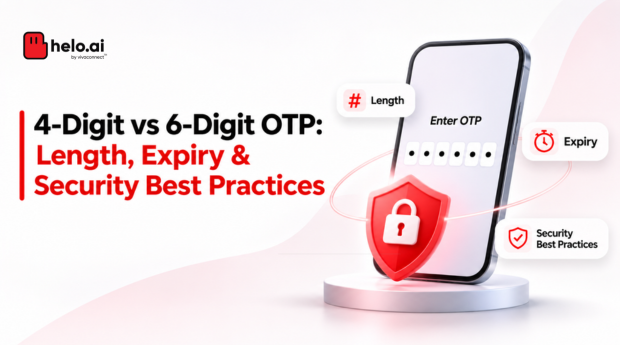


A customer receives a verification code, enters it and moves on. The process looks simple, but the number of digits in that code can affect how difficult it is to guess.
Should a business use a 4-digit verification code or a 6-digit OTP? Does a longer code automatically make authentication safer? And how long should an OTP remain valid?
The right choice depends on the authentication method, the sensitivity of the action, delivery conditions and the security controls protecting the verification process.
This guide compares 4-digit and 6-digit OTPs and explains how businesses can choose the right code length, expiry period and security controls.
Use six digits as the baseline. A 6-digit OTP has 1,000,000 possible combinations, 100 times more than a 4-digit code's 10,000. Length alone does not secure a flow. Pair it with secure random generation, short expiry, single-use validation and strict attempt limits.
Published by Helo.ai, which sells verification and messaging products. Standards are quoted from the sources listed at the end of this guide, and example values are labelled as examples. See the disclaimer at the bottom of the article.
What is the difference between a 4-digit and 6-digit OTP?
An OTP, or One-Time Password, is a temporary code used to verify a user or authorise an action. It is generally valid for a limited period or a specific authentication event.
The main difference between a 4-digit and 6-digit OTP is the number of possible combinations.
| Feature | 4-digit OTP | 6-digit OTP |
|---|---|---|
| Possible combinations | 10,000 | 1,000,000 |
| Random guessing probability per attempt | 1 in 10,000 | 1 in 1,000,000 |
| User effort | Easier to enter | Slightly more effort |
| Security margin | Smaller | Larger |
A 4-digit OTP number can range from 0000 to 9999, giving 10,000 possible combinations. A 6-digit OTP code can range from 000000 to 999999, giving 1 million combinations.
That means a 6-digit code has 100 times as many possible combinations as a 4-digit code.
A 5-digit SMS code sits between the two, with 100,000 possible combinations.
However, code length alone does not determine whether an authentication system is secure. Expiry, attempt limits, secure generation and single-use validation are equally important.
What attempt limits do to the odds
Guess probability depends on how many tries an attacker gets. The figures below are simple arithmetic for a randomly generated numeric code and a hypothetical limit of five wrong attempts per code.
4-digit code
5 guesses out of 10,000 combinations is a 5 in 10,000 chance of a lucky guess before lockout.
6-digit code
5 guesses out of 1,000,000 combinations is a 5 in 1,000,000 chance, which is 100 times lower.
The limit matters as much as the length. With no cap on attempts, both codes can eventually be guessed, and a new code that resets the counter lets an attacker keep trying.
4-digit vs 6-digit OTP: Which is more secure?
A 6-digit OTP generally provides a stronger starting point because it increases the number of possible combinations.
Consider an attacker trying to guess a randomly generated code:
- A 4-digit code has a 1-in-10,000 chance of being guessed in one attempt.
- A 6-digit code has a 1-in-1,000,000 chance of being guessed in one attempt.
The difference becomes more important when an attacker can make repeated attempts.
But a 6-digit code with unlimited attempts is still vulnerable to guessing. A secure implementation needs to restrict failed attempts, control resends and invalidate codes after use.
What do security standards say?
NIST SP 800-63B-4 requires at least six decimal digits for the relevant out-of-band authentication secrets. It also requires rate limiting when these secrets have less than 64 bits of entropy. This guidance applies to the authentication scenarios covered by NIST; it should not be presented as a universal legal requirement for every commercial SMS OTP implementation.
RFC 4226, which defines the HOTP algorithm, specifies a minimum six-digit output. OWASP's Forgot Password guidance describes numeric PINs of six to twelve digits and says codes should be single-use and expire after an appropriate period.
Practical recommendation: Use six digits as a sensible baseline for business verification flows. Consider eight-digit or longer codes where the risk level and user experience justify them. For high-risk actions, evaluate stronger authentication rather than relying on code length alone.
"The verifier SHALL generate random authentication secrets that are at least six decimal digits (or equivalent) in length"
NIST treats SMS and voice as a restricted authenticator
NIST classes out-of-band delivery over the public telephone network, which includes SMS and voice, as a restricted authenticator. Organisations that use it are expected to offer at least one unrestricted alternative, tell users about the risk, and consider risk signals such as a recent SIM change or number port before sending a code. This is one more reason to treat code length as a single control rather than the whole design.
Longer is not a magic fix: what a PIN study found
A 2022 USENIX Security study of 1,010 participants, "The Same PIN, Just Longer", looked at upgrading device PINs from four to six digits. It found that 6-digit PINs were only slightly harder to guess than 4-digit PINs when attackers tried a few common codes, and that attackers who knew a user's old PIN guessed the new one far more easily. The study covers user-chosen PINs, not randomly generated OTPs, so it does not say that six digits are unnecessary. It does support the point that predictable values weaken any code, which is why OTPs should be randomly generated and never derived from a previous value.
When should businesses use a 4-digit, 5-digit or 6-digit OTP?
The right choice depends on what the code is protecting and which security requirements apply.
| Code length | Possible use | Considerations |
|---|---|---|
| 4-digit OTP | Existing low-risk or tightly controlled verification flows | Smaller code space; not suitable where the applicable standard requires six or more digits |
| 5-digit OTP | Systems with an existing five-digit implementation | More combinations than four digits, but still below the six-digit minimum specified for relevant NIST out-of-band authentication |
| 6-digit OTP | Common business verification and authentication flows | Larger code space and aligns with relevant NIST and HOTP minimum-length guidance |
| 8-digit or longer OTP | Higher-risk flows where usability allows | Larger guessing space, but still requires expiry, attempt limits and other controls |
These are general design considerations, not a universal permission to use a particular code length. Financial services and other regulated businesses should follow the requirements applicable to their authentication use case.
A longer code is not a substitute for stronger authentication. For sensitive transactions, account recovery or high-risk access, businesses may need additional verification or phishing-resistant methods.
How long should an OTP remain valid?
OTP expiry determines how long a generated code can be used.
If the validity period is too short, customers may not receive the SMS or enter the code in time. If it is too long, an exposed code remains usable for longer.
There is no single expiry duration that suits every OTP implementation.
For a typical SMS verification flow, businesses can evaluate a short validity window such as 3–5 minutes as an initial configuration. This is a practical starting point to test, not a universal security standard.
Consider these factors:
- Delivery time: Allow enough time for the code to reach the customer.
- Transaction sensitivity: Higher-risk actions may require tighter controls or stronger authentication.
- User experience: Customers need enough time to read and enter the code.
- Replay prevention: A code should not remain usable after successful verification.
- Resend behaviour: A new code should have clearly defined validity and replacement rules.
NIST's out-of-band authentication guidance requires authentication to be completed within 10 minutes and a given secret to be accepted only once during its validity period. This is an upper time limit for the specific NIST authentication context, not a recommendation to keep every commercial SMS OTP valid for 10 minutes.
"In all cases, the authentication SHALL be considered invalid unless completed within 10 minutes."
Illustrative starting policy for an SMS login OTP
The values below are examples to test against your own delivery data and risk, not a standard and not a Helo.ai recommendation for every flow.
| Control | Example starting value | Why it matters |
|---|---|---|
| Code length | 6 digits, randomly generated | Meets the six-digit minimum used in NIST and HOTP guidance |
| Validity | 3–5 minutes, then test | Balances delivery delay against exposure of an unused code |
| Failed attempts | Small fixed cap per code and per account, such as 5 | Limits online guessing; a new code must not reset the count |
| Resend cooldown | 30 to 60 seconds between requests | Slows abuse and avoids confusing users with several live codes |
| Resends per period | A low cap per number per hour | Limits cost abuse and harassment of real users |
| After success | Invalidate the code immediately | Prevents replay of a used code |
SMS OTP expiry vs TOTP expiry: Are they the same?
No. They use different mechanisms.
- SMS OTP: The application generates a code and sends it to the customer through SMS. The application controls its validity period and verification rules.
- TOTP (Time-Based One-Time Password): The code is generated by an authenticator using a shared secret and the current time. RFC 6238 defines this approach and recommends a 30-second time step as its default.
A TOTP generated by an authenticator app is not the same as an SMS code that expires after three or five minutes. Businesses should configure and test each method according to its own standard and implementation.
OTP security best practices businesses should follow
Choosing six digits instead of four is only one part of OTP security. Businesses should protect the complete generation, delivery and verification process.
The OTP lifecycle and where each control sits
1. Generate codes using secure randomness
Use a cryptographically secure random number generator for OTP creation. Avoid predictable sequences, timestamps, customer IDs or simple number patterns.
Generate codes independently for each authentication event.
2. Set an appropriate validity period
Keep the OTP valid only for the time required to complete verification. The expiry window should reflect delivery conditions, the authentication method and the risk associated with the action.
3. Limit verification attempts
Apply strict limits to incorrect code entries. Without attempt restrictions, an attacker can repeatedly guess possible combinations.
Use controls such as:
- Per-account attempt limits.
- Per-number and per-IP request limits.
- Resend cooldowns.
- Temporary restrictions after repeated failures.
- Monitoring for unusual request patterns.
Generating a new OTP should not reset the failed-attempt count.
4. Make every OTP single-use
Once an OTP is successfully verified, invalidate it immediately.
A previously used code should not be accepted again, even if its original expiry time has not passed.
5. Handle resend requests carefully
A resend should follow a clearly defined rule. A common approach is to generate a new code and invalidate the previous one.
Make it clear which code is currently valid. Otherwise, customers may enter an older message and receive an incorrect-code error.
6. Protect OTPs in storage and logs
OTP values are authentication secrets. Avoid storing them in long-term plaintext form or exposing them in application logs, analytics, debugging tools or support dashboards.
OWASP recommends careful handling of OTP values, including short validity, single-use validation and strict attempt limits.
Hashing an OTP does not make it equivalent to a strong password. A short numeric code has a small possible value space, so additional protections are necessary.
7. Monitor suspicious verification activity
A sudden increase in OTP requests or failed attempts can indicate automated abuse.
Monitor:
- Repeated OTP requests for the same number.
- High request volumes from one IP or device.
- Unusual verification attempts across multiple accounts.
- Repeated failures followed by account recovery attempts.
- Sudden changes to registered phone numbers or devices.
Use risk-based checks when activity appears suspicious.
OTP length and delivery for businesses in India
Code length is only one part of an India-ready OTP flow. Three practical points apply to many Indian businesses.
- Payments and banking rules. The Reserve Bank of India issued authentication directions for digital payments in 2025. Regulated entities should read the directions for their own use case rather than rely on a general guide. See the RBI press release, and Helo.ai's banking solutions page for how verification fits financial services.
- DLT registration. Commercial SMS in India is sent through registered headers and templates. An OTP message template needs to be registered before it can be delivered, so plan registration time into any change of message wording. Helo.ai offers DLT management support.
- SMS abuse. Attackers can trigger large volumes of OTP requests to inflate your messaging bill or to harass real users. Per-number limits, resend cooldowns and monitoring for unusual request patterns, covered above, are the main defences.
Does OTP length matter for SMS, WhatsApp and voice verification?
The delivery channel and the OTP's security design are separate considerations.
A six-digit code sent through SMS is still a six-digit code. Sending it through WhatsApp or reading it through a voice call does not automatically increase the number of possible combinations.
The channel affects delivery, accessibility and exposure risks. Code length affects the number of possible values.
| Channel | What businesses should consider |
|---|---|
| SMS OTP | Delivery conditions, SIM-related risks and telecom requirements |
| WhatsApp OTP | Template and authentication requirements, channel availability and account eligibility |
| Voice OTP | Call delivery, user experience and protection against unauthorised access |
| Email OTP | Inbox access, email account security and delivery delays |
A multi-channel verification strategy can help businesses offer alternatives when one channel is unavailable. However, fallback should follow consistent expiry, attempt limits and validation rules.
Moving from SMS to another channel does not automatically make an OTP phishing-resistant. Businesses should select authentication methods based on their threat model and the sensitivity of the action.
WhatsApp authentication templates
WhatsApp Business messaging offers a dedicated authentication template category for one-time codes. Template rules, button options and code-expiry settings are set by Meta and can change, so check the current Meta authentication template documentation before you build. For a comparison of channels see Helo.ai's guide to WhatsApp vs SMS for OTP and its walkthrough on sending WhatsApp verification codes.
If you are new to the basics, start with what SMS verification is. Delivery speed affects how long your code should stay valid, so also see the Helo.ai glossary entry on SMS latency. Channel options are available on the SMS, WhatsApp, email and voice product pages.
Plan your OTP delivery with Helo Verify
Talk to Helo.ai about channel fallback, retry rules and delivery reporting for your verification flow.
4-digit vs 6-digit OTP: A practical decision checklist
Before selecting an OTP length and expiry period, product and engineering teams should review:
- What action is the code protecting?
- Which security standard or industry requirement applies?
- How many possible combinations does the code provide?
- How many incorrect attempts are permitted?
- How long does delivery typically take?
- Does a resend invalidate the previous code?
- Is the code invalidated immediately after successful verification?
- Are requests monitored for unusual activity?
- Are OTPs protected in storage and logs?
- Would a stronger authentication method be more appropriate?
The goal is to balance customer convenience with the security requirements of the application.
How Helo.ai supports OTP verification
Businesses need more than a code-generation process. They also need a dependable way to deliver verification messages through suitable communication channels.
Helo Verify is Helo.ai's verification solution. Its public product information lists OTP delivery through SMS, WhatsApp and email, alongside SIM-binding security and real-time verification.
When evaluating a verification solution, businesses should also review how channel availability, delivery reporting, retry rules and fraud controls fit into their authentication architecture.
Explore Helo Verify or contact Helo.ai to discuss your verification requirements.
Frequently asked questions
Is a 4-digit OTP safe?
A 4-digit OTP has 10,000 possible combinations. It provides less protection against random guessing than a six-digit code. It should not be used where the applicable security standard requires at least six digits. Any implementation using four digits needs strict attempt limits, short validity and additional controls.
How many combinations does a 6-digit OTP have?
A six-digit numeric OTP has 1 million possible combinations, from 000000 to 999999.
What is a 6-digit OTP number?
It is a one-time verification code containing six numeric digits. It may be used to verify a phone number, confirm a login or complete an authentication step.
Can an OTP be 5 digits?
Yes. A system can generate a five-digit numeric code, which has 100,000 possible combinations. If you receive a five-digit code by SMS, enter the code provided by the service rather than assuming it is invalid. However, businesses should check whether their authentication requirements permit five-digit codes.
How long should a 6-digit OTP be valid?
There is no universal expiry duration for every six-digit OTP. Businesses should use a short validity period based on delivery conditions and risk. A 3–5-minute window can be evaluated as a starting point for typical SMS verification, subject to testing and applicable requirements.
Does a longer OTP always mean better security?
A longer code increases the number of possible combinations, but it is not enough by itself. Secure randomness, short expiry, single-use validation and strict attempt limits are also essential.
Should businesses use the same OTP length for every transaction?
Not necessarily. The code length and authentication method should reflect the sensitivity of the action. Higher-risk activities may require stronger authentication rather than simply adding more digits.
Is a TOTP the same as an SMS OTP?
No. An SMS OTP is generated by an application and delivered through SMS. A TOTP is generated using a shared secret and time-based algorithm, usually through an authenticator app. Their generation and expiry mechanisms are different.
What OTP length does NIST require?
For the out-of-band authentication scenarios it covers, NIST SP 800-63B-4 requires randomly generated secrets of at least six decimal digits, single use within the validity period, completion within 10 minutes, and rate limiting where the secret has less than 64 bits of entropy. It is not a universal legal rule for every commercial SMS OTP.
Should a resend reset the failed-attempt count?
No. Generating a new OTP should not reset the failed-attempt count, otherwise an attacker can request fresh codes and keep guessing. Apply attempt limits per account as well as per code.
Is SMS OTP still acceptable?
It remains widely used, but NIST classes SMS and voice delivery as a restricted authenticator and expects an unrestricted alternative to be offered. Treat SMS OTP as one option within a layered design and consider stronger methods for sensitive actions.
Do I need to change a working 4-digit OTP to 6 digits?
Review it against the standard or regulation that applies to you. If six digits are required, change it. If not, compare the risk of the action, your attempt limits and your expiry rules, and test the effect on completion rates before changing the flow.
Conclusion
The choice between a 4-digit and 6-digit OTP comes down to the balance between usability and security. A six-digit code offers 100 times more possible combinations than a four-digit code, making it a stronger starting point against random guessing.
But code length is only one part of the equation. Short expiry, single-use validation, secure generation, attempt limits and suspicious-activity monitoring all contribute to a safer verification process.
For businesses, the best OTP design is one that protects the action being verified without making the customer experience unnecessarily difficult.
Review your verification flow with Helo.ai
Share your use case, volumes and channels and the Helo.ai team can walk through delivery options for your OTP flow.
Disclaimer. This article is general information, not legal, regulatory, compliance or security advice. Standards and regulations change and apply differently by industry and country, so check the current text of any standard you rely on and consult qualified advisers for your own flow. Example values are illustrations to test, not guarantees of security. Helo.ai is the publisher and offers verification and messaging products. Standards and links were last checked in November 2026.