.jpeg)


Businesses use WhatsApp to share order updates, answer customer queries, send payment reminders, handle support requests and communicate important information. But when customer data moves through a messaging platform, security becomes a major consideration.
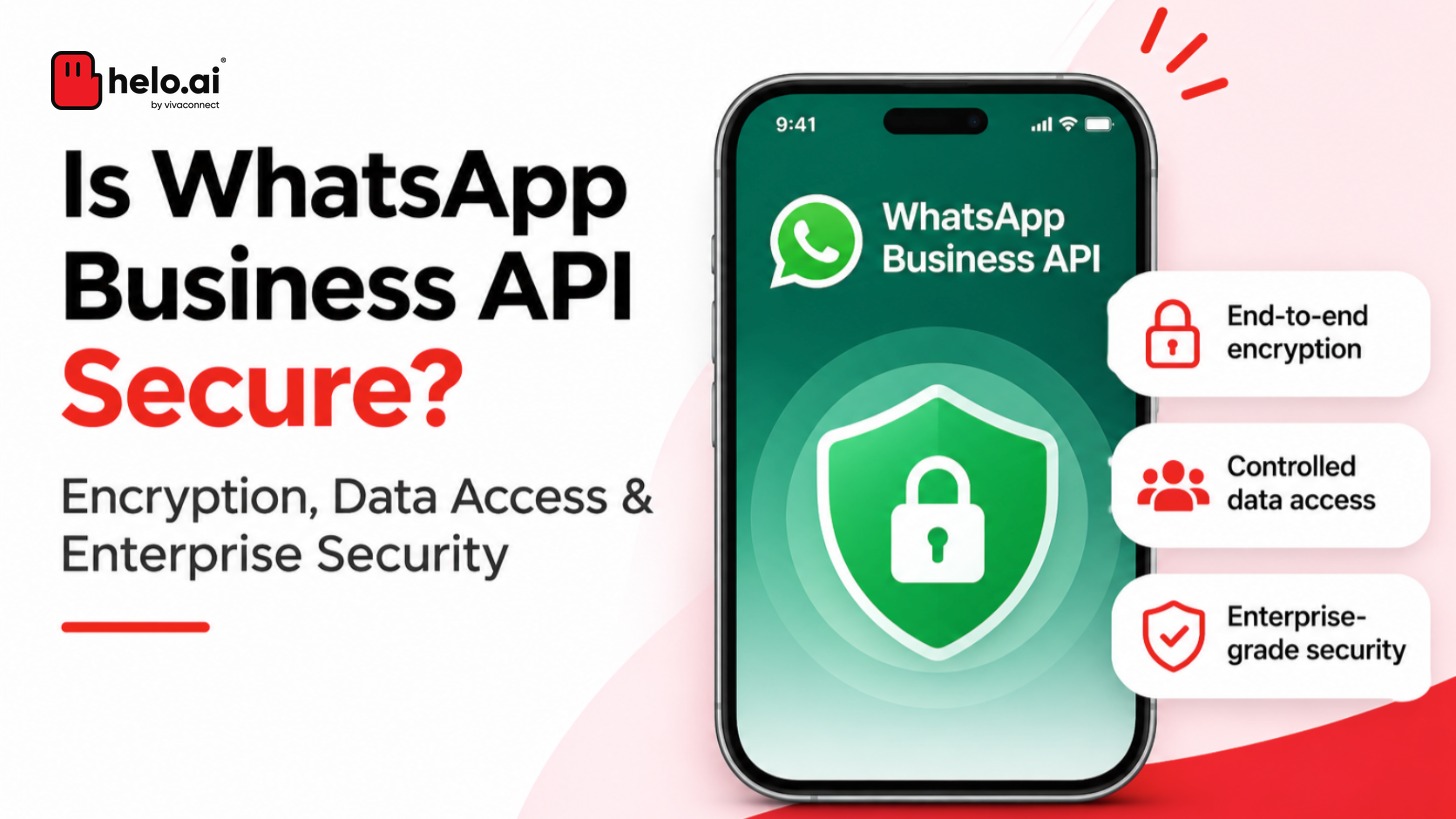
So, is WhatsApp Business API secure?
The WhatsApp Business Platform uses encryption and security controls to protect messages and data. However, businesses should understand how messages are processed, who can access them, how their WhatsApp API provider handles customer information, and what additional controls are needed on their side.
Security is not just about encryption. It also depends on how the platform is configured, who has access, how customer data is stored and how the business manages its communication systems.
In this guide, we'll explain how WhatsApp Business API security works, how messages are encrypted, what businesses should know about data access, and the security measures enterprises should evaluate before using WhatsApp for customer communication.
Yes, WhatsApp Business API messages are encrypted in transit. Unlike personal chats, the Cloud API decrypts messages to forward them to the business, which changes who can access content. Overall security also depends on your provider, access controls, integrations and data retention.
How Does WhatsApp Business API Security Work?
WhatsApp Business API, now commonly used through the WhatsApp Business Platform Cloud API, allows businesses to connect WhatsApp messaging with their internal systems, customer support platforms, CRM tools and communication workflows.
The platform uses encryption to protect messages during transmission and security mechanisms to protect the infrastructure that processes business communication.
However, the security model is different from a personal WhatsApp conversation.
When a customer sends a message to a business using the Cloud API, the message is securely transmitted to the Cloud API, processed and then forwarded to the business. This allows the business to receive the message through its connected systems and respond.
The same process applies in reverse when a business sends a message to a customer.
This means businesses need to understand not only how WhatsApp protects messages, but also what happens after a message reaches the business platform.
How Are WhatsApp Messages Encrypted?
WhatsApp uses the Signal Protocol as the foundation for message encryption. Encryption helps protect messages from being read by unauthorised parties while they are being transmitted.
For business communication, encryption is one part of a larger security framework.
1. Encryption in Transit
Encryption in transit protects information as it travels between systems.
When a customer sends a message to a business on WhatsApp, encryption helps protect the message while it is moving through the communication network.
This reduces the risk of message content being exposed through unauthorised interception during transmission.
2. Message Processing Through the Business Platform
When a business uses the WhatsApp Business Platform Cloud API, messages are processed through the Cloud API before being delivered to the business.
This processing allows businesses to:
- Receive customer messages through connected systems.
- Route conversations to customer support teams.
- Trigger automated responses and workflows.
- Connect conversations with CRM or other business tools.
- Manage customer interactions at scale.
Because the platform processes messages, businesses should understand the data access and processing arrangements associated with the platform and any service providers they use.
3. Encryption at Rest
Encryption at rest refers to protecting data when it is stored rather than when it is travelling between systems.
Businesses should understand how their messaging provider protects stored customer information, including message content, attachments, customer details and operational records.
The storage practices may differ across platforms and providers. Businesses should review the relevant security documentation rather than assume that every system storing WhatsApp data uses the same controls.
Source check: Meta’s data privacy and security page says Cloud API messages at rest are encrypted, and that messages have a maximum retention period of 30 days to provide base features. It says Meta acts as a data processor on behalf of the business, where privacy law recognises that term. This covers Meta’s Cloud API only, so ask your provider about its own storage.
Is WhatsApp Business API End-to-End Encrypted?
This is one of the most important questions businesses ask when evaluating WhatsApp security.
Personal WhatsApp chats are end-to-end encrypted. This means the message is protected between the sender and recipient, and WhatsApp cannot read the message content.
However, WhatsApp Business Platform Cloud API uses a different processing model.
Messages are encrypted during transmission to the Cloud API, where they are processed and forwarded to the business. The Cloud API manages the encryption and decryption required for this communication flow.
This is different from a personal chat where only the communicating endpoints can access the message content.
Personal WhatsApp vs Business API
| Personal WhatsApp chat | WhatsApp Business Platform Cloud API |
|---|---|
| End-to-end encrypted conversations | Messages are encrypted in transit to and from the Cloud API |
| Communication between individual chat endpoints | Messages are processed through the Business Platform |
| WhatsApp cannot read personal message content | Cloud API processes messages to deliver them to businesses |
| Designed for private conversations | Designed for business messaging, integrations and communication workflows |
This does not mean the WhatsApp Business API is insecure.
It means businesses need to understand the architecture and the parties that may process or access messages, including their own employees and authorised service providers.
For enterprises handling sensitive customer information, this distinction should be part of the security review.
Source check: Meta’s data privacy and security page says “the message travels encrypted via WhatsApp between the user and Cloud API”, and that the Cloud API decrypts the message and forwards it to the business. It adds that the Cloud API manages the encryption and decryption keys on behalf of the business. WhatsApp’s trust and safety page says business messages are protected with the Signal protocol, but it does not say whether the Business Platform is end-to-end encrypted.
What Happens to Customer Messages on WhatsApp Business API?
When a customer messages a business, the message passes through several stages.
Incoming Message Flow
Step 1: Customer sends a message
A customer sends a message from their WhatsApp account to the business number.
Step 2: Message is transmitted securely
The message travels through WhatsApp's messaging infrastructure using encryption.
Step 3: The Cloud API processes the message
The WhatsApp Business Platform receives and processes the message so it can be delivered to the business.
Step 4: Message reaches the business system
The message is forwarded to the business's connected application, platform or authorised service provider.
Step 5: Business responds
The business replies through its messaging system. The response is processed through the Business Platform and transmitted to the customer.
This communication flow allows businesses to integrate WhatsApp with customer support, CRM, automation and other operational systems.
However, each connected system introduces its own data-handling responsibilities. Businesses should understand where information is processed, which systems retain it, and who can access it.
Is WhatsApp Business API Safe for Businesses?
WhatsApp Business API can be used for business communication when it is supported by appropriate platform security, provider safeguards and internal controls.
But businesses should not evaluate security based on the messaging channel alone.
A secure communication setup depends on multiple layers working together.
| Security layer | What businesses should evaluate |
|---|---|
| Platform security | Security practices and infrastructure used by the Business Platform |
| Provider security | Controls implemented by the WhatsApp API provider |
| Account security | Protection of WhatsApp Business accounts and credentials |
| Access management | Who can view conversations, customer data and campaign information |
| Data protection | How customer information is stored, processed and retained |
| Integration security | How WhatsApp connects with CRM, support and business applications |
| Network security | Protection of APIs, endpoints and data exchange |
| Monitoring | Detection of suspicious activity and security incidents |
| Operational controls | Processes for managing access, incidents and data handling |
The platform provides the messaging infrastructure. Businesses and their providers still need to secure the systems and workflows that operate around it.
Security Risks Businesses Should Be Aware Of
Even when a messaging platform uses encryption, businesses can still face security risks through poor access management, exposed credentials, insecure integrations or inadequate internal processes.
1. Unauthorised Account Access
If account credentials, administrator access or authentication methods are not adequately protected, unauthorised users may gain access to business messaging systems.
Businesses should limit access to authorised personnel and regularly review account permissions.
2. Excessive Employee Access
Not every employee needs access to every customer conversation.
Unrestricted access can increase the risk of accidental exposure, misuse or inappropriate handling of customer information.
Role-based access should be used wherever supported, with permissions aligned to each employee's responsibilities.
3. Weak API and Integration Security
Businesses often connect WhatsApp with CRM platforms, customer databases, automation tools and other applications.
If these integrations are poorly secured, customer information may be exposed outside the messaging platform.
Businesses should review API credentials, access permissions, endpoint security and integration practices.
4. Third-Party Data Exposure
A WhatsApp API provider may have access to customer messages and business data as part of the service it delivers.
Businesses should understand:
- What data the provider can access.
- How that data is processed.
- Where it is stored.
- Whether it is shared with other service providers.
- How it is protected.
- How long it is retained.
- How it is deleted when no longer required.
5. Improper Data Retention
Keeping customer data for longer than necessary can increase the risk and impact of a security incident.
Businesses should establish retention policies for conversation records, attachments, customer details and related communication data.
6. Phishing and Social Engineering
Employees may receive fraudulent messages, login requests or attempts to obtain credentials and account access.
Security awareness and verification procedures help reduce the risk of employees being manipulated into exposing customer data or business accounts.
7. Insecure Webhooks and APIs
Webhook endpoints and APIs are important parts of WhatsApp Business integrations.
Businesses should ensure endpoints are protected, requests are validated where applicable, credentials are secured, and unauthorised requests are rejected.
10 Security Controls Enterprises Should Evaluate
If your organisation plans to use WhatsApp Business API for customer communication at scale, the following controls should form part of your provider and platform assessment.
1. Encryption
Understand how messages and customer data are protected during transmission and while stored.
Ask your provider what encryption practices apply to the data it handles.
2. Role-Based Access Control
Ensure users receive access based on their roles.
For example, a customer support agent may need access to assigned conversations, while a campaign manager may need access to campaign-related functionality.
Avoid unnecessary administrator access.
3. Multi-Factor Authentication
Where supported, use additional authentication factors for administrator accounts and other sensitive access points.
This adds another layer of protection beyond passwords.
4. Secure API Access
Review how API credentials are generated, stored, rotated and revoked.
Ensure credentials are not exposed in source code, unsecured documents or shared environments.
5. Webhook Verification
Webhook requests should be validated to help confirm that incoming notifications are legitimate.
Businesses should review the security mechanisms supported by their integration and implement the appropriate verification controls.
Source check: Meta’s webhooks documentation says each event notification is signed with a SHA256 signature in the X-Hub-Signature-256 header, generated with your app secret. It says validation is optional but recommended, and that the endpoint needs HTTPS with a valid TLS certificate. Self-signed certificates are not supported.
6. Data Retention Controls
Understand how long customer messages, attachments, contact details and other records are retained.
Ensure retention policies are documented and followed.
7. Access Logs and Monitoring
Businesses should be able to review relevant account and system activity where supported.
Monitoring can help identify unusual access patterns, suspicious activity or potential security incidents.
8. Secure Integrations
Review the systems connected to WhatsApp, including CRM, ticketing, customer databases, automation tools and analytics platforms.
Each integration should have a clear purpose and appropriate access permissions.
9. Incident Response
Ask your provider how security incidents are handled.
Understand how incidents are reported, escalated, investigated and communicated, and what responsibilities belong to your organisation.
10. Security Documentation
Review the provider's available security documentation, certifications, policies and contractual commitments.
Do not rely only on marketing statements. Security claims should be supported by documentation relevant to your organisation's requirements.
Source check: Meta’s data privacy and security page says Meta has obtained SOC 2 Type II and ISO 27001 reports for the Cloud API. That covers Meta’s service, not your provider, so ask the provider for its own documentation.
Comparing WhatsApp providers?
See how Helo Broadcast manages WhatsApp, SMS, RCS and email campaigns from one control plane.
WhatsApp Business App vs WhatsApp Business API: Which Is More Secure?
The WhatsApp Business App and WhatsApp Business Platform serve different business needs.
The Business App is generally suited to smaller businesses managing conversations directly from their devices.
The Business Platform is designed for businesses that need integrations, shared workflows, automation and communication at scale.
Security is not determined simply by which product is chosen. It depends on the features, configuration, access controls, devices, connected systems, data-handling practices and the way each product is used.
| Area | WhatsApp Business App | WhatsApp Business Platform |
|---|---|---|
| Primary use | Direct customer messaging | Integrated business messaging at scale |
| User access | App/device-based access | Platform and system-based access, depending on setup |
| Integrations | More limited | Supports API integrations and business workflows |
| Automation | App-level features | Programmatic workflows and automation |
| Security responsibility | Device, account and user security | Platform, provider, integration and organisational controls |
| Best suited for | Smaller teams | Businesses with larger communication requirements |
The right choice depends on how your business manages customer communication, the systems involved and the level of operational control required.
How to Choose a Secure WhatsApp Business API Provider
Choosing a provider is an important part of your WhatsApp security strategy.
Before onboarding, ask the provider these questions.
| Question | Why it matters |
|---|---|
| What security controls protect customer data? | Understand the provider's security approach |
| Who can access customer conversations? | Evaluate access restrictions |
| How is customer data stored? | Understand storage and protection practices |
| What data is retained and for how long? | Evaluate retention policies |
| How are API credentials secured? | Reduce integration-related risk |
| How are security incidents handled? | Understand incident response |
| What security documentation is available? | Validate security claims |
| Are connected integrations secured? | Understand risks beyond WhatsApp |
| Can user access be restricted by role? | Reduce unnecessary access |
| How is data deleted when the service ends? | Understand offboarding and data handling |
For enterprises, security reviews should include the provider's technical controls, contractual terms, data processing practices, operational safeguards and relevant certifications.
The provider should be able to explain its security approach clearly—not simply claim that its platform is secure.
WhatsApp Security vs Compliance: What's the Difference?
Security and compliance are related, but they are not the same.
Security focuses on protecting information, systems, accounts and communication against unauthorised access, exposure, misuse or disruption.
Compliance focuses on meeting applicable legal, regulatory, contractual and platform requirements.
For example:
| Security | Compliance |
|---|---|
| Protecting customer data | Obtaining required consent |
| Preventing unauthorised access | Following applicable privacy obligations |
| Securing APIs and integrations | Respecting opt-outs and communication requirements |
| Monitoring suspicious activity | Following messaging policies |
| Protecting stored information | Maintaining required records |
A business can have strong technical security and still fail to follow messaging policies or privacy requirements.
Similarly, following messaging rules does not automatically mean the business has adequate security controls.
If you're reviewing WhatsApp from a compliance perspective, read our guide on WhatsApp API compliance.
For Helo.ai's own security certifications and compliance information, refer to our Security and Compliance page.
How Helo.ai Supports Enterprise Communication
For businesses managing customer communication across multiple teams and channels, security needs to be considered alongside operational visibility, integration and access management.
Helo.ai helps enterprises manage customer communication across WhatsApp, SMS and RCS through connected messaging and engagement workflows.
When evaluating a business communication platform, enterprises should look beyond message delivery and assess how the platform fits into their security, access, data-handling and operational requirements.
The right communication setup should allow teams to manage customer interactions efficiently while following the organisation's internal security and data-handling policies.
Scope check: The Helo.ai security and compliance page says its security framework is aligned with ISO/IEC 27001 and does not claim formal certification. It does not mention SOC 2. The draft refers to Helo.ai’s “security certifications”, so please change that wording or confirm the certifications. The Helo Broadcast page lists SMS, WhatsApp, RCS and email from a single control plane, and says nothing about WhatsApp security controls.
Managing messaging at scale?
Managing customer communication at scale? Talk to our team about your enterprise communication requirements.
Frequently Asked Questions
Is WhatsApp Business API secure?
WhatsApp Business Platform uses encryption and security controls to protect business messaging. Businesses should also evaluate the security of their API provider, integrations, account access, data storage and internal processes.
Are WhatsApp Business API messages encrypted?
Yes, messages are protected by encryption during transmission. However, the Business Platform processes messages so they can be delivered to businesses. This is different from personal end-to-end encrypted conversations.
Is WhatsApp Business API end-to-end encrypted?
The Cloud API has a different encryption and processing model from personal end-to-end encrypted chats. Messages are encrypted in transit to and from the Cloud API, but the Cloud API processes messages for business delivery.
Can WhatsApp or a business read WhatsApp API messages?
Business messages are processed through the Business Platform and delivered to the business. The business and authorised service providers may access message content as required to provide the service. Businesses should review their provider's data-processing and access practices.
Is WhatsApp Business API safe for banks and financial institutions?
It can be used as part of enterprise communication, but financial institutions should evaluate their security, privacy, regulatory, vendor-risk, access-management and data-retention requirements before implementation.
Does WhatsApp Business API store messages?
Message handling and storage depend on the platform and service configuration. Businesses should review WhatsApp's documentation and their provider's policies to understand what data is stored, where it is stored and for how long.
How can businesses protect WhatsApp customer data?
Businesses should use appropriate access controls, secure authentication, API credential management, integration security, data-retention policies, monitoring and incident-response processes.
Is WhatsApp Business API more secure than SMS?
They are different communication channels with different security characteristics. WhatsApp uses encrypted messaging, while traditional SMS does not provide the same end-to-end encryption model. However, the overall security of business communication also depends on the systems, devices, integrations and processes used to manage it.
Final Takeaway
WhatsApp Business API provides an encrypted messaging infrastructure, but enterprise security requires more than encryption alone.
Businesses need to understand how messages are processed, who can access customer information, how their API provider handles data, and what controls protect connected systems.
When encryption, access management, data handling, monitoring and internal security practices work together, businesses can build a more secure foundation for customer communication on WhatsApp.
Note. Helo.ai offers communication products and published this guide. Meta, WhatsApp and Helo.ai pages were checked on 25 November 2026. Platform security features and policies change, so confirm them with your provider before relying on them.