.jpeg)
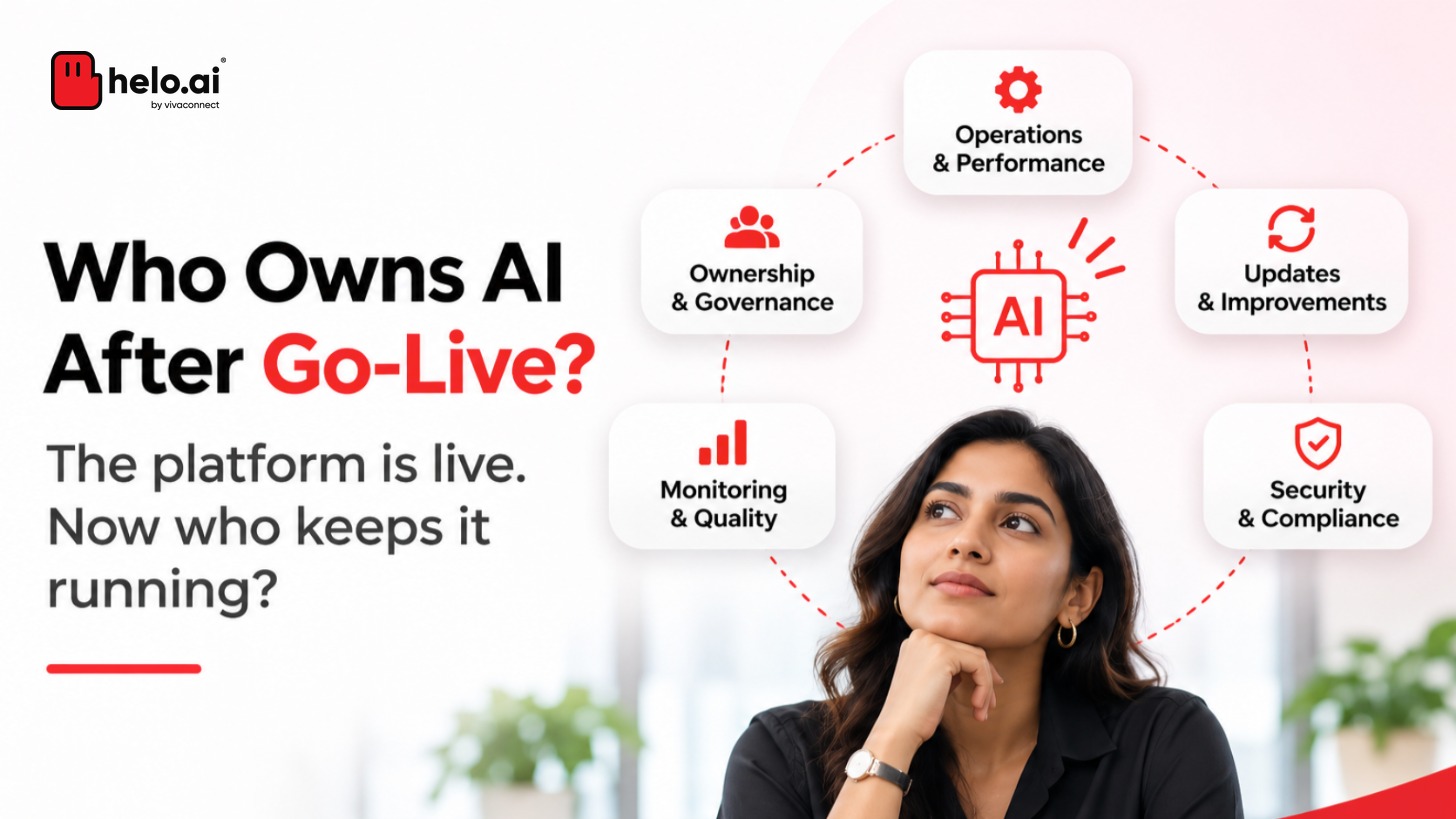


Launching an AI customer service agent is one milestone. Running it every day is another.
Once an AI agent goes live, someone needs to update its knowledge, review conversations, investigate errors, modify workflows, manage integrations and make sure it continues to meet customer expectations.
But who is responsible for all this work?
Your internal team? The AI platform vendor? An implementation partner? Or a combination of all three?
During AI procurement, businesses often compare features, integrations, accuracy, pricing and deployment timelines. But the operating model behind the platform can be just as important. A platform that is easy to launch may still require ongoing effort to maintain. A managed service may reduce the workload but introduce dependencies for routine changes.
The decision is not simply whether you want managed or self-service AI. It is about understanding what your team can handle, what you need external support for, and who will be accountable once the AI starts interacting with customers.
After an AI customer service agent goes live, someone must update knowledge, review conversations, fix errors and approve changes. Compare self-service, managed and shared operating models by who handles each task. Define responsibilities, access, service levels and escalation paths before signing, and test them with a real post-launch scenario in the demo.
What Is the Difference Between Managed and Self-Service AI Customer Service?
In a self-service AI operating model, your internal team manages day-to-day AI operations using the tools and access provided by the platform. This can include updating knowledge, modifying workflows, reviewing conversations and making routine changes.
In a managed AI operating model, a vendor or implementation partner takes responsibility for some of these ongoing tasks, as defined in the service agreement. The customer still retains responsibility for business policies, decisions, approvals and outcomes.
A shared operating model divides these responsibilities between the internal team and the provider.
| Operating model | Who manages the AI? | Best suited for |
|---|---|---|
| Self-service | Internal team manages routine operations | Teams with the required skills, time and platform access |
| Managed | Vendor or partner handles agreed operational tasks | Teams that need external operational support |
| Shared | Customer and provider divide responsibilities | Businesses that want internal control with specialist support |
Neither model is automatically better. The right choice depends on the complexity of your AI deployment, internal capabilities, operational workload, desired control and the support available from the provider.
Self-Service AI Operating Model: What Does Your Team Own?
In a self-service model, the business operates its AI agent through the platform's available configuration, administration and monitoring capabilities.
Your internal team manages routine updates and improvements. The platform provider may still offer onboarding, training, technical support and assistance with platform-level issues.
Self-service does not mean the customer is left on their own. It means the customer has the ability and responsibility to manage the agreed operational tasks independently.
What your internal team may need to manage
- Knowledge updates: Maintaining FAQs, product information, policies, instructions and service content.
- Conversation improvements: Reviewing responses and refining instructions, prompts or conversation flows.
- Workflow changes: Updating customer journeys, conditions, routing or escalation logic where the platform permits.
- Performance monitoring: Reviewing resolution, fallback, escalation, customer feedback and other relevant indicators.
- Troubleshooting: Identifying whether problems come from knowledge, configuration, integrations or the platform itself.
- Administration: Managing user access, permissions, settings and routine platform activity.
- Testing and publishing: Checking changes before they affect live customer conversations.
The advantage is operational control. If the team has the right access and capabilities, routine changes may not have to wait for an external service provider.
But that control comes with responsibility.
Your team needs to know how the platform works, how to make changes safely, how to test them, and how to identify when a problem requires technical support.
When does self-service make sense?
Self-service may be a suitable option when:
- Your CX or operations team has the time to manage AI regularly.
- Business users can make routine changes using the platform.
- Internal administrators are trained and available.
- Your workflows are relatively manageable.
- You want direct control over updates and improvements.
- Your organisation has a process for testing, approving and publishing changes.
The key is not simply whether your team can access the platform. It is whether they can operate it confidently and consistently.
Managed AI Operating Model: What Does the Provider Handle?
In a managed model, the customer relies on a vendor or service partner to perform some of the ongoing operational work.
The scope may range from technical support and monitoring to content updates, workflow modifications, conversation optimisation and operational reviews.
However, the term managed service can mean different things to different providers. It should never be assumed that every operational task is included.
What a managed service may include
Depending on the agreement, a provider may take responsibility for:
- Monitoring and operational reviews
- Knowledge or content updates
- Conversation and workflow changes
- Troubleshooting
- Technical maintenance
- Performance analysis
- Recommendations for improvement
- Reporting
The customer generally remains responsible for business policies, source information, customer-facing decisions, approval of changes and setting priorities.
When does managed AI make sense?
A managed operating model may be worth considering when:
- Your internal CX team has limited technical resources.
- Your team cannot dedicate time to regular AI maintenance.
- Workflows require frequent specialist support.
- Your AI deployment spans several business units or channels.
- You need operational support during early adoption.
- You want external expertise for specific ongoing tasks.
The benefit depends entirely on what the provider actually takes off your team's plate.
If routine updates still require lengthy approval cycles or fall outside the service agreement, a managed model may not deliver the operational convenience you expect.
Shared AI Operating Model: What Does Shared Ownership Look Like?
A shared operating model divides responsibilities between the customer, platform provider and, where involved, the implementation partner.
This is often worth evaluating when the business wants to retain control over customer experience and business knowledge but needs external support for technical operations or specialist tasks.
Consider a customer service AI agent handling order queries, returns and delivery questions for an e-commerce business.
Customer team
Owns business decisions and customer experience
- Product and policy information
- Approved responses
- Customer service priorities
- Change approvals
AI platform provider
Supports platform capabilities and technical issues
- Platform functionality
- Platform-level incidents
- Technical support
- Product updates, where applicable
Implementation partner
Handles assigned implementation or operational work
- Integration support
- Configuration changes, if contracted
- Testing and deployment support
- Knowledge transfer, if agreed
The division of work must be clearly documented. Otherwise, shared ownership can become a situation where everyone is involved but nobody is accountable.
A shared model works only when responsibilities, access, approvals, support boundaries and escalation paths are clear.
Source check: NIST’s AI Risk Management Framework is voluntary guidance. Its GOVERN 2.1 says roles, responsibilities and lines of communication for managing AI risks should be documented, which supports writing the division of work down.
Self-Service vs. Managed AI: What Should You Compare?
The most useful comparison is not just how much work each model requires. It is how each model affects control, turnaround time, resources, dependency and the ability to operate independently.
| Decision factor | Self-service model | Managed model | What procurement should verify |
|---|---|---|---|
| Routine change turnaround | Depends on internal availability and process | Depends on provider availability and agreed SLA | Typical turnaround for each type of change |
| Internal workload | More operational involvement | Reduced for tasks outsourced | What work remains with the customer |
| Operational control | More direct control | Shared control | Access, approvals and deployment rights |
| Skill requirement | Internal capabilities needed | External expertise may be available | What expertise is actually included |
| Vendor dependency | Can be lower for routine changes | Can be higher when provider access is required | Administrator access and independence |
| Knowledge retention | Internal team learns through direct operation | Requires deliberate knowledge transfer | Documentation, training and handover |
| Ongoing cost | Platform cost plus internal resources | Platform plus service fees, if applicable | Total cost of operations |
| Troubleshooting | Internal diagnosis with vendor support as needed | Provider may handle agreed issues | Issue ownership and escalation boundaries |
| Scaling operations | Depends on internal capacity | May be supported by provider resources | Capacity, additional charges and scope |
| Change approval | Internal process | Customer approval may still be required | Who approves and who executes changes |
This table is more useful during procurement than a simple feature comparison because it highlights the questions that can affect your operations long after implementation.
Who Is Responsible for What After Go-Live?
Before signing an AI customer service contract, map the operational tasks to the people who will actually perform them.
A vendor may provide a platform. An implementation partner may configure workflows. Your internal team may own business content. But these boundaries need to be defined rather than assumed.
AI Customer Service Responsibility Matrix
| Operational task | Customer team | Platform vendor | Implementation partner |
|---|---|---|---|
| Business policy and service rules | Owns and approves | Supports platform controls | Implements if scoped |
| Knowledge content accuracy | Owns source information | Provides platform capabilities | May support content preparation |
| Routine knowledge updates | Manages directly or approves | May assist if agreed | May manage if agreed |
| Conversation configuration | May manage directly | Provides platform and support | May configure if agreed |
| Workflow modification | Owns business requirements and approval | Supports platform functionality | Executes if agreed |
| AI response quality review | Owns business quality expectations | Provides tools or technical support | May assist with review |
| Performance monitoring | Reviews business outcomes | Supports platform monitoring | May provide operational reporting |
| Integration troubleshooting | Coordinates business systems | Supports platform-side issues | May troubleshoot integration layer |
| Platform incidents | Communicates impact and priorities | Owns platform-side resolution | Supports within agreed scope |
| Change testing and approval | Approves business impact | Supports platform capabilities | Executes testing if assigned |
| User administration | Owns governance and access decisions | Provides access controls | May administer if authorised |
| Continuous improvement | Sets priorities and approves changes | Provides capabilities and recommendations | May deliver agreed improvements |
This matrix is a starting point, not a universal allocation of responsibility.
For example, the customer may own knowledge accuracy but delegate knowledge configuration. The vendor may own platform incidents while the implementation partner manages integration issues. A customer may have administrator access but still require technical support for complex workflow changes.
The important thing is to assign a responsible owner to every operational task.
What Happens When Something Goes Wrong? A Practical Scenario
A responsibility matrix becomes much more useful when you test it against a real operational problem.
Scenario: The AI starts giving incorrect refund information
Your business updates its refund policy. A few days later, customers begin receiving outdated refund information from the AI.
How does the problem get resolved?
Self-service
Internal team handles the correction
- Review the incorrect conversation.
- Identify whether the source content or workflow is responsible.
- Update the approved refund information.
- Test the AI response.
- Publish the change.
- Monitor subsequent conversations.
Managed
Provider handles agreed operational tasks
- Customer identifies the issue and shares the approved policy.
- Provider investigates within the agreed service scope.
- Provider updates the relevant knowledge or configuration.
- The change is tested and submitted for approval, as required.
- The approved change is deployed.
- Both parties verify the outcome according to the agreed process.
Shared
Internal owner and provider handle different parts
- Internal team confirms the correct refund policy.
- Internal administrator updates the approved content, if permitted.
- Provider investigates if the issue involves retrieval, configuration or technical behaviour.
- Changes are tested and approved.
- The team verifies the response and monitors performance.
The same exercise should be repeated for a failed integration, an incorrect escalation route, an unexpected AI response or a new customer journey.
If nobody can explain how these problems will be handled, the operating model is not fully defined.
Want to see a post-launch scenario live?
The Helo Convo page offers a free 30-minute working session where the team builds a use case live.
What Does Your Team Need to Manage AI Independently?
Choosing self-service means more than having administrator access. Your team needs the capability, authority and time to make changes safely.
Before opting for self-service, evaluate the following areas.
Knowledge and content management
Can your CX or operations team update information without involving developers?
When a business changes a refund policy, someone should know where the information is maintained, how the AI accesses it, how the change is tested and when it becomes active.
Ask:
- Can authorised users update knowledge without coding?
- Are changes reviewable?
- Can outdated information be identified?
- Is there a way to test updated content before publishing?
- Who approves policy-related changes?
Conversation and workflow configuration
Routine changes should not always become engineering projects.
Your team may need to modify a greeting, update a response, change a qualification question, adjust a workflow or modify an escalation condition.
Ask:
- Which changes can business users make?
- Which changes require technical support?
- Is a testing environment available?
- Can changes be reviewed before deployment?
- Can previous versions be restored?
Performance monitoring
Someone must regularly review how the AI performs in real customer conversations.
This includes more than checking how many conversations were automated.
Teams should understand:
- Which queries are being resolved successfully?
- Which queries are being escalated?
- Where does the AI fail to understand intent?
- Which responses generate negative feedback?
- Are customers repeatedly asking the same question?
- Are workflows completing successfully?
Analytics are useful only when someone knows how to interpret them and turn findings into improvements.
Source check: NIST’s AI Risk Management Framework, in its core functions, lists post-deployment monitoring plans under MANAGE 4.1, including mechanisms for capturing and evaluating input, incident response and change management. It also asks for clearly defined roles for ongoing monitoring under GOVERN 1.5.
Troubleshooting capability
Not every issue requires the vendor.
Some problems may involve incorrect knowledge, incomplete instructions or an inefficient workflow. Others may involve APIs, authentication, platform errors or third-party dependencies.
Your team should understand where a problem is likely to originate and when to escalate it.
Ask the vendor to demonstrate how an issue is diagnosed and what information your team can access before raising a support request.
Internal ownership and time
Self-service requires an internal owner.
That may be a CX operations manager, digital transformation team, customer service operations lead or designated platform administrator. It does not necessarily mean hiring a dedicated AI engineer.
But the role needs defined responsibilities and time.
If maintaining the AI becomes an additional task for a team already stretched across multiple priorities, the platform may remain live while gradually becoming outdated.
What Are the Risks of Each Operating Model?
Both models solve different problems and introduce different risks.
Risks of self-service
Limited internal expertise
Your team may have access to configuration tools but lack the experience to troubleshoot complex problems or optimise workflows.
Inconsistent updates
If ownership is unclear or updates are not part of a defined routine, knowledge and conversation flows may become outdated.
Overdependence on a single administrator
If only one person understands how the AI is configured, changes or troubleshooting may become difficult when that person is unavailable.
Operational workload
Maintaining AI may compete with existing customer service responsibilities, particularly when multiple workflows and channels are involved.
Risks of managed services
Dependency for routine changes
If every small update requires a service request, turnaround time may depend on provider availability and agreed service levels.
Unclear scope
Content updates, workflow modifications, optimisation and monitoring may not all be included in the managed service.
Limited knowledge transfer
If your team never learns how the AI is configured or maintained, switching providers or bringing operations in-house may become difficult.
Reduced visibility
If reporting, configuration access or operational documentation is limited, your internal team may struggle to understand what is happening or why changes were made.
These risks can be reduced by defining service scope, access, documentation, escalation paths, change approvals and knowledge transfer before deployment.
How to Choose the Right AI Support Operating Model
The choice should be based on your internal capabilities and the operational complexity of the AI deployment—not simply on which option sounds easier.
| Your situation | Operating model to evaluate |
|---|---|
| Strong CX operations team with platform administration skills | Self-service |
| Business team comfortable with no-code configuration and testing | Self-service |
| Limited internal bandwidth for ongoing AI operations | Managed or shared |
| Complex integrations requiring regular technical support | Shared or managed |
| AI deployment across several channels and business units | Shared with central governance |
| Team is learning how to manage AI after its first deployment | Shared with structured knowledge transfer |
| Need internal control but require specialist support | Shared |
For many enterprises, a shared model is worth evaluating first. It can allow the business to retain control of policies, knowledge, customer experience and approvals while relying on external support for agreed technical or operational tasks.
But shared ownership should not be selected simply because it sounds balanced. It must be designed around actual responsibilities.
A simple decision guide
- If your team can make routine changes, test them and monitor performance consistently, evaluate self-service.
- If your team lacks operational capacity and the provider offers a clearly scoped service, evaluate managed.
- If you want internal control but need specialist support for selected tasks, evaluate shared.
- If you are unsure, ask the vendor to walk through real post-launch tasks before deciding.
How to Evaluate the Operating Model During an AI Demo
A vendor demonstration should show how the AI works—and how your team will operate it.
Instead of watching only a customer conversation, ask the vendor to demonstrate a post-launch scenario.
Demo scenario: A policy changes
Ask the vendor to show:
- Where the new policy is added.
- Who can update the AI's knowledge.
- How the updated response is tested.
- How the change is approved.
- How it is published.
- How the team verifies that the AI is now responding correctly.
- What happens if the updated response creates a new problem.
Then repeat the exercise with a workflow change or an integration issue.
This reveals the actual operating model far more clearly than a feature list.
A platform that allows independent changes may be suitable for self-service, but you should still verify permissions, testing, approval controls and the administrator experience.
A vendor that offers operational support may be suitable for managed services, but you should verify the tasks covered, service levels, charges and knowledge-transfer commitments.
Ten Questions to Ask Your AI Customer Service Vendor Before Signing
The operating model should be part of your procurement evaluation, not something discussed after deployment.
Use these questions during vendor demonstrations and contract discussions.
- Who will manage the AI after go-live? Ask for a named responsibility structure, not a general support promise.
- Which changes can our team make independently? Request a live demonstration of updating knowledge, modifying a workflow and testing the change.
- What requires vendor intervention? Identify the exact configuration, technical and operational tasks that cannot be performed internally.
- What is included in ongoing support? Clarify whether monitoring, troubleshooting, optimisation, content updates and workflow changes are included or charged separately.
- How are issues diagnosed? Understand the tools and information available to your internal team.
- What are the response and resolution commitments? Separate response time from resolution time, and confirm what the SLA actually covers.
- How are changes tested and approved? Establish the review, testing and deployment process for customer-facing changes.
- What documentation will we receive? Ask for configuration documentation, workflows, integration details, operating procedures and access information.
- How will our team be trained? Confirm onboarding, administrator training, knowledge transfer and ongoing enablement.
- What happens if we want to take operations in-house or change providers? Ask about access, data export, documentation, transition support and exit terms.
The answers should be documented in the proposal, statement of work or service agreement wherever applicable.
How Helo Convo Fits Into Your AI Operating Model
When evaluating an AI customer service platform, the question isn't just what the AI can do during a customer conversation. It is also how your team will manage it once it is live.
With Helo Convo, evaluate the workflows you need to manage, the integrations involved, the knowledge sources that power responses and the operational access available to your team.
During a platform demonstration, focus on the tasks your team expects to handle after deployment.
Can your team update knowledge? Can they review conversations? How are workflow changes handled? What requires technical assistance? What support is available when an issue goes beyond routine administration?
These are the questions that help determine whether the platform fits your preferred operating model.
Rather than assume every organisation needs a managed service—or that every team can operate AI independently—define your responsibilities upfront and evaluate the platform against them.
If you are still comparing platforms, start with our guide to conversational AI platforms. Once you have shortlisted the right platform, evaluate how it will be operated after deployment.
Scope check: The Helo Convo page says workflows are generated from a prompt and shown as nodes before going live, and that engineers are not needed to maintain it. It lists RBAC, SSO and audit logs, and a free 30-minute working session. It does not describe a testing environment, version history, ongoing managed operations or support tiers. Confirm those before this section suggests Convo fits a particular operating model.
Defining who runs your AI after go-live?
Talk to the Helo.ai team about the operating model your deployment needs.
Frequently Asked Questions
What is the difference between managed and self-service AI customer service?
Self-service AI allows a business to manage its AI agent's knowledge, workflows and routine administration internally using the available platform tools. Managed AI involves a vendor or partner taking responsibility for some ongoing operational tasks. The exact scope varies by provider and agreement.
Does self-service AI mean we don't need vendor support?
No. Self-service refers to the ability to manage routine operations and configuration independently. Platform support, product issues, technical troubleshooting and infrastructure responsibilities may still sit with the vendor.
Is managed AI more expensive than self-service?
Not necessarily. Managed services may add service fees, while self-service requires internal time, training and operational resources. Compare the total cost of running the AI, including internal effort, external support, change turnaround and maintenance.
Can we start with managed AI and move to self-service later?
Potentially, if the platform supports it and the agreement allows it. Before signing, confirm administrator access, documentation, training, knowledge transfer, configuration ownership and transition assistance.
Who should own AI customer service internally?
Ownership may sit with customer experience, customer service operations, digital transformation or a dedicated AI operations team. The important thing is to define accountability for performance, content accuracy, change approvals and continuous improvement.
What should an AI managed service agreement include?
It should clearly define the scope of managed work, service levels, monitoring, troubleshooting, change management, responsibilities, charges, access, documentation, escalation paths and transition or exit support.
Can a non-technical team manage an AI customer service agent?
That depends on the platform and the tasks involved. Some platforms allow business users to manage knowledge, conversation flows and routine configuration. Technical integrations, complex workflow changes or platform-level issues may still require specialist support.
Conclusion
Buying an AI customer service platform is one decision. Deciding who will operate it after go-live is another.
Self-service can give your team greater control and faster routine changes, provided it has the right tools, skills and time. A managed model can reduce the internal workload, provided responsibilities, service scope and dependencies are clearly defined. A shared model can combine internal ownership with external expertise, provided the boundaries are clear.
Before signing an AI customer service contract, make sure you know who will update the AI, who will investigate when it fails, who will approve changes and how your team can take ownership over time.
If those answers are not clear before go-live, they will become operational problems after it.
Note. Helo.ai offers an AI platform, Helo Convo, and published this guide. NIST and Helo.ai pages were checked on 25 November 2026. Product capabilities and service terms change, so confirm them with any vendor in writing.