.jpeg)
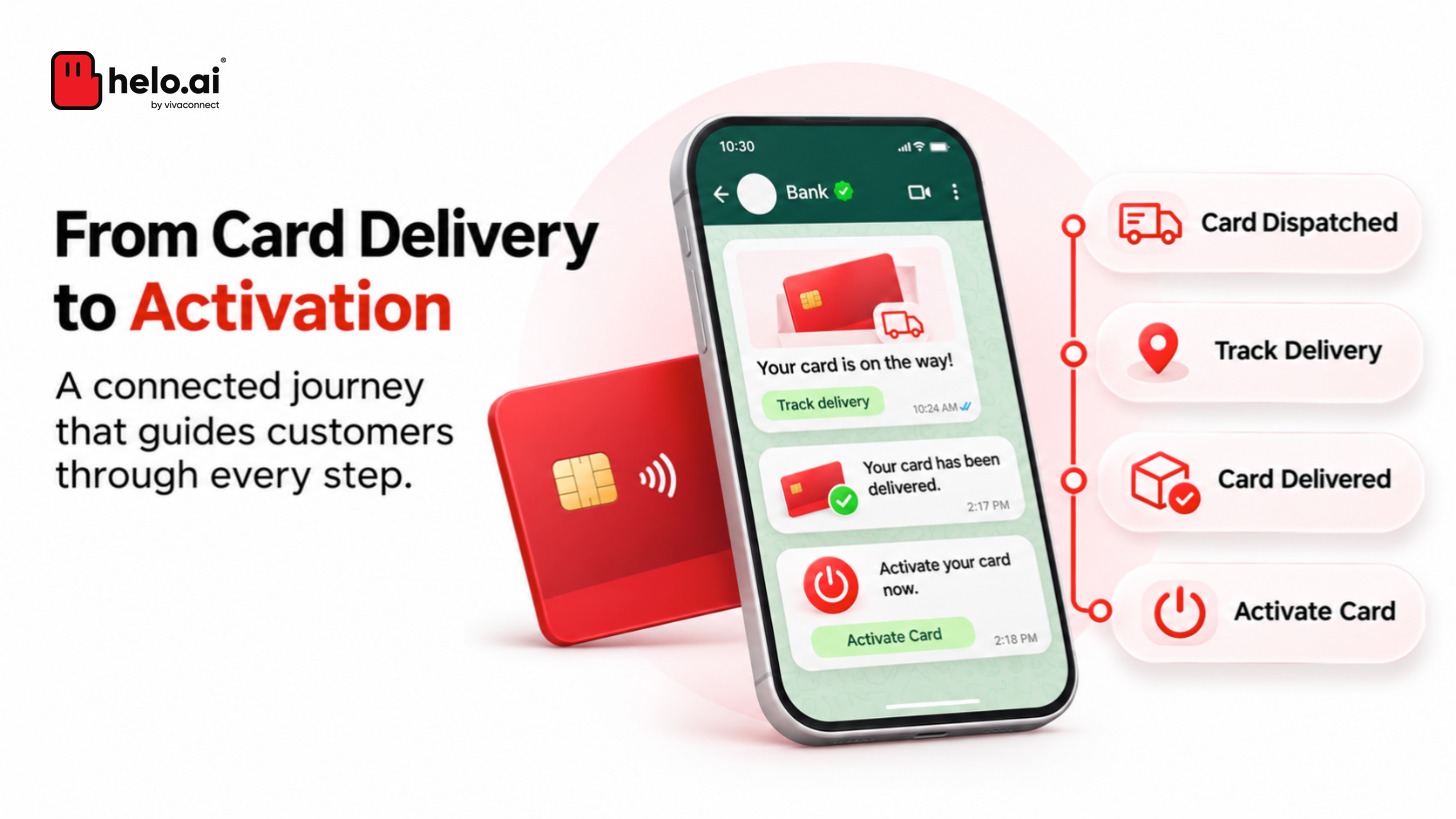


Issuing a credit card is only the beginning of the customer journey. The next step is helping the customer activate it, understand its features and make informed use of the card.
Some customers activate their cards as soon as they receive them. Others delay activation because they are unsure about the process, have difficulty generating a PIN or do not know which features are available. Even after activation, some cardholders may need guidance on managing transaction settings, viewing statements or understanding their card benefits.
For banks, these are different communication opportunities. A customer who has just received a card needs activation instructions. Someone who has activated the card but rarely uses it may benefit from relevant product guidance. A long-inactive card, meanwhile, needs to be handled in line with applicable RBI requirements.
A connected communication journey using WhatsApp, SMS and Voice AI can help banks respond to each situation with relevant information.
This guide explains how to plan a credit card activation and usage-nudge journey, how different channels can work together, and what banks should consider when designing these communications.
Credit card activation and usage nudges work best when each message matches the card’s actual status. WhatsApp can guide, SMS can remind and Voice AI can assist. Banks must follow RBI rules on 30-day activation consent and one-year non-use closure.
What Is a Credit Card Activation and Usage Journey?
A credit card activation and usage journey is a sequence of customer communications and actions that begins when a card is issued and continues after activation.
It has two related but distinct objectives:
- Card activation: Help customers understand how to activate a newly issued card through the issuer's approved process.
- Post-activation engagement: Help cardholders understand their card features, manage settings and access relevant services after activation.
A typical journey may include:
- Confirming card issuance and dispatch.
- Sharing delivery updates.
- Explaining available activation methods.
- Following up when a card remains inactive.
- Helping customers understand PIN generation and transaction controls.
- Sharing information about statements, billing cycles and card features.
- Providing support when customers face difficulties.
- Identifying long-inactive cards and handling the required customer communication.
The important point is that these stages should not be treated as one continuous promotional campaign. Each communication should reflect the customer's actual card status and have a clear purpose.
Why Do Banks Need a Structured Credit Card Journey?
A customer may receive a credit card without knowing what to do next. Even when activation is straightforward, unclear instructions can delay the process.
A structured journey helps banks address these gaps while keeping communication relevant.
Customers May Not Know How to Activate Their Card
Banks may provide activation through mobile banking, internet banking, IVR or other authorised methods.
Customers need clear instructions about the available options and where to complete the process.
Customers May Need Help After Delivery
A delivery notification does not necessarily mean that the customer knows how to activate the card.
A follow-up can explain the official activation route and offer assistance if the customer encounters a problem.
Inactive Cards Need Timely Attention
Banks need visibility into cards that remain inactive after issuance.
A status-based communication journey helps teams identify these customers and manage the required follow-ups within the applicable regulatory timelines.
Customers May Not Understand Their Card Features
After activation, customers may still be unfamiliar with transaction controls, contactless payments, international usage settings, billing cycles or statement access.
Relevant guidance can help them understand the services available through their card.
Long-Inactive Cards Need a Different Approach
A card that has been activated but not used for an extended period is different from a newly issued card awaiting activation.
Banks should identify these accounts separately and follow the applicable RBI process. A routine activation reminder is not a substitute for the required communication about potential account closure.
Customer Support Teams Handle Repetitive Queries
Questions about PIN generation, activation methods, transaction settings and card features can create avoidable support enquiries.
Automated communication and conversational assistance can help customers find the right information before they need to speak to an agent.
RBI Guidelines for Credit Card Activation and Usage in India
Credit card communication journeys must follow the applicable RBI directions. Two requirements are particularly relevant: the activation process for newly issued cards and the treatment of cards that remain unused for an extended period.
The RBI's 2025 Commercial Banks – Credit Cards and Debit Cards: Issuance and Conduct Directions specify the following requirements for commercial banks within their scope.
Activation of Newly Issued Cards
If a credit card has not been activated by the customer for more than 30 days from its date of issuance, the card issuer must seek OTP-based consent from the cardholder for activation.
If the customer does not provide consent, the issuer must close the credit card account without cost to the customer within seven working days from the date of seeking confirmation.
The RBI also recognises certain customer-initiated processes indicating an intent to use the card as possible activation actions. These include:
- PIN generation.
- Modification of transaction controls.
- Interactive Voice Response (IVR).
- A recorded call to the customer-care centre.
- SMS.
The distinction is important: a reminder sent by the bank is not the same as a qualifying customer-initiated activation action. The bank must record the actual action completed by the customer.
Cards That Remain Unused for More Than One Year
The RBI also provides a separate requirement for cards that have not been used for more than one year.
In such cases, the card issuer must initiate the closure process after informing the cardholder. If the customer does not respond within 30 days, the card account must be closed, subject to payment of any outstanding dues.
The RBI clarifies that card usage is not limited to financial transactions. Certain customer-initiated activities, such as generating a statement, changing a PIN or modifying transaction controls, are also considered usage.
However, calls made to customer care for reasons other than the specified usage-related activities do not count as card usage.
This creates an important distinction for banks:
- A newly issued card that has not been activated requires the activation process.
- An activated card that has not been used for more than one year requires the applicable unused-card closure process.
- A cardholder who actively manages card settings may have performed an action recognised as usage, even without making a purchase.
What Banks Should Consider When Designing Communication
Banks should use the card's issuance date, activation status and usage records to determine the appropriate communication.
A WhatsApp message, SMS or Voice AI interaction can explain the next step, but it should not replace the issuer's required OTP consent or closure process.
For business credit cards, the RBI directions specify that the relevant activation consent or intimation should be directed to the principal account holder, unless the agreement specifies otherwise. For retail credit cards, the required activation consent is sought from the principal cardholder rather than add-on cardholders.
The directions also specify that card issuer representatives should contact customers only between 10:00 a.m. and 7:00 p.m.
Banks should review the latest RBI directions and their own compliance policies before configuring these workflows. Other card issuers should also check the RBI directions applicable to their category rather than assuming that every provision in the commercial-bank directions applies identically.
Source check: The RBI Directions are dated 28 November 2025 (RBI/DOR/2025-26/155) and were updated as on 1 October 2026. The 30-day activation rule is in paragraph 11(6) and the one-year non-use rule is in paragraph 20. After closing an unused card, the issuer must also update the credit information company within 30 days.
How to Design a Credit Card Activation and Usage Journey
A useful communication journey is based on the customer's actual card status, not simply the number of days since the last message.
Here is one way a bank can structure it.
Stage 1: Card Issuance and Dispatch
Once the card is issued, the customer can receive a notification confirming that it is being prepared or dispatched.
The communication may include:
- Confirmation of card issuance.
- Dispatch or delivery status, where available.
- Expected delivery information, if verified.
- A reminder to use the bank's official channels for activation.
- A link to the bank's official help or support page.
The message should not contain sensitive card information.
Stage 2: Card Delivery and Activation Instructions
After delivery is confirmed, the bank can explain how the customer can activate the card.
Depending on the issuer's process, the customer may be directed to:
- The bank's official mobile application.
- Internet banking.
- An authorised IVR number.
- The official customer-care channel.
- Another activation method supported by the issuer.
The communication should clearly explain where the customer needs to complete the activation process.
Stage 3: Activation Status Check
The bank's card management system can check whether the card has been activated.
If activation is complete, the customer should exit the pending-activation reminder journey.
If the card remains inactive, the system can trigger an appropriate follow-up based on the issuance date and the issuer's communication policy.
This prevents customers who have already activated their cards from receiving unnecessary reminders.
Stage 4: Follow-Up for Inactive Cards
If the card remains inactive, the bank can send a reminder explaining the next steps.
The communication should:
- Clearly identify its purpose.
- Provide the official activation route.
- Offer support if the customer is facing an issue.
- Avoid pressuring the customer to activate the card.
- Respect the applicable RBI requirements and channel rules.
The timing and content of these messages should be configured around the card issuance date and the issuer's approved process.
The 30-day RBI requirement should be handled through a specific compliance workflow, not treated as just another marketing reminder.
Stage 5: Post-Activation Guidance
Once the bank confirms activation, the journey can shift from activation instructions to useful card-management information.
For example, the bank can explain:
- How to generate or change a PIN through official channels.
- How to manage domestic and international transaction controls.
- How to understand contactless payment settings.
- Where to view statements and transaction history.
- How to access card-related support.
- How to report a lost or stolen card.
The objective is to help customers understand the card they have received, not encourage unnecessary spending.
Stage 6: Relevant Usage Nudges
After activation, banks can use customer interaction and card-status information to identify relevant opportunities for guidance.
Examples include:
- Card activated, but no transaction recorded: Share information about card features and how to use the card securely. Avoid assuming that the customer must make a purchase.
- Transaction controls not configured: Explain how customers can manage domestic, international, online or contactless transaction settings through the bank's official application.
- Statement not accessed: Show customers where to find their statement and understand their billing cycle.
- Card benefits not explored: Share relevant information about benefits included with the customer's card, subject to the product terms.
- Card approaching long-term inactivity: Use the bank's verified usage records to identify the applicable RBI process and send the required communication.
These nudges should be based on actual customer status and should not be used to push credit or spending beyond the customer's needs.
How WhatsApp, SMS and Voice AI Work Together
Each channel serves a different purpose in the activation and usage journey.
Using all three does not mean sending the same message everywhere. Banks should choose the channel based on the customer's needs, message purpose, available permissions and action required.
WhatsApp: Interactive Activation and Card Guidance
WhatsApp is useful when the bank wants to explain a process and guide customers through a conversation.
A message can include:
- Card dispatch or delivery updates.
- Activation instructions.
- A button linking to the bank's official activation page or application.
- Answers to common card-related questions.
- A customer-support option.
For example, a customer may ask:
“How do I activate my new credit card?”
A WhatsApp bot can explain the available activation methods and direct the customer to the bank's official channel.
After activation, the customer may also ask how to change transaction settings or view a statement. The conversational workflow can provide the relevant instructions or transfer the enquiry to a support representative.
Where WhatsApp fits best: Interactive instructions, FAQs, card-management guidance and customer support.
SMS: Direct and Concise Notifications
SMS is useful for short notifications and reminders, particularly when the customer needs a direct instruction.
A bank can use SMS to communicate:
- Card dispatch information.
- Delivery-related updates.
- Activation instructions.
- Relevant activation reminders.
- Information about card-related services.
- Links to official banking channels.
For example:
Your new credit card is awaiting activation. To understand the available activation methods, visit the official ABC Bank mobile app or website. For assistance, contact ABC Bank through its verified support channels.
SMS content should be concise and should use the bank's registered sender identity and approved content templates wherever applicable.
Where SMS fits best: Short notifications, direct reminders and links to official banking channels.
Voice AI: Conversational Assistance
Some customers prefer speaking rather than reading instructions or navigating multiple screens.
An AI voice agent can handle common questions about card activation and explain the available steps in a conversational manner.
For example:
Customer: I received my credit card, but I don't know how to activate it.
Voice Agent: I can help you understand the activation process. You can activate your card through the bank's official mobile application or an authorised IVR service. Would you like me to explain the steps?
Customer: I tried the app, but it didn't work.
Voice Agent: I can connect you with a customer-support representative for further assistance.
A voice agent can also support multilingual conversations and transfer the call to a human agent when the customer needs help beyond the configured workflow.
It should not ask customers to disclose their full card number, CVV, PIN, password or OTP during an ordinary activation-support conversation.
Where Voice AI fits best: Spoken guidance, common-query handling, multilingual assistance and human-agent handoff.
Example: An Omnichannel Credit Card Journey
Consider a customer who has received a new credit card but has not yet activated it.
The bank can coordinate communication across channels using the card's status and the customer's interaction history.
| Journey stage | Channel | Communication or action |
|---|---|---|
| Card dispatched | SMS | Share dispatch information and verified delivery details |
| Card delivered | Explain the official activation process | |
| Card remains inactive | SMS | Send an appropriate activation reminder |
| Customer needs help | Voice AI | Explain activation steps and answer common questions |
| Issue remains unresolved | Human agent | Handle the customer's specific problem |
| Activation confirmed | WhatsApp or SMS | Share relevant card-management guidance |
| Customer needs feature guidance | WhatsApp or Voice AI | Explain transaction controls, statements and card services |
| Long-term inactivity identified | Approved bank communication channel | Follow the applicable RBI notification and closure process |
This journey should be event-driven.
For example, if the card is activated after a WhatsApp interaction, the pending activation reminder should be cancelled. The customer should not receive a follow-up that assumes the card is still inactive.
Similarly, a customer who has changed transaction controls or generated a statement should not automatically be treated as having an unused card if the action qualifies as usage under the applicable RBI directions.
The bank should maintain records of message delivery, customer responses, card status, qualifying actions and support escalations.
Explore WhatsApp for card journeys
See how Helo.ai’s WhatsApp Business Platform supports interactive guidance and customer conversations for banks.
Credit Card Activation and Usage Message Examples
Here are sample communication ideas for different stages of the journey.
These are illustrative drafts. Actual messages must be reviewed against the bank's approved content, customer permissions, WhatsApp template requirements and applicable telecom regulations.
Card Dispatch Notification – SMS
Your ABC Bank credit card has been dispatched. You can check delivery updates through our official website or mobile app. For assistance, contact ABC Bank through its verified support channels.
Activation Instruction – WhatsApp
Hello {{1}}, your new ABC Bank credit card has been delivered. You can complete the activation process through the official ABC Bank mobile app. Need help? Select an option below.
Suggested options:
- View activation instructions
- Contact customer support
Inactive Card Reminder – SMS
Your ABC Bank credit card is awaiting activation. If you wish to use it, please follow the activation instructions available through the official ABC Bank mobile app or customer-care channel.
Activation Assistance – Voice AI
Hello, this is ABC Bank's automated assistance service. I can help explain how to activate your new credit card. Would you prefer instructions for the mobile app or the authorised IVR service?
Transaction Control Guidance – WhatsApp
You can manage your ABC Bank credit card's transaction settings through the official mobile app. Visit the card-management section to review the available domestic, international and online transaction controls.
Statement Access Guidance – SMS
Your ABC Bank credit card statement is available through the official mobile app and internet banking. Sign in through the bank's verified channels to review your statement and payment details.
Card Feature Information – WhatsApp
Want to understand the features available with your ABC Bank credit card? Visit the official card section in our mobile app to explore the benefits, applicable terms and card-management options.
What Should Banks Measure in a Credit Card Journey?
Sending reminders is only one part of the process. Banks should also understand whether customers are completing the required actions and where they encounter difficulties.
Here are useful metrics to monitor.
Card Activation Rate
Measure the proportion of eligible issued cards that are activated within a defined period.
The calculation should use a clearly defined denominator, such as cards issued and eligible for activation during the reporting period.
Time to Activation
Measure the time between card issuance or delivery and the customer's qualifying activation action.
This helps identify where delays occur in the journey.
Post-Activation Engagement
Track relevant customer-initiated actions after activation, such as:
- Viewing a statement.
- Changing a PIN.
- Modifying transaction controls.
- Exploring card-management services.
- Accessing card-related support.
Banks should distinguish these actions from financial transactions when analysing engagement.
Channel Engagement
Monitor WhatsApp message delivery and responses, SMS delivery reports, and voice-call connection and completion outcomes.
Engagement should not be treated as proof of activation or card usage. A message being delivered or opened does not mean the customer has completed the required action.
Activation Support Resolution
Track how many activation-related enquiries are resolved through automated guidance and how many require human support.
This helps identify unclear instructions and recurring customer problems.
Journey Drop-Off
Identify the stages where customers stop interacting.
For example:
- Message delivered but no response.
- Activation page opened but process not completed.
- Customer starts an IVR flow but does not finish.
- Customer requests support but does not complete the next step.
These insights can help banks improve instructions, remove friction and make the journey easier to complete.
Long-Inactive Card Monitoring
Track cards approaching the applicable inactivity threshold using verified card-management records.
This helps the bank identify accounts that may require the RBI-prescribed notification and closure process. Communication engagement alone should not be used as proof of card usage.
Compliance and Security Considerations for Credit Card Communication
Credit card journeys involve sensitive financial relationships. Banks need to design every interaction around customer protection.
Follow RBI Activation and Non-Usage Requirements
Use the correct issuance date, activation status and usage records to manage the journey.
The 30-day inactive-card activation requirement and the separate one-year non-usage closure process must not be combined into a single reminder workflow.
The bank must also ensure that the required consent, notification and closure actions are completed through its approved processes.
Protect Customer Authentication Details
Do not ask customers to share their card PIN, CVV, password or OTP through WhatsApp chats, SMS replies or ordinary AI voice conversations.
If an authenticated action is required, direct customers to the bank's official and secure application, website or authorised IVR process.
Follow TRAI Requirements for SMS Communication
Bulk SMS and commercial voice communications must follow applicable Telecom Commercial Communications Customer Preference Regulations (TCCCPR).
For SMS, banks should complete the relevant Principal Entity registration, header and content-template requirements and meet applicable consent and preference conditions.
The communication category depends on its actual purpose and content:
- Transactional communication: Generally a response to a customer-initiated transaction within the prescribed 30-minute window. Examples include OTPs and transaction alerts.
- Service communication: Can include relevant, non-promotional information about a product or service used or purchased by an existing customer. Certain communications facilitating an ongoing commercial transaction require explicit consent.
- Promotional communication: Contains advertising or promotional material. The applicable opt-out mechanism and preference or consent conditions must be followed. Mixing promotional content into a transactional or service message can cause the entire message to be treated as promotional.
A credit card activation reminder should not automatically be classified as transactional merely because it relates to a credit card. A message that purely provides relevant information about an existing card service may qualify as service communication if it meets the regulatory definition and applicable conditions. The bank should have its compliance team confirm the classification and registered template.
Source check: The three categories are defined in TRAI’s TCCCPR text. A transactional message must be sent within thirty minutes of the transaction. A service message that helps complete an ongoing transaction needs explicit consent. Promotional content in either makes the whole message promotional.
Follow Automated Voice-Call Requirements
Under TCCCPR, senders must notify the originating access provider in advance about the use of autodiallers or robocalls and the intended objective of those calls.
Banks should also review applicable number-series, sender and customer-contact requirements before deploying automated activation or usage calls.
Check the declaration rule: Under TRAI’s Third Amendment text, senders must declare A2P calls, including autodialled and pre-recorded ones, to their originating access provider in advance, with their CLI ranges. Calls made without a declaration are treated as unsolicited commercial communication. The regulation text does not itself list the call objective, and the rule starts sixty days after Gazette publication. TRAI’s 18 September 2026 release summarises it.
Follow WhatsApp Business Platform Rules
Businesses should use approved message templates when initiating conversations outside the 24-hour customer service window.
Templates must follow the designated purpose and current platform requirements. Banks should also review relevant consent, privacy and customer communication obligations before sending messages.
Meta documentation: Meta’s message documentation confirms that the 24-hour customer service window opens when a customer messages the business. Free-form messages can be sent inside it, and approved templates are needed outside it.
Keep Customer Data Protected
Limit the information shared through messages to what is necessary for the communication.
Use approved systems for authentication, access control, data retention and audit trails. Ensure that customer-support teams and automated agents only access the information required for their role.
How Helo.ai Can Support Credit Card Activation and Usage Journeys
A credit card journey involves more than sending reminders. Banks need to coordinate messages, customer responses, support interactions and card-status updates.
Helo.ai's communication and conversational capabilities can support different parts of this process.
WhatsApp: Helo.ai's WhatsApp Business Platform supports interactive messaging and automated customer conversations. Banks can use conversational workflows to share activation instructions, answer common questions and guide customers to official banking channels.
SMS: SMS communication can be used for concise notifications and reminders, subject to the bank's registered templates and applicable DLT requirements.
Voice AI: Helo Voice supports inbound and outbound AI-powered calling, multilingual conversations, integrations with business systems and human-agent handoff. It can help customers understand activation steps and route more complex enquiries to support teams.
A connected journey can use card-status information from the bank's systems to determine what communication should happen next.
For example, when the bank confirms that a card has been activated, the system can stop pending activation reminders and move the customer into the appropriate post-activation guidance journey.
Similarly, a bank can use verified usage information to identify customers who may need relevant card-management guidance or a separate communication under the applicable inactivity process.
The exact integration, authentication process, card-status triggers and activation confirmation mechanism should be designed with the bank's card-management and security teams. These should not be assumed to be available as a standard, preconfigured credit card activation solution.
Explore Helo.ai's WhatsApp Business Platform and Helo Voice, or talk to our team about building a connected BFSI communication journey.
FAQs
What is a credit card activation journey?
A credit card activation journey is a series of communications and customer actions that help a cardholder activate a newly issued card and understand how to use it. It can include dispatch notifications, activation instructions, reminders and post-activation guidance.
How can banks remind customers to activate their credit cards?
Banks can use WhatsApp, SMS and voice calls to share activation instructions and relevant reminders. The communication should direct customers to the bank's official activation process and follow applicable RBI, TRAI and channel requirements.
What happens if a credit card is not activated within 30 days?
Under RBI directions, if a credit card remains unactivated for more than 30 days from issuance, the card issuer must seek OTP-based consent from the cardholder. If consent is not received, the issuer must close the account without cost within seven working days of seeking confirmation.
What happens if a credit card is not used for more than one year?
The card issuer must initiate the closure process after informing the cardholder. If the customer does not respond within 30 days, the account must be closed, subject to payment of outstanding dues. Certain customer-initiated activities, including statement generation and changes to PIN or transaction controls, are also recognised as usage under RBI directions.
Does sending an SMS or WhatsApp message activate a credit card?
No. Sending a reminder is not the same as activating the card. RBI recognises certain customer-initiated actions, including PIN generation and specified IVR, recorded-call and SMS processes, as possible activation. The issuer must record the qualifying customer action.
Can a customer activate a credit card through IVR?
A customer-initiated IVR process indicating an intention to use the card may be considered activation under RBI directions. The issuer should ensure that the process follows its approved authentication and security requirements.
How can WhatsApp help with credit card activation?
WhatsApp can provide activation instructions, answer common questions, share official links and offer customer-support options. The actual activation should take place through the bank's authorised and secure process.
Can Voice AI help customers activate credit cards?
Voice AI can explain the activation process, answer common questions and transfer customers to human support when needed. Any authenticated activation action must follow the bank's approved process rather than relying on an ordinary AI conversation.
What is the difference between card activation and card usage?
Activation is the process by which a cardholder indicates an intention to use the card through a qualifying issuer-approved process. Card usage includes financial transactions and certain other customer-initiated activities recognised by RBI, such as generating a statement or changing transaction controls.
What should banks avoid in credit card activation messages?
Banks should avoid requesting PINs, CVVs, passwords or OTPs through ordinary messages or automated conversations. They should also avoid misleading urgency, promotional content disguised as service communication and reminders sent after the card has already been activated.
Final Takeaway
A new credit card should come with clear instructions, not confusion about what to do next.
A structured communication journey helps banks guide customers from card delivery to activation and beyond. WhatsApp can provide interactive assistance, SMS can deliver concise reminders, and Voice AI can help customers who prefer speaking.
But the journey should not end when a card is activated. Banks can continue providing relevant guidance about card features, statements and transaction controls while separately monitoring long-term inactivity under the applicable RBI requirements.
When every communication reflects the customer's actual card status, banks can make the experience easier to follow while keeping security and regulatory requirements at the centre.
Plan your card activation journey
Talk to the Helo.ai team about connecting WhatsApp, SMS and Voice AI to your card status and support workflows.
Note. Helo.ai makes the WhatsApp, SMS and Helo Voice products mentioned above. RBI, TRAI and Meta pages were checked on 21 November 2026, and these rules change often.